THE SHORT ANSWER
You cannot lawfully change, grind off or scrape a VIN yourself. Knowingly altering one is punishable under federal law by a fine, a jail term capped at 5 years, or both penalties together. The exceptions are repair work that truly requires it, scrap handling under state law, and a number restored or replaced under your state's rules. Covering the plate is not named in that law, but federal rules say the VIN must stay readable through the windshield.
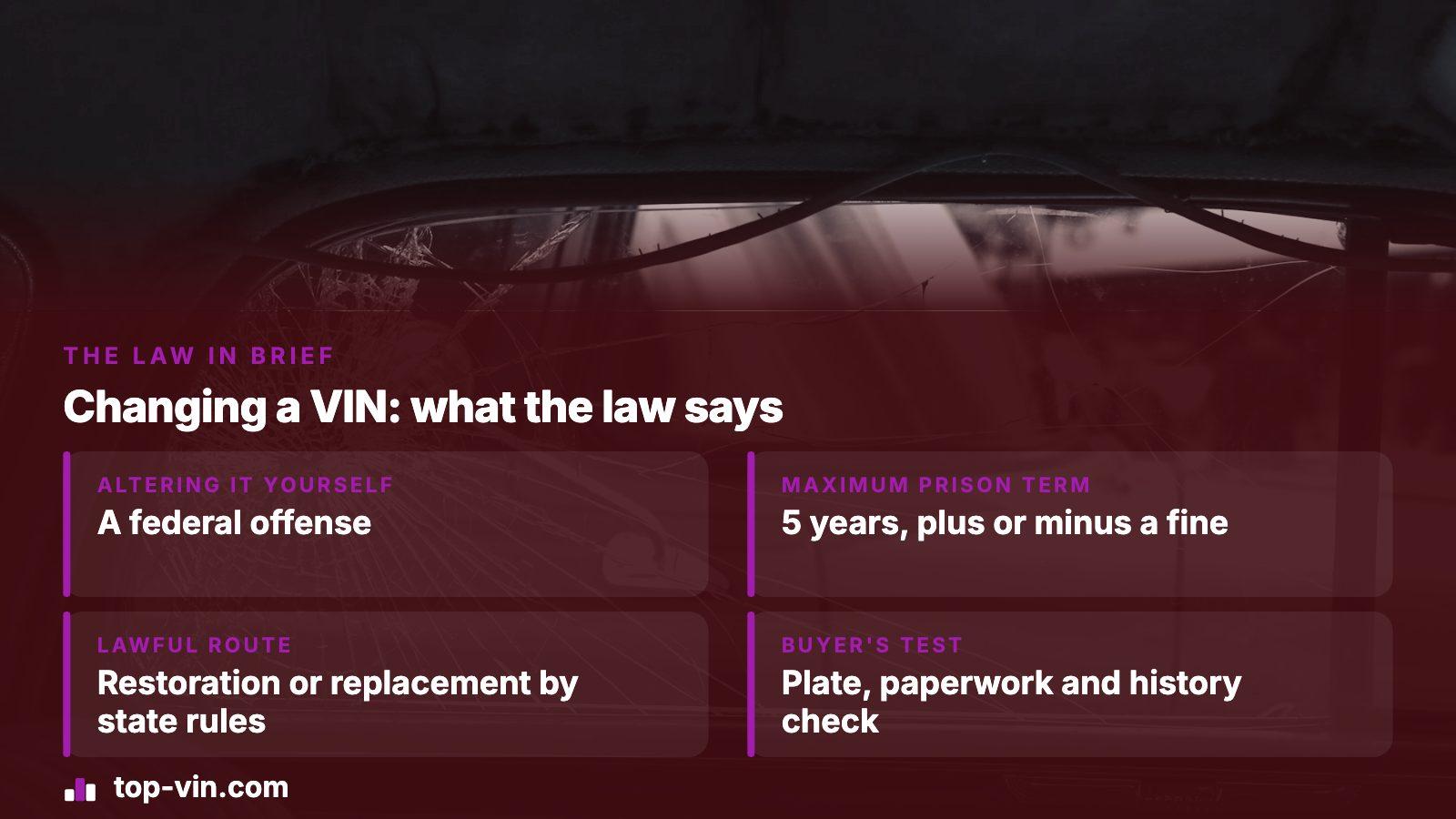
- Altering a VIN yourself
- A federal offense
- Maximum prison term
- 5 years, plus or minus a fine
- Lawful route
- Restoration or replacement under state rules
- Buyer's test
- Compare the dash plate, the paperwork and a history check
The short version for owners
A VIN is the vehicle's identity. Titles, insurance policies, theft reports and recall notices all hang on it, which is why the law treats tampering as more than vandalism. Section 511 of the federal criminal code reaches anyone who knowingly removes, obliterates, tampers with or alters a vehicle's identification number, and the same wording applies to the numbers on vehicle parts.
Three questions people type into search sit under that rule. Can you change it? No, not on your own. Can you remove it? No, apart from the narrow cases below. Can you cover it? The statute does not use that word, but a covered number runs into a different federal rule, and in practice it raises the same suspicion with police and buyers.
What the federal law actually says
The offense needs a knowing act. Accidentally wearing away a tag in a collision is not what the section targets. Deliberately grinding, restamping, swapping a plate or reworking the characters is.
Penalty
A conviction carries a monetary fine, time behind bars of no more than 5 years, or the two combined. The text also protects people who remove a number only because a repair makes it unavoidable, so a body shop cutting out a damaged panel is in a different position from a seller sanding a plate.
Part numbers count too. The definition covers any number or symbol put on a vehicle or part for identification under the federal safety law, which is why chop shops that strip engines and doors tend to run afoul of it.
The cases where a VIN legitimately changes
The same section lists who it does not reach. Each exception comes with a condition, and all of them stop applying once the person is aware the item was stolen.
| Who | Condition |
|---|---|
| Scrap processor or demolisher | Must follow applicable state law for that vehicle or part |
| Repairer | Alteration must be reasonably necessary for the repair |
| Person restoring or replacing a number | Must act in line with state law |
That last row is the one owners care about. A plate lost to rust or rebuilt after a wreck is handled through the state motor vehicle agency, not in the driveway. A related situation is a homebuilt vehicle that never had a maker's number, covered on our custom VIN page.
What a state does when a number is missing or unreadable
States set their own process, so check yours. California gives a useful picture of how one agency handles it. Its DMV can require an in-person verification before registering a vehicle, and the list of triggers includes a revived salvage or junk vehicle, a homebuilt one, and one where the VIN on the paperwork does not match the VIN on file.
The DMV also treats the federal safety label as a second public source for the number. Where that label is gone or cannot be read, DMV staff must hunt for a different VIN that can be reached. Assigning a replacement number is itself a listed reason for an inspection, and licensed verifiers are barred from certain cases such as revived salvage, so those go to the DMV or a peace officer.
The practical lesson: a replacement is something an agency issues after looking at the car, and it leaves a paper trail. A number that changed with no such trail is the red flag.
Covering the VIN instead of changing it
Owners sometimes ask about hiding the dash plate, usually to deter thieves or to keep it off photos in a listing. The criminal statute names removing, obliterating, tampering and altering, so a cover is not spelled out. Federal vehicle rules are plainer about the other half of the problem.
- For cars, SUVs and light trucks, the cabin is where the number belongs.
- Someone standing outside, by the driver's side windshield pillar, should be able to read it in daylight without moving anything.
- The minimum character height is 4 mm, a size set for an observer with 20/20 vision.
A sticker, tint strip or dash cover that blocks that sightline defeats the point of the rule. Police, inspectors and buyers who find a masked plate will assume the worst, and a seller who will not uncover it is telling you something.
Signs a number has been tampered with
A real VIN is hard to fake well. The tell is usually in the details, so look at the car in daylight with a flashlight and a phone camera.
- Rivets that are scratched, mismatched or look newer than the dash around them.
- Characters in an odd typeface, uneven spacing or crooked alignment on a plate that should be printed in capital sans-serif letters.
- A letter I, O or Q, which the federal character set excludes.
- Fresh glue, adhesive halos or paint residue around the plate.
- Door-jamb label and dash plate that disagree, or either one that disagrees with the title.
Do the arithmetic
A VIN has 17 characters and the check digit sits in position 9. A number that fails the check-digit math was typed or stamped wrong, or made up. Our guide on how to read a VIN walks through it.
Checking the number before you pay
A physical read tells you whether the plate looks right. A history lookup tells you whether the number belongs to the car in front of you. Run both. Read the VIN off the dash and the door label, confirm they match the title, then enter it into a check before any money moves.
TopVIN shows a free preview first. If it looks consistent, a full report adds the title brands, odometer readings, salvage and theft records that would show whether the number has a troubled past. It is one payment per report, no subscription, with the options on the pricing page. A clean record does not prove the plate is original, because a cloned number can borrow a clean history, so pair it with an inspection.
If you find something wrong
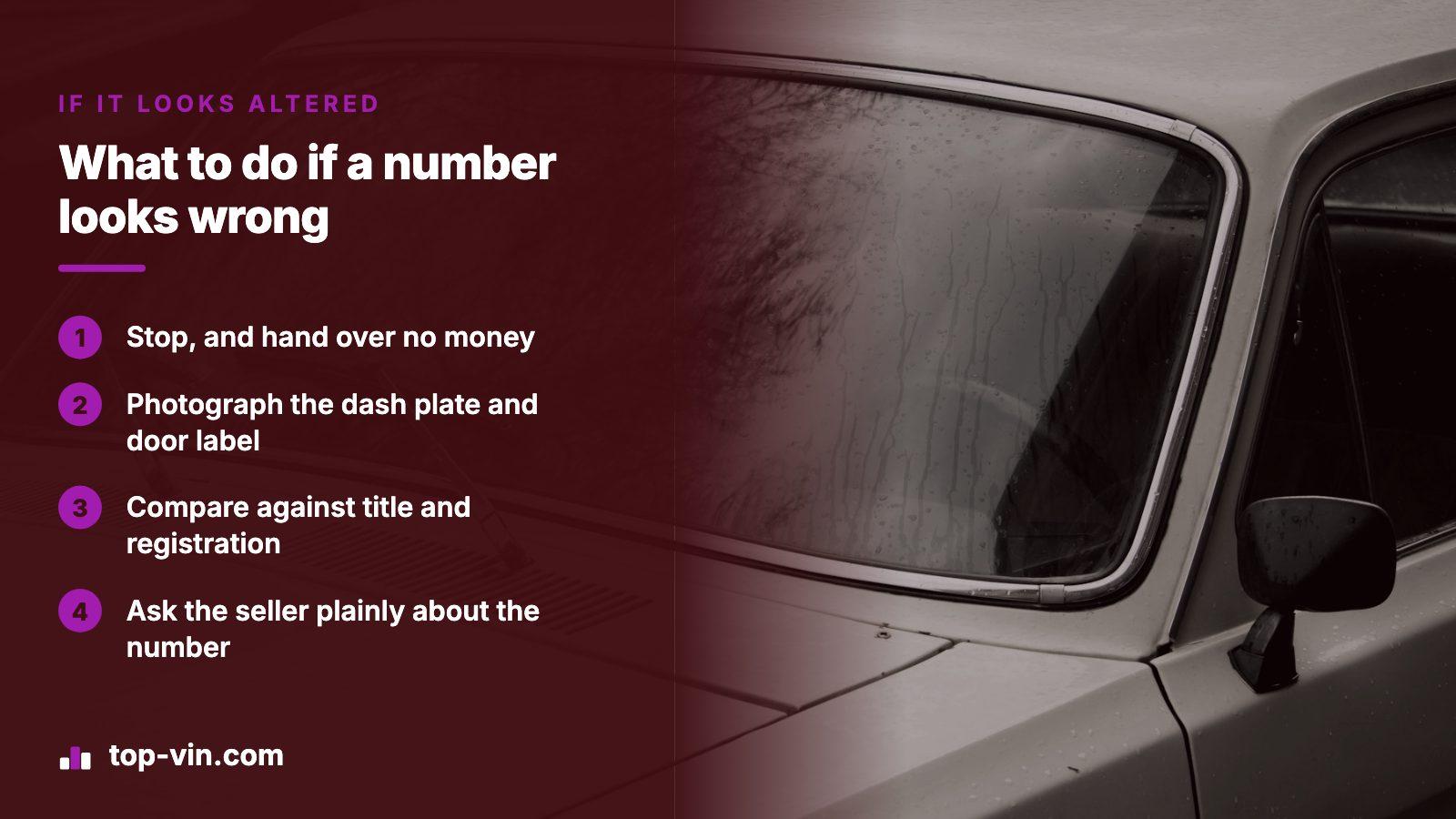
- Stop and do not hand over money or sign anything.
- Photograph the dash plate, door label and any odd marks.
- Compare against the title and registration, and against the history check.
- Ask the seller plainly why the number looks altered, and note whether the answer is specific.
- If the car is already yours, contact your state motor vehicle agency or local police rather than trying to fix the plate yourself.
Federal title data exists partly to keep stolen vehicles from being resold, so a mismatch is worth reporting rather than quietly dropping. The federal title system, NMVTIS, was built to shield buyers from fraud and dangerous cars.
Where this information comes from
- GovInfo: 18 U.S.C. 511 — The offense of altering or removing a vehicle number, its penalty and who it spares.
- 49 CFR 565.13: VIN general requirements — Who assigns a VIN, where it sits, how readable it must be and which characters are allowed.
- California DMV: vehicle verifications — One state's inspection triggers and what it does when a VIN is missing or illegible.
- VehicleHistory.gov: NMVTIS — The federal title system's stated purpose of fighting fraud and stopping resale of stolen vehicles.
Sources and photos: Facts checked against the sources above in November 2026. Photos by Dimitri Karastelev, Tigran Shishmanyan and sippakorn yamkasikorn on Unsplash; diagrams by TopVIN.
Keep reading
- VIN cloning: why a VIN check can pass a stolen car and what catches itA copied number can sit on a different car, and a clean lookup will not catch it.
- VIN inspection: what the inspector checks and what a VIN check addsHow to compare the plate, label and title on the vehicle itself.
- Custom VIN: can you get one, and what a VIN check shows for itWhat happens when a state assigns a number to a vehicle that never had one.
- How to read a VIN: a left-to-right walkthrough with a worked decodeLearn the characters and the check digit so a bad plate stands out.
Frequently asked questions
Is it illegal to change the VIN on your own car?
Generally yes. Federal law punishes anyone who knowingly alters or removes a vehicle's identification number. The carve-outs are repairs where it is reasonably necessary, scrap handling under state law and restoration or replacement under state rules. If a plate is damaged, go through your state motor vehicle agency first.
Can you remove the VIN number from a car?
Not as a private choice. Grinding off or detaching the number falls within the federal offense. Removal is allowed only inside the exceptions, such as a repair that cannot be done otherwise or a demolisher following state law, and none of them cover a person who knows the vehicle is stolen.
Can you cover the VIN number on a car?
The criminal statute does not mention covering, but federal vehicle rules want the dash number readable from outside through the windshield. A cover that blocks it invites questions from police, inspectors and buyers. If theft is the worry, ask your insurer or local police about other deterrents.
What if my VIN plate fell off or is unreadable?
Contact your state motor vehicle agency. Most run an inspection process, and some can assign or restore a number. California, for example, has a DMV employee look for another accessible VIN when the federal label is missing or illegible. Do not make a replacement plate yourself.
How can I tell if a car's VIN was altered before I buy?
Compare the dash plate, the door label and the title, and look for scratched rivets, odd lettering and adhesive residue. Then run the number through a history check. A mismatch or a number with no history for a car that looks well used is a reason to stop the purchase.
Now check the car itself
The guide explains what to look for. The report shows what this VIN has on record.