THE SHORT ANSWER
A VIN check cannot catch a clone on its own. The number on the stolen car was lifted from a real vehicle, so every record that comes back is accurate and describes the donor. Detection happens at the car: the dash plate, the doorway label, any stamped part numbers and the title must all agree. Use a report to learn what the donor identity looks like, then test the car against it.
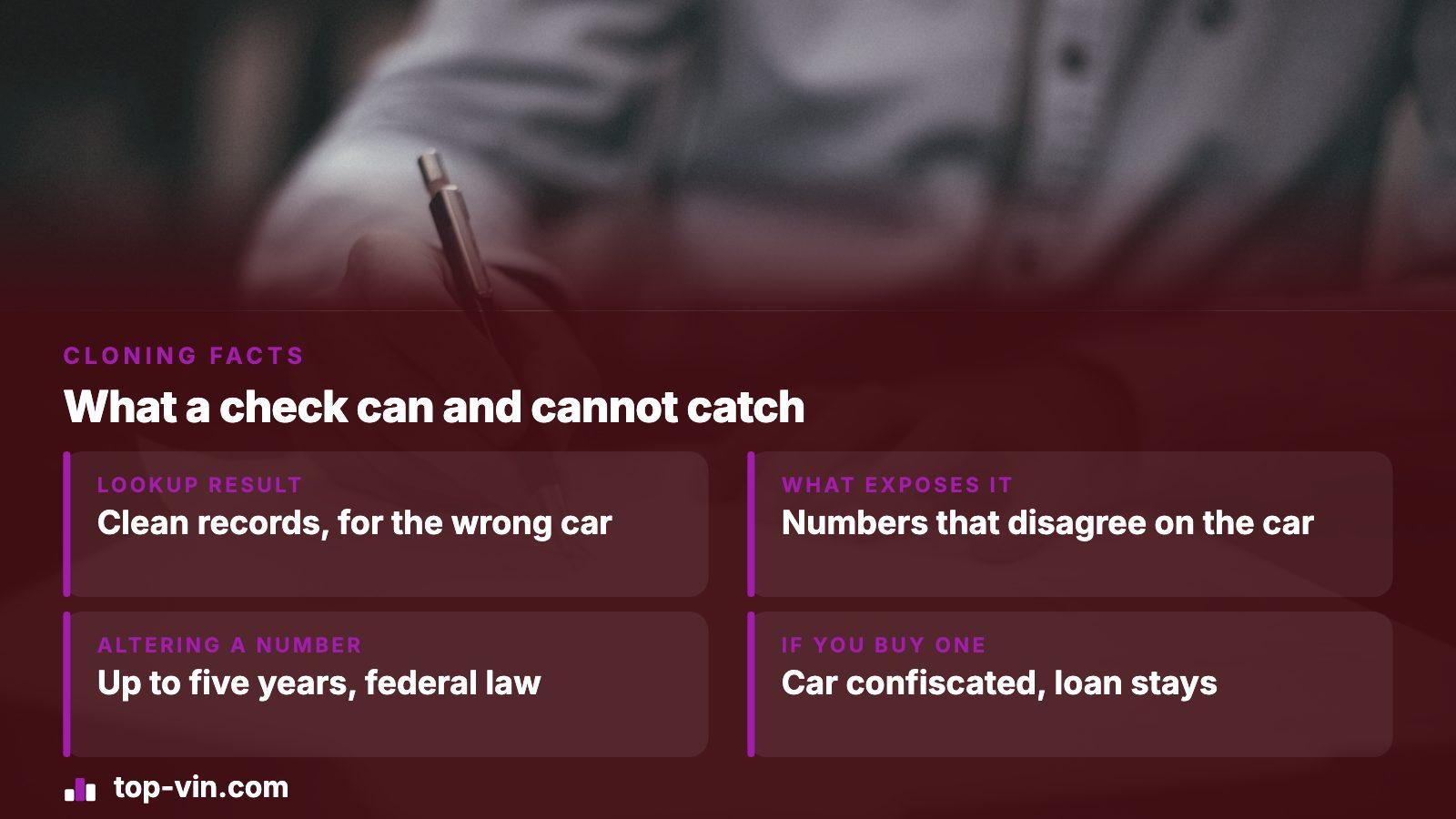
- Lookup result
- Clean records, for the wrong car
- What exposes it
- Numbers that disagree on the car itself
- Altering a number
- Up to five years under federal law
- If you buy one
- The car is confiscated, the loan stays
What a VIN check actually reads
Every VIN tool begins with seventeen characters and returns whatever is filed under them. None of them touches metal.
| Tool | What it looks up | Answer on a clone |
|---|---|---|
| Decode and check digit | Factory build encoded in the characters, plus the arithmetic in position nine | Correct and valid, for the donor car |
| History report | Records filed under the number | Real records that belong to the donor |
| Theft and recall lookups | Reports and open recalls under the number | Clean unless the donor has an entry |
On a cloned car those characters are authentic, so each tool answers truthfully about the wrong vehicle. A database holds records about a number; it cannot tell which of two physical cars is wearing it. A clean result tells you about the number, not about the vehicle you are standing beside.
How a clone gets made and sold
Florida's motor vehicle department describes a scheme built from stolen identification numbers, counterfeit tags and forged documents. A thief picks a donor, a registered vehicle driving elsewhere that matches the stolen car's year, make and model, and copies its number onto the stolen car. The buyer goes through the paperwork, finds nothing wrong and pays.
Two related terms describe cousins of the same crime. Swapping moves or replaces plates and stamped numbers, and re-vinning hands a stolen shell the identity of a written-off car. Both mean physical work on the vehicle you are inspecting, whereas a clone leaves the donor's file untouched, which makes its paper trail the hardest to fault.
Reading a provider's promise about clones
When you compare VIN checks, the cloning question doubles as an honesty test. A site claiming it can flag a cloned car from the number alone promises something a record keyed on that number cannot do. A straight provider says what it reads and sends you to the car for the rest.
- Does it say that a clone's number returns the donor car's history?
- Does it explain that a clean theft record says nothing about this particular car?
- Does it show factory specs and a market value you can hold against the vehicle and the asking price?
The TopVIN preview is a free first step and the report is one payment. Neither claims to find a clone, and neither should be your only check.
Using a report as a baseline for the car
A report cannot expose the swap, but it describes the identity the seller is claiming, and a description can be tested against the car and the seller's story.
- Factory specs: cloners match year, make and model, so compare the engine, body style and trim as well.
- Odometer readings: the last reported mileage and the dash should make a believable story.
- Ownership and use type: a record of fleet or rental use sits oddly beside a one-careful-owner pitch.
- Market value: a figure to set beside an asking price far under similar cars.
A match proves nothing, and a mismatch only sends you back to the plates. It is a prompt, not a verdict.
Numbers to compare on the car
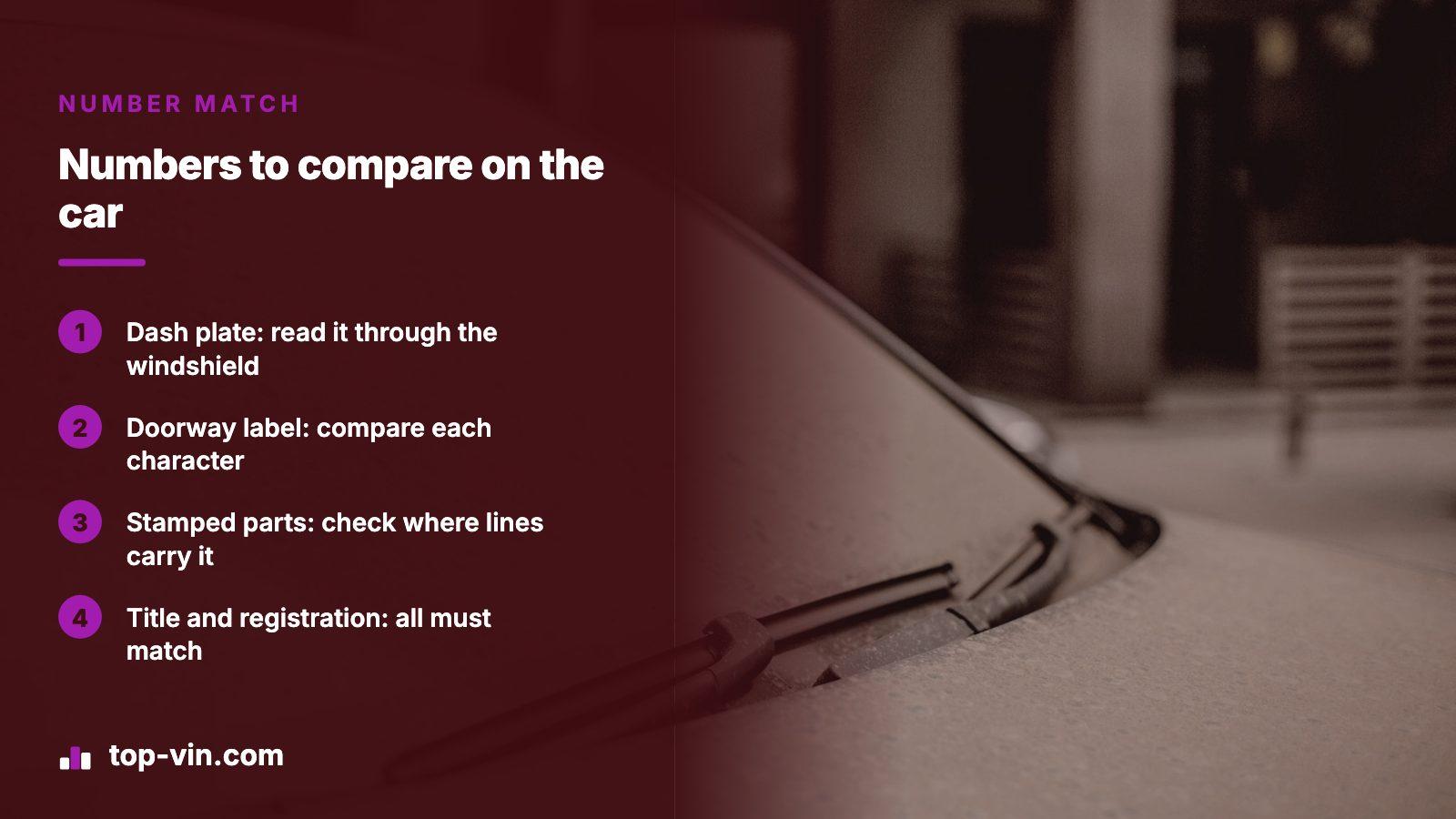
- Dash plate: read it through the windshield. Federal rules say it must be readable from outside in daylight, near the windshield pillar on the driver's side, in characters no shorter than 4 mm. Copy it by hand.
- Doorway label: compare it character by character, and note a crooked label, a different finish or an unfamiliar typeface.
- Stamped parts: covered vehicle lines carry the number on up to 18 major parts, including the engine, transmission, doors and bumpers. Two or three readable ones are enough.
- Title and registration: every number should match, and misspellings count as a signal in their own right.
Any disagreement between two numbers is a reason to leave and call law enforcement. Phoning the seller first only gives them time to move the car.
When a missing or short marking is innocent
Parts marking has limits, and a false accusation costs more than a missed clue.
| What you find | How to read it |
|---|---|
| No stamped numbers on parts | The line may be excluded: the standard skips manufacturers under 5,000 US vehicles a year and lines of 3,500 or fewer, and lines with approved antitheft devices can petition for an exemption. |
| A short number on the engine or transmission | Some makers stamp a shortened form, at least the last eight characters, so compare it with the tail of the full number. |
| A stamped number that differs from the dash plate | No exemption explains this one. Stop and call law enforcement. |
When a changed number is lawful
The federal statute sets a ceiling of five years inside, a fine, or both, for knowingly stripping, defacing or changing a vehicle's identification number. It spares four kinds of people: scrap processors and demolishers working under state law, anyone repairing a vehicle where the change is reasonably necessary, and people who restore or replace a number as state law allows. That cover ends when the person knows the property is stolen.
So a replaced plate raises a question rather than an accusation. Ask for the state paperwork behind it. A lawful restoration leaves a record, and a mismatch with no record behind it is a matter for the police.
Sale signals, and what a bad buy costs
| Signal | Why it fits the scheme |
|---|---|
| Asking price far under similar cars | A bargain is how these cars find buyers |
| Late-model car with no lienholder on the title | Cars that new are usually financed |
| Misspelled paperwork, or a seller not named on the title | Both appear on Florida's list of buyer tips |
| A meeting place away from the address on the papers, or pressure to close fast | The fraud works only if the sale finishes before anyone queries the number at titling |
Florida states the cost plainly: a cloned car whose true history surfaces is confiscated, and you keep any loan on it. If you may already own one, stop driving and repairing it, photograph every number, file a written report with the state fraud unit and with law enforcement rather than the seller, call your lender and your insurer directly, and keep the ad, messages and bill of sale for a lawyer.
The cheaper step comes first. Run the VIN through the TopVIN preview before making the trip to view the car, and buy a report only if it is still a contender. A report is a single purchase, and the pricing page explains the packs for anyone comparing several vehicles.
Where this information comes from
- Florida DHSMV: vehicle cloning — The state's description of the scheme, its buyer tips and the confiscation outcome for a buyer.
- 18 U.S.C. 511: altering or removing motor vehicle identification numbers — The federal offense, its five-year penalty and the groups allowed to alter a number lawfully.
- 49 CFR Part 541: theft prevention standard — Which major parts carry the number, and the exclusions for small makers and low-volume lines.
- 49 CFR Part 565: VIN requirements — The uniqueness requirement and where the dash plate must be readable from outside.
- NMVTIS: consumer information — The federal title record and the approved providers that sell reports from it.
- NICB: VINCheck — A no-charge theft and total-loss screen, also keyed on the number.
Sources and photos: Facts checked against the sources above in November 2026. Photos by Abolfazl Ranjbar, JavyGo and Scott Graham on Unsplash; diagrams by TopVIN.
Keep reading
- VIN verification: the four checks people mean and what each provesMatch the number on the car to the number you checked, plate by plate.
- How to read a VIN: a left-to-right walkthrough with a worked decodeWhat each character means, including the check digit a clone passes.
- VIN inspection: what the inspector checks and what a VIN check addsCarry the comparison onto the car when you inspect it in person.
- VIN etching: what it marks, what it misses and why no lookup shows itWhat factory parts marking covers and what etching adds.
Frequently asked questions
Can a VIN check detect a cloned car?
Not by itself. The number on a clone is real, so the lookup returns true records about the donor car. A check can give you specs, mileage and a market value to compare against the car, but only the numbers on the car and the paperwork can expose the swap.
Does the VIN check digit catch a clone?
No. The check digit only confirms that the characters are consistent with one another. A cloned number was copied from a genuine vehicle, so it passes. A valid digit tells you the number is well formed and nothing more.
Is VIN cloning the same as VIN swapping?
They overlap but describe different work. Cloning copies a real car's number onto a stolen vehicle and leaves the donor untouched. Swapping moves or substitutes plates, labels or stamped numbers. Federal law uses neither word and instead targets anyone who knowingly alters an identification number.
What happens to a buyer who ends up with a cloned car?
Once the true identity comes out, the car is confiscated, and Florida's motor vehicle department notes the buyer remains responsible for any loan. Stop driving it, document every number, contact law enforcement and your lender, and keep the sale paperwork in case you pursue the seller.
How do I check a car for cloning before buying?
Compare the dash plate, the doorway label, any stamped parts and the title, character by character. Run the VIN first so you know the specs and records to expect. Any disagreement between two of those numbers is a reason to stop and call the police, not to ask the seller.
Now check the car itself
The guide explains what to look for. The report shows what this VIN has on record.