THE SHORT ANSWER
You cannot choose your own VIN. Federal rules have the manufacturer assign it, and a state steps in only for a vehicle with none, such as a kit car or homebuilt, after an inspection. A decoder may return blanks for that number, and a history lookup may find little because the number is new. Ask for the state's paperwork and the number the vehicle carried before, then check both.
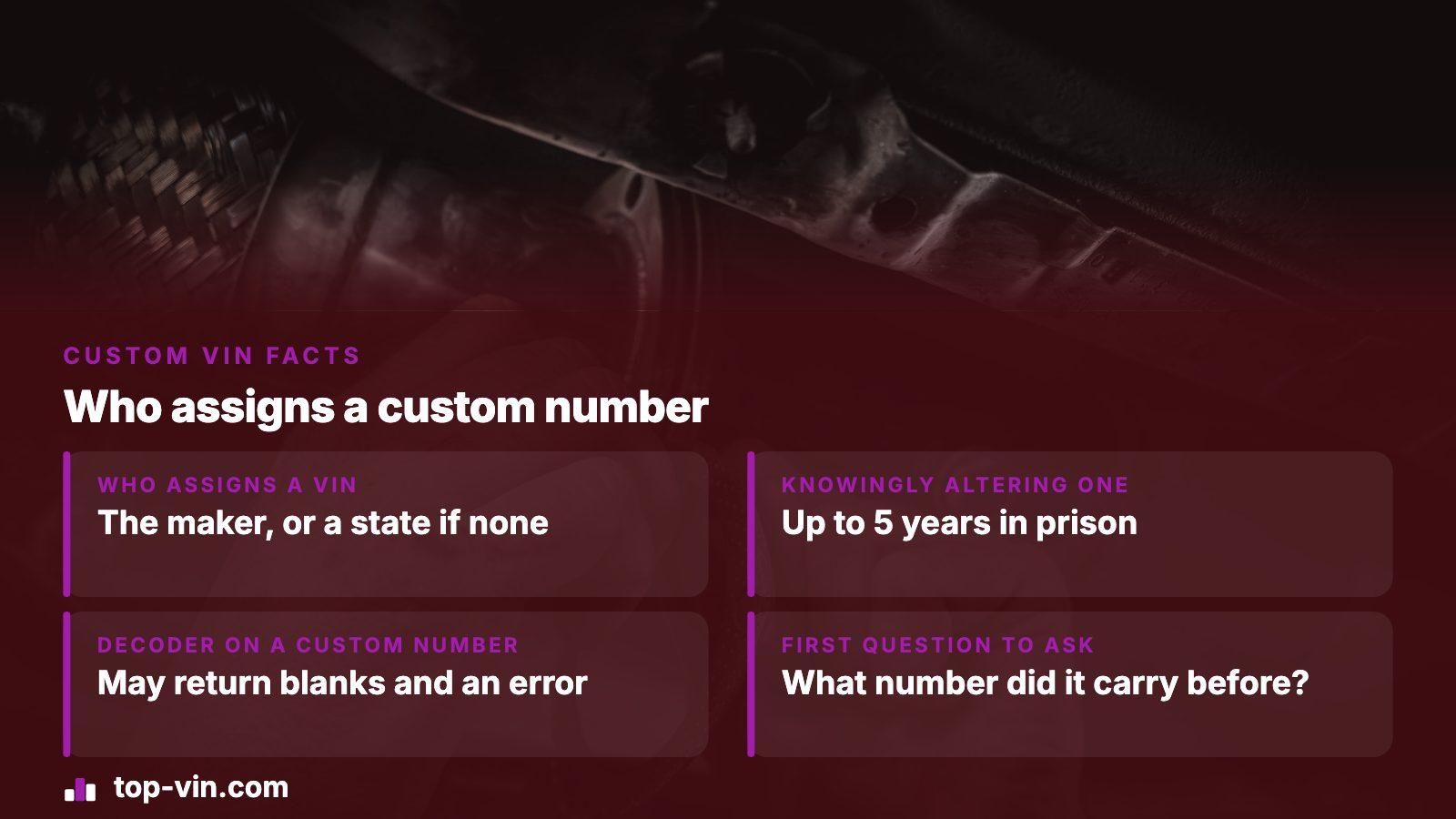
- Who assigns a VIN
- The manufacturer, or a state when none exists
- Knowingly altering one
- Up to 5 years in prison under federal law
- Decoder on a non-factory number
- May return blanks and an error
- Best first question
- What number did it carry before?
Three things people mean by a custom VIN
This phrase covers three situations, and only one of them calls for a buying strategy.
- A number you would like to pick. Not available: Part 565 of the federal vehicle regulations puts the job of assigning each VIN on the manufacturer, and no two vehicles built within a 60-year span starting with the 1980 model year may share one.
- A number a state assigned because the vehicle never had a maker's number, or lost it. Typical cases are kit cars, vehicles assembled from parts, rebuilt frames and some trailers.
- A replica from a manufacturer working under the federal replica rules, which carries the number that manufacturer gave it and is written so a decoder can read the original model.
The middle case is the one a buyer has to evaluate.
Who gets to write a VIN
| How the vehicle came to exist | Where its number comes from |
|---|---|
| Built by a manufacturer in one stage | That manufacturer assigns it |
| Built in more than one stage | The maker of the incomplete vehicle assigns it |
| Altered by a modifier | The original maker's number stays on the vehicle |
| Imported | The original maker's number is kept, and a non-conforming one gets a label repeating it |
| Assembled privately from parts | A state agency assigns one after inspecting the vehicle |
California shows the last row in practice. Its DMV manual sends specially constructed motor vehicles to the Highway Patrol, which inspects them and either confirms or assigns the number. Heavier trailers, from 6,001 pounds empty, take the same route, while lighter ones get a number from the DMV unless the original VIN is still on the frame.
Paperwork a state expects before it assigns a number
States differ, so treat California's list as a sample of the paperwork that ought to exist. For a build from parts, it asks for:
- A signed statement of construction whose total matches the cost figures on the title application, with materials and labor listed even when the owner did the work.
- Bills of sale, receipts or invoices for the body, frame, transmission and engine. A junk receipt issued by the DMV can stand in for a part.
- A surety bond set at the vehicle's fair market value if the build used a previously altered vehicle or raw material with no earlier plate. No bond is needed when documents prove a verified number or the finished value, or when the major parts with no bill of sale add up to no more than $4,999.
- A safety systems inspection certificate, plus a first smog certification from a state referee center.
Hold a seller's folder up against a list like this. A folder with none of it leaves the number without a visible origin, and no lookup can supply one.
How each kind of check treats an assigned number
Every lookup starts from the same characters; each keeps different records under them.
| Check | What sits behind the number | What to expect for an assigned one |
|---|---|---|
| Free decoder (NHTSA vPIC) | Build details that makers register with NHTSA | Often blanks. A made-up 12-character test string returned no make, model or year and an incomplete-VIN error. |
| NICB VINCheck | A free NICB database covering flood damage and other details | Only reports tied to this exact number, so a recently issued one may start empty. |
| Title-record report (NMVTIS data) | The latest title record, any brands, odometer readings, plus total-loss and salvage entries | Whatever title agencies, salvage yards, recyclers and insurers in any state have reported since the number was issued. |
| TopVIN preview and report | Title brands, odometer readings, salvage and theft records, open recalls, factory specs and market value, where on file | The preview costs nothing, so you can judge how much is on file before paying for a report. Specs and value may be thin for a number no maker wrote. |
A thin result is not a clean one
For an ordinary car, an empty title report is good news; the federal title system calls its short reports intentional. A number assigned last year is different. It can look spotless because records have had little time to build up, and a lookup on the new number will not necessarily reach what was filed under the old one.
Kentucky's junk-title form shows how a number changes. Junking a title applies a permanent salvage brand. If the vehicle is reactivated later, it must be rebuilt, takes a Kentucky-assigned VIN, carries a permanent rebuilt brand, and may owe back taxes covering up to five years. The brand is meant to follow the vehicle; the old number is the key to what was filed earlier.
Ask for the earlier number
If a seller says the vehicle was rebuilt, retagged or given a new frame, ask which number it carried before and run that one too. Recall lookups work from the maker's number, so the original is the one that counts for open recalls.
Why the plate is not a do-it-yourself job
Section 511 of Title 18 covers VIN tampering: knowingly stripping, defacing or changing the number on a vehicle or one of its parts can bring a fine, a sentence of up to five years, or both. The law carves out scrap processors and demolishers working under state rules, repairers whose change is needed for the repair, and people who restore or replace a number as state law permits. Knowing the item is stolen removes that protection.
What matters to a buyer is that a lawful replacement leaves a state record. A plate that looks fresher than the car around it, with no record behind it, deserves a question to the seller.
Replicas that come with a maker's number
The federal VIN rules include a replica category for vehicles a manufacturer builds to copy an earlier model. The number must make the copied car's make, model and model year recoverable, and the replica's own model year is the calendar year it was built. A manufacturer-built replica is therefore meant to decode, while a garage-built copy living on a state-issued number may not. That makes the first kind easier to vet: its number can go through a decoder and the usual lookups. The title and the paperwork say which kind you have.
A sensible order for checking a vehicle with a custom number
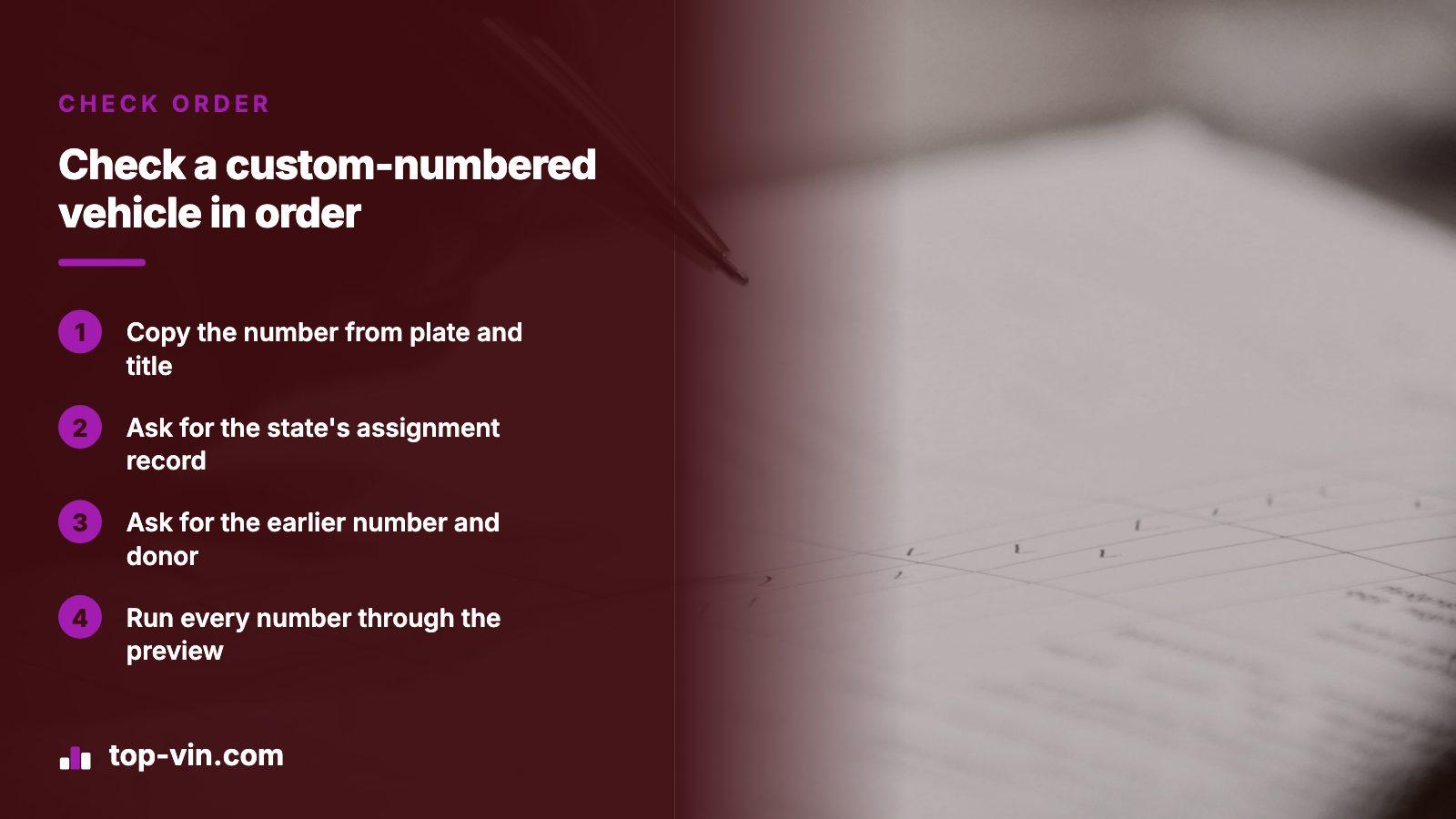
- Copy the number from the plate and from the title, and confirm they match character for character.
- Ask for the state's assignment record and the construction file, and measure both against the list above.
- Ask for the earlier number, and for the donor vehicle's number if a donor was used.
- Run every number through the TopVIN preview. It is free, so it costs nothing to see how much is on file.
- Search the same numbers in NICB's free database and book an independent inspection, as the federal title-system site advises.
- Buy a report only for the numbers that matter. That is a single purchase, and the pricing page lists pack options for comparing several vehicles.
A report cannot replace the state's file, but it shows whether the history under each number matches the story you were told.
Where this information comes from
- eCFR: 49 CFR Part 565, VIN requirements — Who assigns a VIN, how imports and alterations are treated, and the replica provisions.
- GovInfo: 18 U.S.C. 511 — The federal offense for altering a vehicle number, its penalty and the people it spares.
- California DMV: specially constructed vehicles — One state's inspection route, paperwork list and bond rule for a vehicle built from parts.
- Kentucky Transportation Cabinet: form TC 96-351 — The state's warning that a reactivated junked vehicle gets a new assigned number and a rebuilt brand.
- NMVTIS: understanding a vehicle history report — What the federal title system reports and where its data comes from.
- NMVTIS: used car buying tips — The advice to pair a title report with an inspection, and the pointer to NICB's free database.
- NHTSA: vPIC decoder API — The public decoder used for the blank-result test on a short made-up string.
Sources and photos: Facts checked against the sources above in November 2026. Photos by Linus Belanger, Masjid MABA and Martin Fennema on Unsplash; diagrams by TopVIN.
Keep reading
- How to read a VIN: a left-to-right walkthrough with a worked decodeSee what the 17 characters of a factory VIN encode, which an assigned number may not follow.
- Old car VIN number lookup: what comes back for an older carClassics with missing tags often end up with assigned numbers, and this covers older numbering.
- VIN inspection: what the inspector checks and what a VIN check addsTake the plate-to-title comparison onto the car itself.
- VIN cloning: why a VIN check can pass a stolen car and what catches itWhy a clean lookup can still sit on the wrong vehicle.
Frequently asked questions
Can I get a custom VIN for my car?
Not by choosing one. Federal rules have the manufacturer assign a VIN, and a state issues one only when a vehicle has none, after inspecting it. Changing a number yourself can break federal law. If a tag was lost, ask your state motor vehicle agency about its restoration process.
Will a VIN check work on a state-assigned VIN?
It will read the number, but it may find little. A decoder depends on a maker's registration and can return blanks. Title, brand and salvage lookups return what was filed under that exact number, so a new one can look empty. Run the earlier number too.
Does a custom VIN mean the vehicle has a rebuilt title?
Not always. A kit car or homebuilt can receive an assigned number without ever being wrecked. A rebuilt vehicle can too: Kentucky's form says a reactivated junked vehicle gets a Kentucky-assigned VIN with a permanent rebuilt brand. Read the title wording and ask why the number was assigned.
Do replicas get custom VINs?
A replica built by a manufacturer under the federal replica rules carries a number that manufacturer assigned. A garage-built copy is different and usually relies on a state-assigned number. Run it through a decoder first; a blank result points to the paperwork. The title shows which one you have.
What should I check on a trailer with a custom VIN?
Trailers fall under the federal VIN rule, kits included. California's DMV generally numbers trailers under 6,001 pounds and sends heavier ones to the Highway Patrol. Ask for the state's record of the assignment and receipts for the major parts, then compare the plate with the title.
Now check the car itself
The guide explains what to look for. The report shows what this VIN has on record.