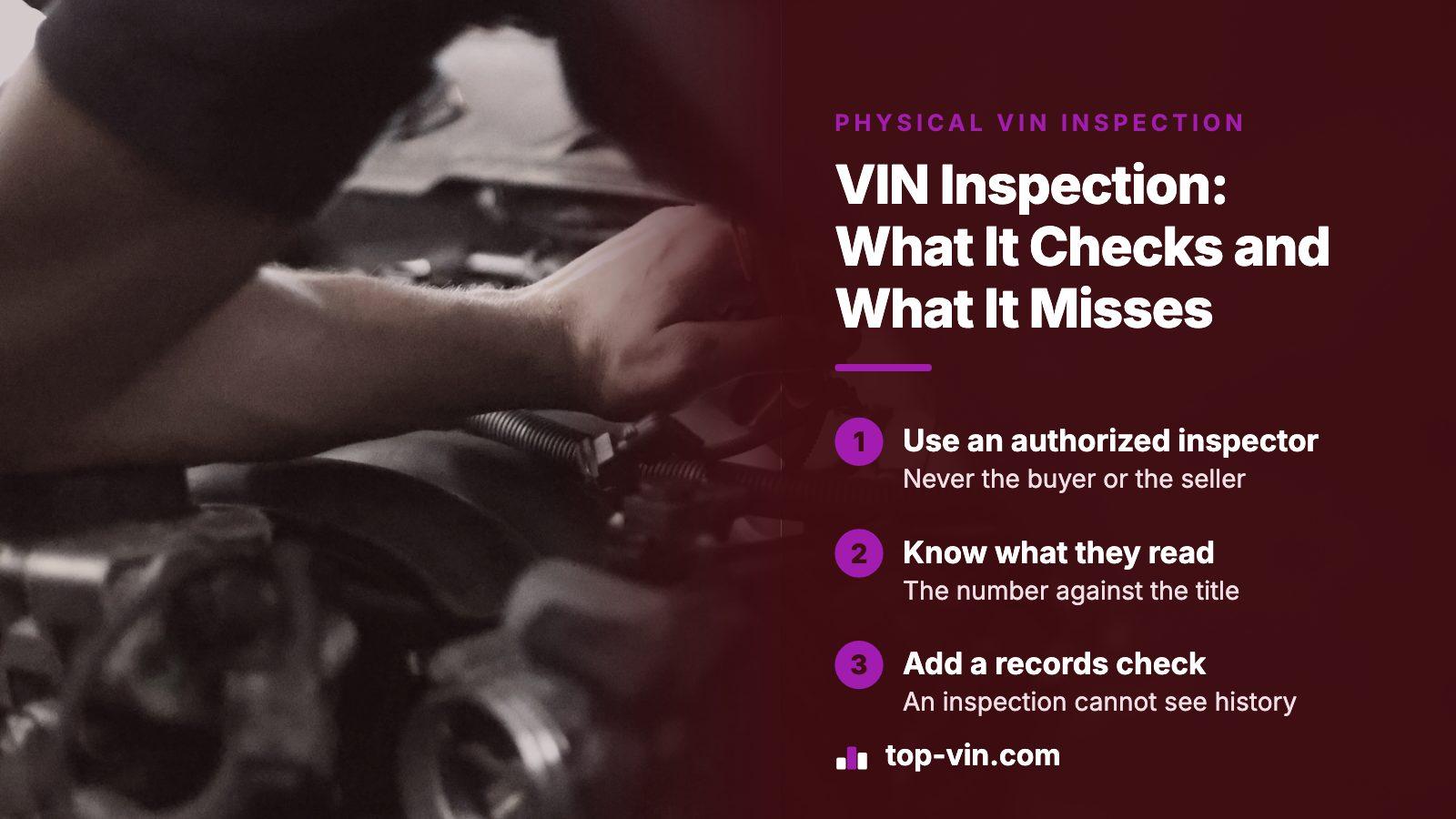
THE SHORT ANSWER
A VIN inspection compares the number on a vehicle with the number on its ownership papers, done in person by someone the state names. No federal rule demands it, so each state decides which cars need one, who may sign and what it costs. Out-of-state titles, rebuilt wrecks and doubtful numbers are the usual triggers. It proves the car matches its paper. A VIN check is the separate step that reads title, salvage and theft records.
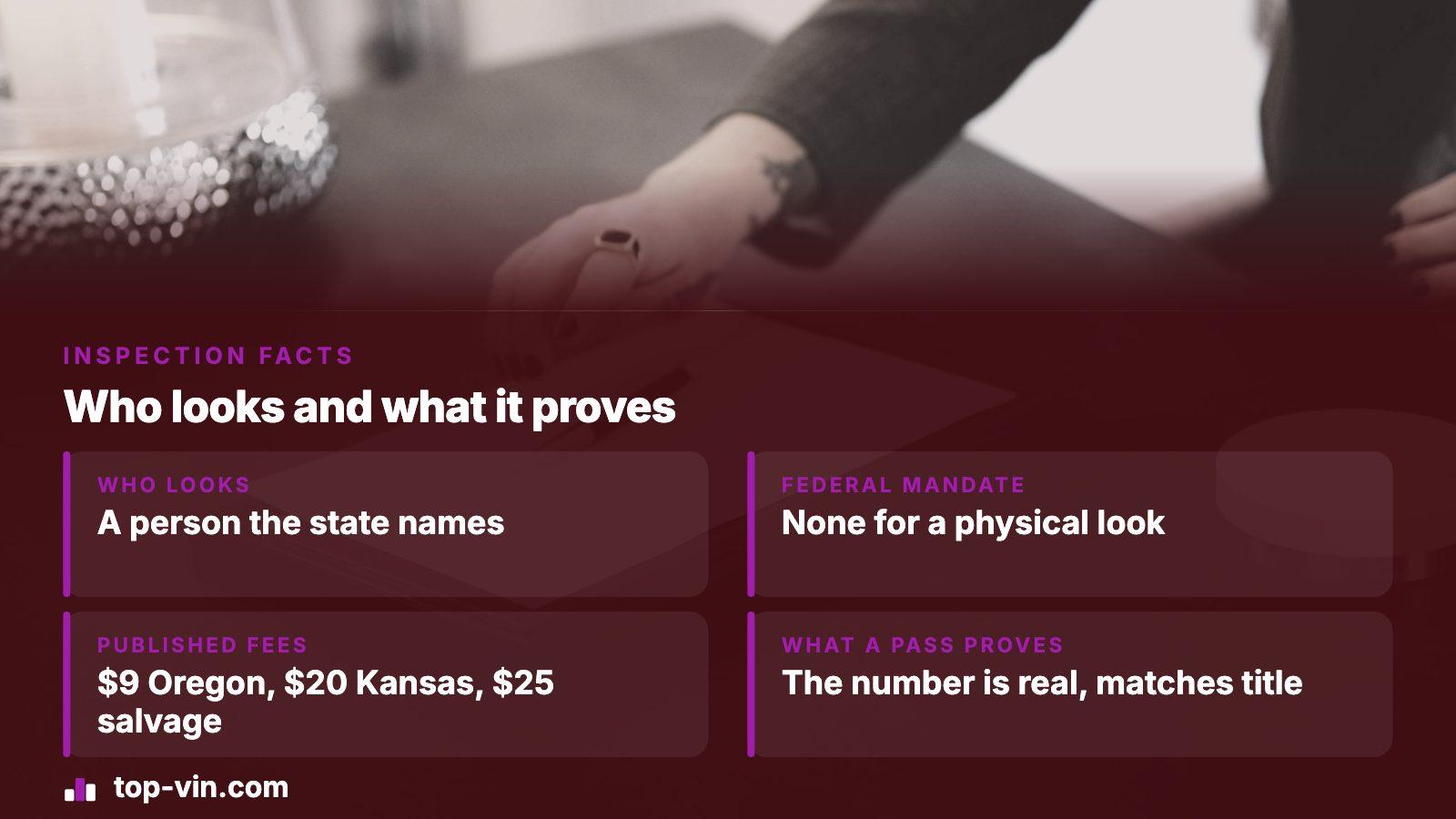
- Who looks
- A person the state names, never the buyer or the seller
- Federal mandate
- None for a physical look; 28 CFR 25.54 is a records check
- Published fees
- $9 in Oregon, $20 in Kansas, $25 for Kansas salvage
- What a pass proves
- The number is real and matches the title
Two checks that answer different questions
Search results use one word for two jobs. Oregon's DMV describes the inspection as a physical examination confirming that the number on your vehicle matches the title or ownership document. A VIN check never touches the car. It reads what insurers, salvage yards and title offices have filed under the number.
| Point | VIN inspection | VIN check |
|---|---|---|
| Done by | A person the state authorizes, standing at the car | You, from a screen, with the 17 characters |
| Catches | A plate lifted from another car, a number that disagrees with the title | A brand from another state, a total loss, odometer entries that do not agree |
| Misses | Anything that happened to the paperwork rather than the metal | Whether the dash plate was fitted last week |
| Typical cost | A state fee, often with an appointment | A free preview, then one payment for the full report |
When a state sends a car to an inspection
Buyers meet this requirement at the titling counter, not at the dealership. States ask when a vehicle's paper trail is foreign, thin or doubtful, and the lists differ.
- Oregon: a title issued elsewhere, a first title as an assembled or reconstructed build, a recovered stolen car that was not totaled, and an Oregon salvage car applying for a regular title.
- Washington: total-loss or salvage history, a rebuild, and a home-built, kit, street rod or custom car on its first title. A missing or defaced number goes to the State Patrol alone, and a clean title from another state is not on the statute's list.
- Exempt: in Kansas, a never-titled new car sold with a signed manufacturer's statement of origin. Washington exempts all-terrain and utility-type vehicles.
Ask the titling office what applies before booking; a needless appointment costs a day, and a skipped one holds up the title.
Who signs, and what it costs
The buyer and the seller never sign. California's form carries a printed warning that the applicant must not complete it. The signature is worth something because the signer has nothing to gain.
| State | Who may look at the car | What is published |
|---|---|---|
| Kansas | Highway Patrol stations and partner agencies such as a sheriff's office | $20 regular, $25 salvage |
| Oregon | DMV; a dealer on cars it sold; DEQ only beside a required emissions test | $9, and nothing from Oregon when another state does it |
| California | DMV staff, licensed private verifiers, auto club employees, trained officers | Nothing on the form; verifiers set their own price |
| Washington | State Patrol or another authorized inspector | Five dollars, charged only if the Patrol assigns a new number |
What the inspector actually reads
Federal rules decide what there is to find. A VIN runs 17 characters, position nine holds a check digit, and on a car the number must be legible from outside, in daylight, near the left windshield pillar. The Kansas Highway Patrol tells buyers to compare it everywhere it appears:
- The dashboard stamping behind the windshield, driver's side
- A plate or sticker at the driver's door jamb
- Engine firewall stamping
- The insurance card and policy
California's form adds the federal certification label, and tells the verifier not to treat it as the main source of the number. Kansas will not swap in the door sticker when adhesive hides part of the dash number, since the number must show through the glass.
What a failed inspection sets off
A doubtful number is rarely handed back for another try. On California's form, a number that is missing, illegible or looks altered gets an asterisk that stops processing and sends the car to the Highway Patrol, and tampering must be reported to the DMV's investigators. Oregon's DMV refers you to state police only by stamping your form, and troopers work by appointment.
Where a number has vanished, Washington's State Patrol assigns a new one, stamps it somewhere conspicuous and the department treats it as official. A later lookup then starts abruptly, because the record is describing what happened.
A look at the door post
Washington puts a mark on the driver's side latch post of an inspected rebuild or salvage vehicle, and it is a class C felony to take it off. If a Washington car's papers say rebuilt and the post is bare, get an explanation before any money moves.
What an inspection cannot see, and what a VIN check adds
A person at the car can spot a moved plate. Nobody at the car can see a total-loss payout from another state or a salvage brand shed at a state border. That evidence lives in records. The federal title system, NMVTIS, tracks five things: the state holding the title and when it last issued, brands applied by any state, the mileage on file, total losses and salvage records. State titling agencies, insurers, junk and salvage yards and recyclers report them.
The Justice Department's NMVTIS site tells buyers to get an independent inspection and a history report, not one or the other. The title check in 28 CFR 25.54 is itself a records step and never requires anyone to look at the car.
The TopVIN preview is free, so you can see whether a number has a record before you make the drive. A full report is bought once, nothing renews, and the pricing page covers the packs. Beyond the title record it adds salvage-auction photos, mileage readings and theft entries.
A sensible order for a used-car buyer
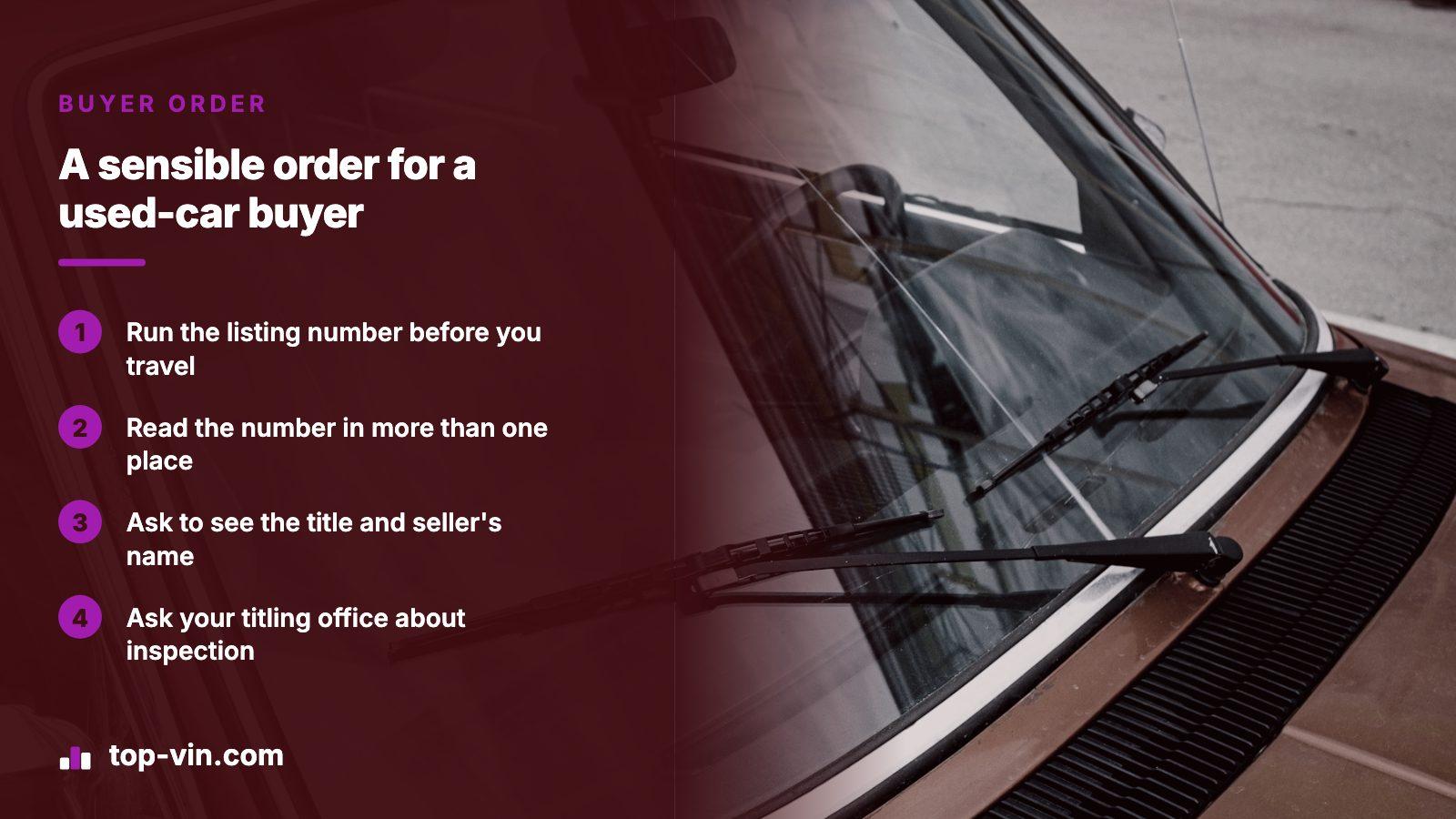
- Run the number from the listing before you travel. NICB's VINCheck lookup costs nothing and covers theft and total-loss reports; a brand or a theft entry ends the trip.
- At the car, read the number in more than one place and compare it with the listing, the title and the insurance card.
- Ask to see the title, and look for the seller's name on it. In Kansas, a seller who never titled the car personally has left a jumped title, which must be fixed before the process can finish.
- Weigh the price. The Kansas Highway Patrol says a cloned car can sit $20,000 or more below what similar cars list for, and recovered clones tend to carry titles from other states. It also calls a cash-only seller a red flag.
- Before paying, ask your titling office whether an inspection applies, and hire a mechanic to judge condition, which no inspection covers.
If the check or the metal says stolen, leave the car alone and call the police, not the seller.
Getting through the appointment
Kansas publishes the most detail on what happens on the day:
- Bring the original signed title. Photocopies are refused, and bills of sale and lien papers must be originals too, free of erasures.
- Bring the car itself, unloaded on arrival. One that cannot run gets a house call only rarely, and a supervisor must approve it.
- Bring government-issued ID and the purchase paperwork. The owner need not attend, and an agent may bring the car.
- A rebuilt car needs part receipts, the repair work order, photos from before repairs and the donor car's number for each used part.
Patrol stations there run weekdays only, the busiest metro stations take appointments, and the form you leave with expires after 120 days.
Where this information comes from
- Oregon DMV: Vehicle identification number inspections — Oregon's definition, trigger list, inspector list, fee and the out-of-state option.
- Kansas Highway Patrol: VIN frequently asked questions — Kansas fees, documents, hours, salvage requirements, the form's expiry and the new-car exemption.
- Kansas Highway Patrol: Beware of buyer scams — Where to compare the number on a car and the warning signs on cloned vehicles.
- California DMV: Form REG 31, Verification of Vehicle — Who may verify, the stop-and-refer findings, the label instruction and the tampering report.
- Washington Legislature: RCW 46.12.560 — Washington's inspection triggers, the door post marking and the replacement number rule.
- eCFR: 49 CFR 565.13, VIN general requirements — The 17-character rule, the check digit position and how the dash number must be readable.
- NMVTIS: Understanding an NMVTIS vehicle history report — The five record types, who reports them and the advice to pair a report with an inspection.
Sources and photos: Facts checked against the sources above in November 2026. Photos by Mustafa Sheikhmouss, Max Tokarev and Annika Wischnewsky on Unsplash; diagrams by TopVIN.
Keep reading
- VIN verification: the four checks people mean and what each provesCompare the number stamped on the car with the paperwork, plate by plate, as an inspector does.
- VIN cloning: why a VIN check can pass a stolen car and what catches itHow a stolen car can carry a clean number, and what exposes it.
- DMV VIN check compared: what the state shows and what to run beside itWhat a state's own lookup shows, and what to run beside it.
- How to read a VIN: a left-to-right walkthrough with a worked decodeDecode the 17 characters before you compare them with the title.
Frequently asked questions
What is a VIN inspection?
A physical check in which an authorized person finds the identification number on a vehicle, notes how it is attached and confirms it matches the ownership paper. It is not a safety test, an emissions test or a valuation, and it says nothing about accidents or liens.
Does a VIN inspection replace a VIN check?
No. An inspector can spot a swapped plate but not a flood claim filed elsewhere, and a record lookup shows that claim but not a plate fitted last week. Federal buying advice recommends an independent inspection and a history report together.
Who can do a VIN inspection on my car?
Only whoever your state names, never you or the seller. Kansas uses Highway Patrol stations and partner agencies such as sheriff's offices. Oregon lets its DMV, its dealers and, beside an emissions test, DEQ do it, and California also licenses private verifiers.
What does a VIN inspection cost?
Published prices are modest and vary: Oregon charges $9, and Kansas charges $20 for a regular inspection and $25 for salvage. Oregon charges nothing for one done in another state, though that state may charge. California's form lists no price because licensed verifiers set their own, so ask before you book.
If the car passes a VIN inspection, is it safe to buy?
No. A pass says the number is real and matches the paper, nothing more. It does not test brakes or look for flood, salvage or lien history. Hire a mechanic for condition, and run a VIN check for the title brands and total-loss entries an inspector cannot see.
Now check the car itself
The guide explains what to look for. The report shows what this VIN has on record.