THE SHORT ANSWER
A car seat LATCH check has two halves. The anchors themselves, two lower bars and a tether point at each position, can only be confirmed on the car, since no VIN record or federal decoder carries them. A VIN check covers the other half: the true model year, structural damage and salvage history, insurance records and open recalls. Anything assembled from September 1, 2002 onward falls under the full federal anchor rule, so pair the build date with a hands-on look.
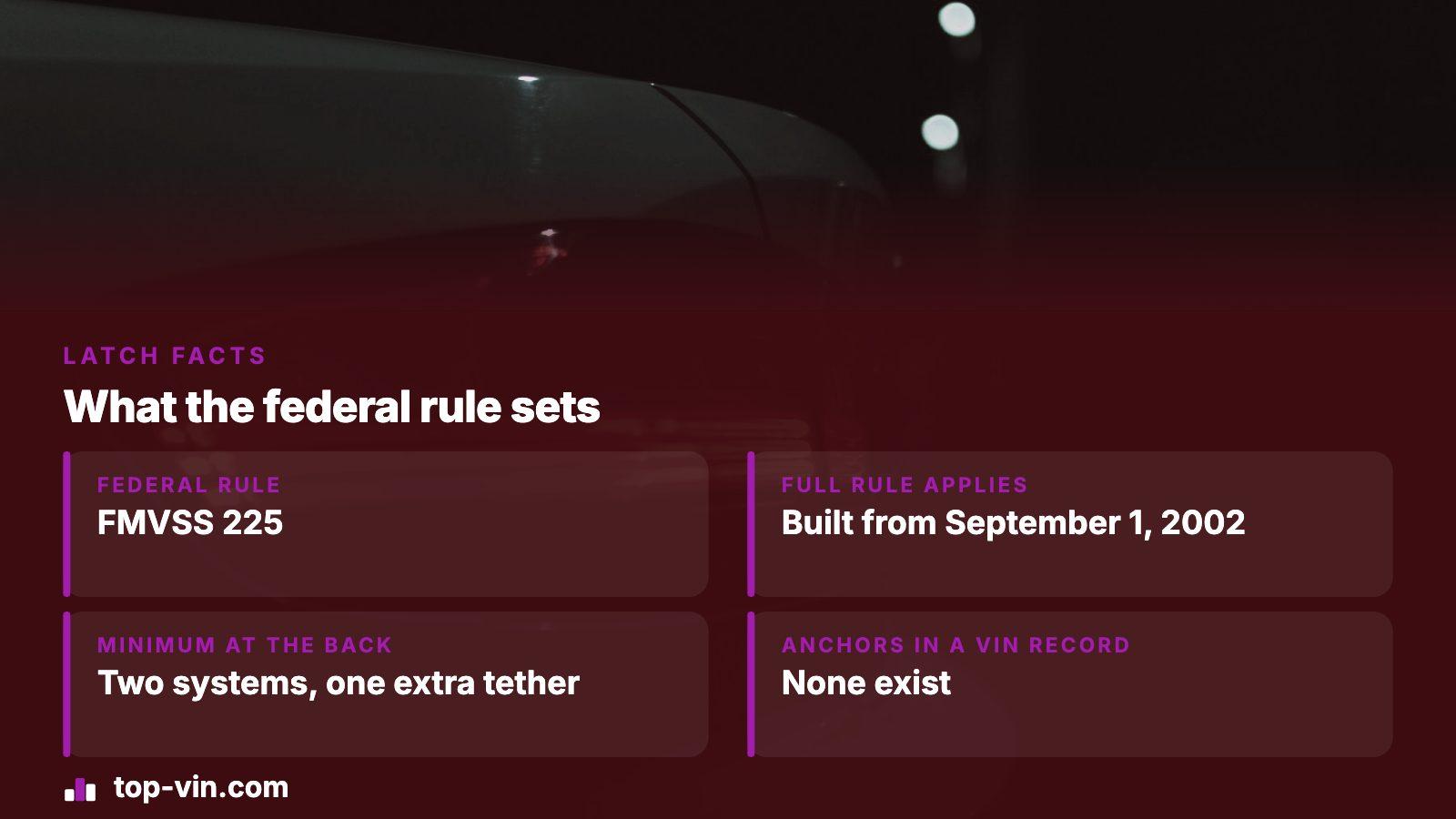
- Federal rule
- FMVSS 225
- Full rule applies
- Built from September 1, 2002
- Minimum at the back
- Two complete systems, one extra tether
- Anchors in a VIN record
- None exist
What a VIN check adds when the question is child seats
Parents often assume a VIN lookup will list a car's LATCH hardware. It will not. The federal decoder has no field for anchorages, and the commercial databases behind history reports do not hold that detail either. Anyone who quotes an anchor count from a VIN is guessing from the model.
The useful question is what a check settles around the anchors:
- Identity: the VIN pins down the model year, body and factory details, so a listing's guess does not stand in for the car.
- History: damage entries, title brands and auction records show whether the car was wrecked. Seat hardware is part of the structure, so a repair near the rear seats deserves a closer look.
- Safety campaigns: open recalls, seat-related ones included, that still need a dealer visit.
Which check answers which car seat question
| Your question | Where the answer lives | Cost |
|---|---|---|
| Does this car's build date fall under the full anchor rule? | The month and year on the driver's door frame label, read against the federal standard | None |
| Are any recalls open on this VIN? | NHTSA's recall lookup, plus the recall entries in a report | None at NHTSA |
| Was the car wrecked, branded or sold at auction? | A vehicle history report such as TopVIN's | Free preview, then one payment |
| Which positions carry lower bars and a tether? | Your own eyes, then the owner's manual | None |
Work through the no-cost rows first. The report earns its place on the history row, which nothing else here can answer.
What the federal rule requires, and what it leaves out
The anchor rule is Federal Motor Vehicle Safety Standard 225. It defines one complete system as two lower bars in the seat crease plus a tether anchor above or behind the seat back. A position with only the tether is not a complete system, whatever the listing implies.
The floor is lower than most parents expect: two complete systems and a tether at a third position, as soon as the back of a vehicle holds at least three forward-facing seats. On a three-row vehicle, one complete system must sit in the second row where a suitable position exists. A seven-seat van can meet the rule with far fewer anchors than seats.
From an NHTSA owner complaint
Someone who bought a 2008 Dodge Grand Caravan with seating for 7, planning on five car seats, found only 3 top tether anchors. A fourth forward-facing seat had no tether point, and other parents, the owner heard, often skip the top strap.
Count tether points against the children you carry before you count seat belts.
Build dates that decide what a car must have
The standard runs on the date a car was built, not the model year in the ad, and the two can sit months apart.
| Built | What applies |
|---|---|
| From September 1, 1999 | Any anchors fitted, even by choice, must meet the rules for position, marking and strength |
| September 1, 1999 to September 1, 2000 | Most of a maker's output, convertibles aside, carries tether anchors at three rear spots |
| September 1, 2000 to September 1, 2002 | A growing share of production gets complete systems, so look-alike cars can differ |
| From September 1, 2002 | The full rule: two complete systems plus a tether at a third position |
| From March 1, 2005 | Lower bars may no longer fold or tuck away |
The phase-in years are the awkward ones: the duty fell on each maker's output as a whole, so a trim level or model year proves nothing.
From an NHTSA owner complaint
A 2004 Toyota Corolla Matrix owner, already in a dispute with a dealer over unrepaired recalls, wrote that the back seat had no child seat anchors. The owner was told this was unlawful for the build date.
Whatever the law says, read the build date and look at the back seat before you pay. A VIN record will not settle the anchors, but it does surface the recalls.
Running the check before you travel to see the car
- Ask the seller for the 17-character VIN and a photo of the build-date label on the driver's door frame.
- Type the VIN into the lookup on this page and open the free preview to confirm it matches the car in the ad.
- If it does, buy one report, or a pack when you are comparing several cars and want the same read on each.
- Read the damage, title, auction and recall sections first.
- Save the anchor check for the visit, and bring your own car seat.
Reading the results with a back seat in mind
| Entry | Why it matters here | Your move |
|---|---|---|
| Branded title | A serious loss was recorded, and repairs may have touched the seat structure | Ask for repair papers and an inspection that includes the rear seats |
| Rear or side damage record | Seat mounts and belt hardware sit where the impact landed | Have a mechanic check belts and mounts, not just the bodywork |
| Auction photos | They show the car as it looked at an earlier sale | Compare the panels near the rear doors with the car on the lot |
| Open recall | Safety work is outstanding | Book it with a dealer for that brand before a child rides |
A quiet report is encouraging, not proof. Each line reflects what a source filed, and small repairs are often never filed at all.
The hands-on part: five minutes in the back seat
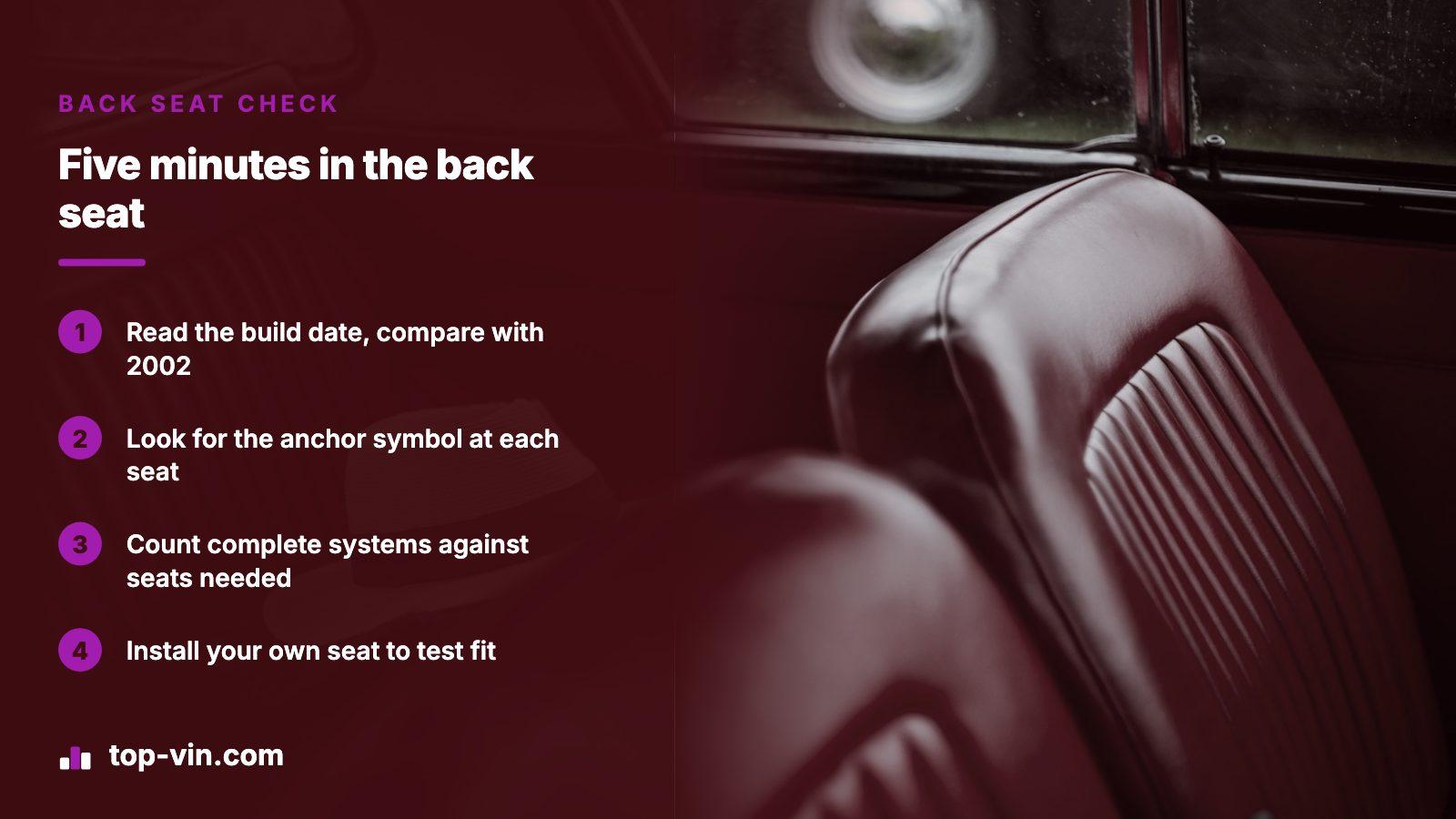
- Read the build date and compare it with the September 2002 line.
- At each rear position, look for the anchor symbol first, then feel for two thin bars in the seat crease and a tether point behind or above the seat back.
- Count complete systems against the seats you need to fill, and confirm one in the second row of a three-row car.
- Install your own seat. Anchor spacing and buckle position decide the fit, and no rule covers that.
From an NHTSA owner complaint
A 2018 Honda CR-V owner spent 12 to 15 attempts across a week trying to find the rear anchors. The manual did not help, a web search was needed, and clipping a seat on still proved impossible. The owner wrote that they had given up.
Find the anchors at the viewing. That is the cheapest moment to learn they are hard to use.
Cost of the check and the step after it
The preview costs nothing, and you can use it to verify the VIN matches the car you are standing next to before spending anything. A report is a single payment that never renews. For a shortlist there are multi-report options of 3, 5 and 10. Current amounts sit on the pricing page.
- Run the preview, then the report, on the VIN copied from the car itself.
- Treat the center rear seat as tether-only until you have seen otherwise.
- Ask whether the rear seats were ever replaced or retrimmed.
- Check that the owner's manual is in the car, since it names the approved seating positions.
Where this information comes from
- 49 CFR 571.225: FMVSS 225, child restraint anchorage systems — Source for the system definition, the two-plus-one minimum, the second-row rule and the compliance dates.
- NHTSA: recalls lookup by VIN — Where open safety campaigns for a specific VIN can be checked at no charge.
- NHTSA vPIC VIN decoder — The federal build record, which has no anchorage field.
- NHTSA owner complaint 10278800 — owner experience, paraphrased
- NHTSA owner complaint 11543220 — owner experience, paraphrased
- NHTSA owner complaint 11051726 — owner experience, paraphrased
Sources and photos: Facts checked against the sources above in November 2026. Photos by Maxim Hopman, Nik and Johnathan Kaufman on Unsplash; diagrams by TopVIN.
Keep reading
- Safety features by VIN: what a check shows and what the build date decidesWhich equipment dates a VIN can and cannot settle, and why build month matters.
- How to read a VIN: a left-to-right walkthrough with a worked decodeWhat each of the 17 characters says, so you can spot a mismatch with the paperwork.
- VIN check with photos: what a report shows and what it can'tHow auction and salvage photos help you judge the rear of a family car.
- Specs by VIN compared: what each lookup returns and what it leaves blankConfirm the factory model year and body before you rely on a listing.
Frequently asked questions
Does a VIN check show car seat LATCH anchors?
No. Neither the federal decoder nor any history provider carries an anchorage field. A VIN check returns factory build, damage and title records and open recalls. Anchors have to be confirmed by looking at the rear seat, and the door frame label tells you which rule applied.
How many LATCH positions must a car provide?
Fewer than many parents expect. In a rear row of three or more forward-facing seats, the minimum comes to two complete systems plus a tether at a third, which leaves the center seat often tether-only. Some models exceed that, but only the specific car can tell you.
Do older cars have LATCH anchors?
It turns on the build date. Full compliance starts September 1, 2002, with a phase-in over the two years before. Bars that fold away are allowed on anything built before March 1, 2005, so they are not a defect.
Should I pull on the anchors to test them at a viewing?
No. The standard's rigidity figures describe a certification test done before the car was sold, not a check you can repeat by hand. For the car's past, use a history report and a mechanic. For fit, test your own seat.
Is NHTSA's recall lookup enough for a family car?
It is a good first step and costs nothing. It lists open campaigns on the VIN, seat-related ones included. It says nothing about damage, branded titles or auction history, which is where a report adds information. If children will ride, run both.
Now check the car itself
The guide explains what to look for. The report shows what this VIN has on record.