THE SHORT ANSWER
A car's event data recorder keeps about 5 seconds of speed, throttle, brake and belt readings before a crash, plus a very fast crash pulse, and all of it stays in a module inside the car. A VIN check cannot read it. Use the VIN check for the records it does hold: reported accidents, damage, salvage photos, title brands and recalls. Commission a physical read only when one specific event is in dispute.
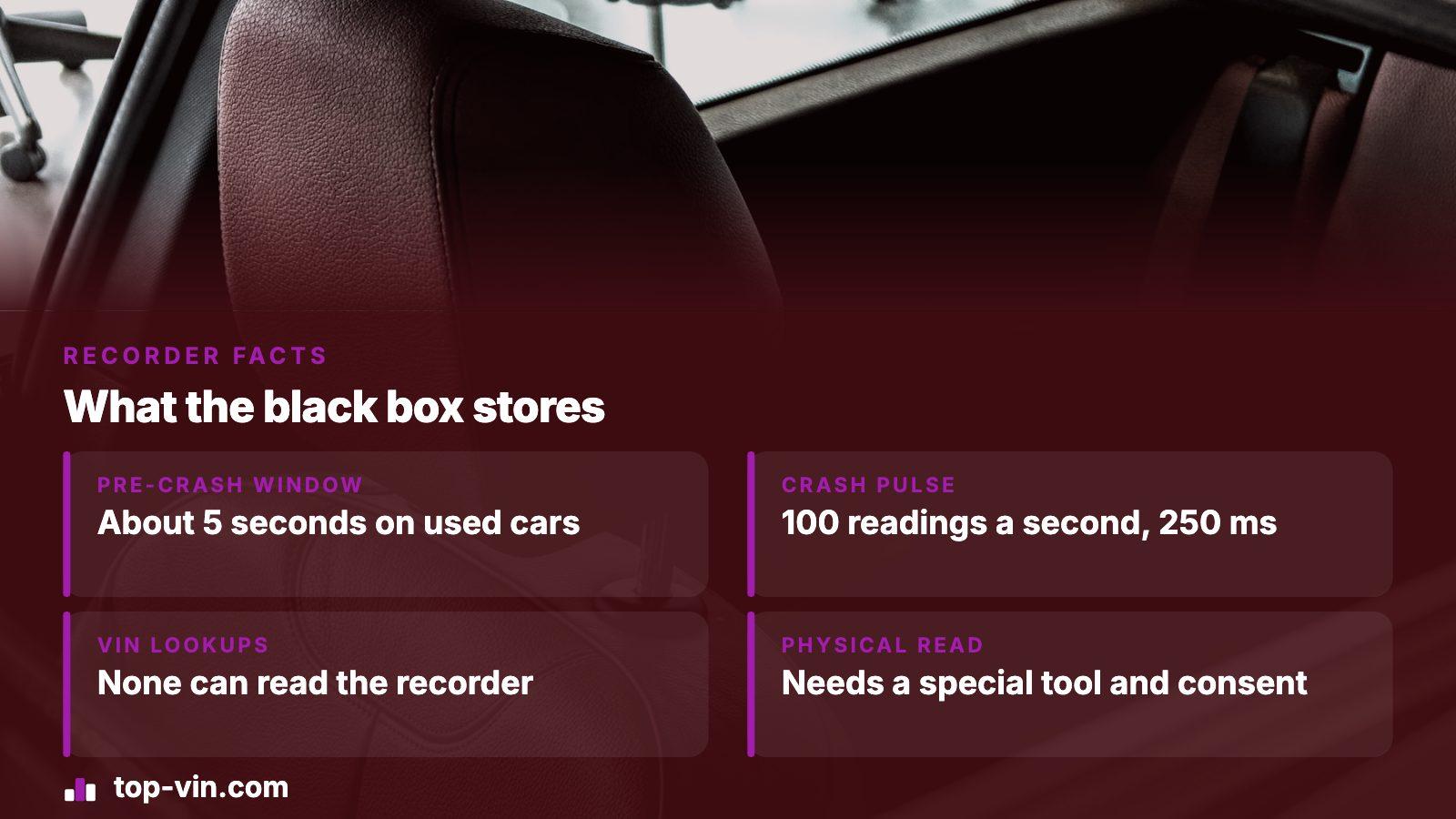
- Pre-crash window
- About 5 seconds on today's used cars
- Crash pulse
- 100 readings a second for 250 ms
- VIN lookups
- None can read the recorder
- TopVIN check
- Free preview, then one payment
What a VIN check shows when the question is the black box
People who search for an event data recorder check are usually buyers who suspect the car was hit. The suspicion is fair, but the recorder is the wrong place to start. Its contents sit in a module inside the car, and no database links them to the VIN. A TopVIN preview works from records instead. It tells you whether crash, damage, salvage or title entries exist for those 17 characters, and the paid report prints the detail.
That trail settles the part of the question a lookup can settle. Insurance and auction entries show that an impact happened, the damage and photo sections show where, and the recall section shows whether a restraint campaign is still open. What the trail cannot tell you is how fast the car was going or whether the driver braked. Only the recorder holds that.
Which check answers which question
Picking the best VIN check for this errand means matching the tool to the question. For a car that may have crashed, the options line up as follows.
| Question about the crash | What answers it | What to expect |
|---|---|---|
| Did this car have a reported accident or total loss? | A VIN history report, after the free preview | Records and photos, not recorder data |
| Is a restraint recall still open? | NHTSA's recall lookup, or the recall section of the report | Open campaigns only, matched by VIN |
| Does this car carry a recorder at all? | The statement in the owner's manual | The regulation dictates its wording |
| How fast, how hard, was the brake on? | A trained examiner with a read tool | Needs physical access to the car |
| Was the airbag module ever swapped? | Repair history, then a hands-on inspection | A new module starts with a blank record |
What the recorder stores, and the five-second catch
Federal rule 49 CFR Part 563 sets the minimum a recorder must capture. For the impact itself that is the change in velocity, sampled 100 times a second across the first 250 milliseconds. Before the impact it is vehicle speed, throttle or accelerator position and whether the service brake was on, plus the driver's belt status, the state of the airbag warning lamp and the timing of any airbag deployment.
The pre-crash window is where people get misled. The headline entry in the rule's table reads 20 seconds at 10 readings a second, but a footnote turns that into a phase-in. Cars built before September 1, 2031 only need 5 seconds at 2 readings a second, and the longer version starts with 25 percent of a maker's output from September 1, 2028. A used car on a lot today therefore holds roughly ten data points of pre-crash driving.
How to run the check on a specific car
The VIN half of this errand takes a few minutes. Do it before you spend time on anything physical.
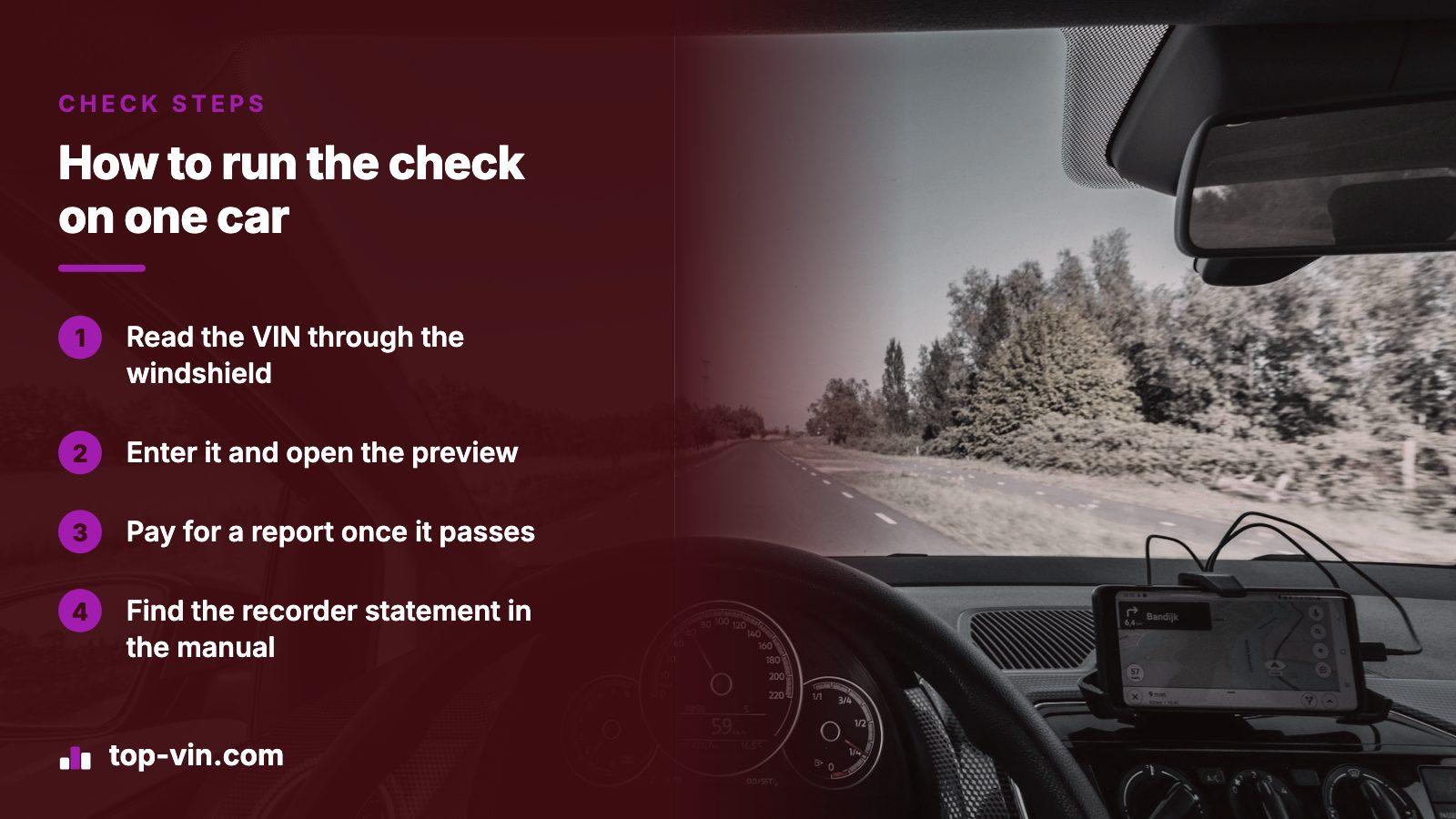
- Read the 17 characters from the plate you can see through the lower driver-side windshield, then check them against the label on the door pillar. If a character differs, stop and ask why.
- Enter the VIN on TopVIN and open the free preview, which confirms the code decodes to the car in the listing.
- Pay for a report once the car has survived the preview. It adds the damage, salvage, title, odometer, insurance and recall detail.
- Find the recorder statement in the owner's manual. If the text is there, the car carries a recorder. A missing manual costs you the quickest check.
Reading the crash trail for red flags
Once the report is open, look for entries that disagree with each other or with the seller.
- A damage or accident entry that the seller never mentioned and that has no repair story behind it.
- Salvage or auction photos showing torn airbag covers, a sagging roofline or a bent frame.
- A title brand that appears soon after a crash entry.
- Two accident records close together, which hints at a multi-impact event, the case the recorder's event-count field was built for.
- An open restraint recall, since it concerns the same hardware a deployment question turns on.
- An odometer reading that stalls or drops around the date of a damage entry.
One entry rarely settles anything. Several that agree usually do.
What the recorder does not keep, and who can read it
The manual statement answers the privacy worry in the regulator's own words. A recorder stays idle in normal driving and commits a record only in a non-trivial crash. It holds no name, gender, age or crash location. The same note admits the limit: police or other parties can pair the recorded data with identifying details gathered at the scene.
Access is a matter of equipment. Part 563 obliges makers to put read tools on the commercial market, so independent examiners and crash reconstructionists can get a read, not only the manufacturer. It still takes the tool, a person who knows how to use it and physical access to the car.
When a physical read is worth paying for
For a routine used-car purchase a read is overkill, because the ordinary accident, title and damage records answer the question at lower cost. A read earns its fee when one event is contested, such as a seller calling a repaired deployment a parking bump while the records say otherwise. Two fields in the output matter most: how many events the recorder logged and the gap between the first two, and whether the file finished writing. A file marked incomplete is partial, for instance when power is lost mid-crash.
From an NHTSA owner complaint
After a crash that included a rollover, a 2018 Genesis G80 owner filed a complaint with NHTSA. By the owner's reading, the recorder report, obtained through the insurance process, showed airbag staging that did not add up, a belt tensioner that activated although the belt registered as unlatched, and "missing crash-event data." No warning lamp had come on beforehand, and the owner says the maker never examined the restraint unit.
The lesson for a buyer: a recorder printout reached this owner through an insurer, never through a VIN lookup, and one person's reading of an odd file is a claim until an expert confirms it.
Cost of the check and the steps after the preview
Previewing costs nothing. Pay once for a single report, or buy 3, 5 or 10 together; nothing renews. The pricing page lists current amounts. NHTSA's recall lookup also costs nothing, so run it next to the report. Whatever you pay buys records for one VIN, never a read of the car's recorder.
Order of operations
Manual statement, then VIN preview, then the paid report if the car still fits, then a hands-on inspection. Ask for a recorder read last, and only for one event the records cannot explain.
Where this information comes from
- 49 CFR Part 563: Event data recorders — The federal rule behind the data list, the pre-crash phase-in and the tool-availability requirement.
- 49 CFR 563.11: Information in owner's manual — The statement every covered manual must carry, including the note on personal data.
- NHTSA: Recalls lookup — Open safety campaigns by VIN, including restraint-system recalls.
- NHTSA: vPIC VIN decoder — The federal build record for a VIN, which holds no recorder data.
- NHTSA owner complaint 11717210 — owner experience, paraphrased
Sources and photos: Facts checked against the sources above in November 2026. Photos by Maxim Tolchinskiy, Sander Jeurissen and Obi on Unsplash; diagrams by TopVIN.
Keep reading
- VIN inspection: what the inspector checks and what a VIN check addsThe hands-on check that belongs beside the records, and where a recorder read would be arranged.
- VIN check with photos: what a report shows and what it can'tSalvage and auction photos are the closest a record gets to showing crash damage.
- Totaled but still drivable: what the title and a VIN check will showWhat a write-off means when a crashed car still runs.
- Safety features by VIN: what a check shows and what the build date decidesWhich restraint equipment a VIN decodes to, useful beside a deployment question.
Frequently asked questions
Can a VIN check read a car's event data recorder?
No. The recorder's data stays in a module inside the car and is not sent to any database tied to the VIN. A VIN check reads records: accidents, damage, salvage photos, title brands, odometer and recalls. For recorder contents, someone has to connect a read tool to the vehicle itself.
How many seconds does a car's black box record before a crash?
On cars built before September 1, 2031, the federal minimum is 5 seconds at 2 readings a second. The 20-second version at 10 readings a second phases in over later model years, so it describes few cars on used lots. The manual statement calls the total period typically 30 seconds or less.
Does an event data recorder track where I drive?
No. The note the regulation puts in every owner's manual says nothing gets recorded in ordinary driving, and that name, gender, age and crash location are never part of the file. The catch is that investigators can match recorder data with identifying details collected at a crash scene, tying a record to a person afterward.
How do I know whether a used car has an event data recorder?
Look in the owner's manual for the regulation's statement that the vehicle is equipped with one. Part 563 governs vehicles that have a recorder and does not require every car to carry one, so a model-year cutoff is only an estimate. In practice, nearly all recent passenger cars and light trucks sold here have one.
What if the seller says the car only had a minor bump?
Compare the story with the records first. Open the VIN preview, read the accident, damage and salvage entries, and study any photos. If a record contradicts the seller and the car is worth the trouble, have an inspector look at the airbag module and ask whether it was replaced. A recorder read comes last.
Now check the car itself
The guide explains what to look for. The report shows what this VIN has on record.