THE SHORT ANSWER
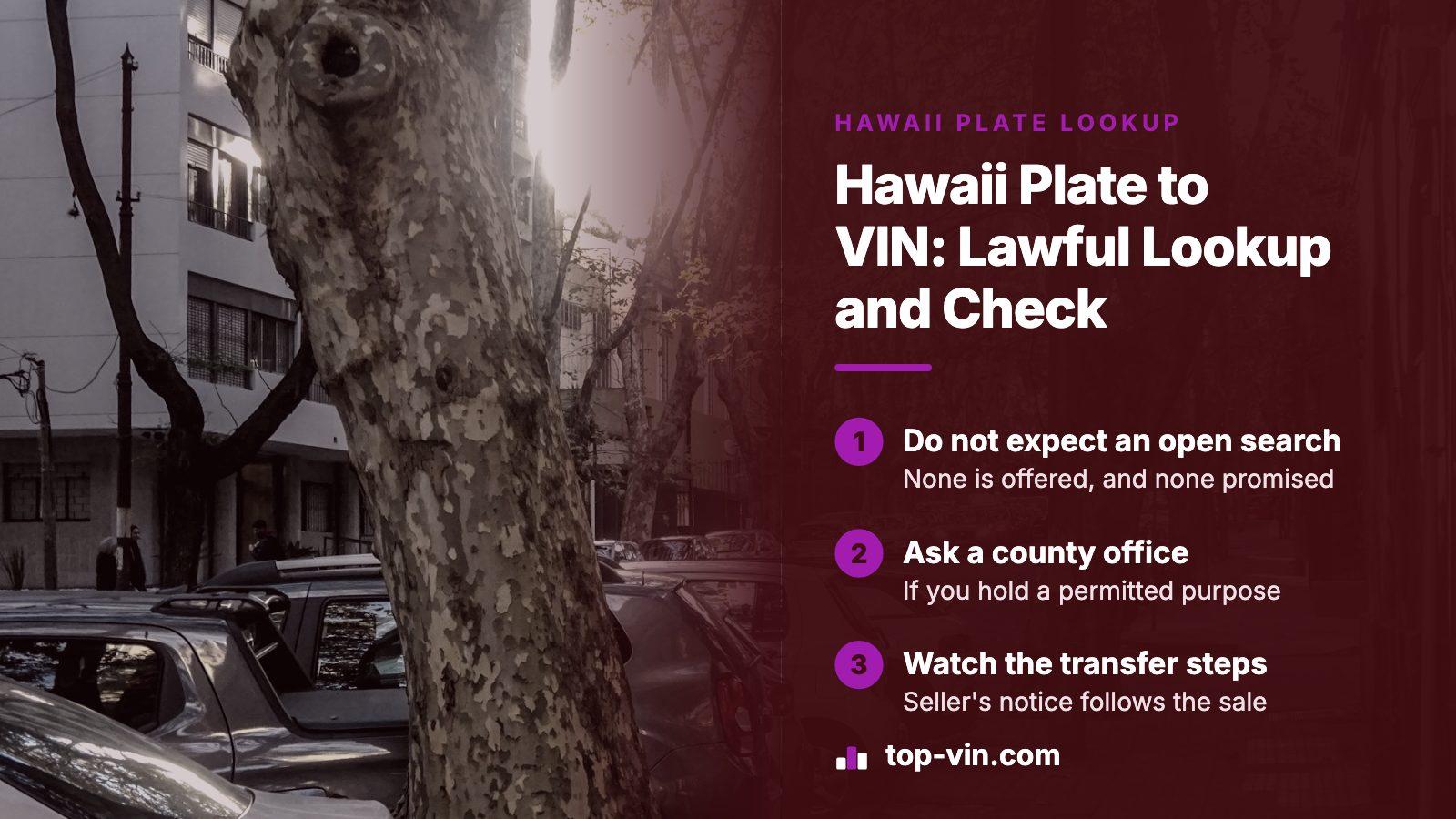
Hawaii does not offer an open plate-to-VIN search, and we do not promise one. Get the VIN from the seller, from the vehicle itself, or from the title, the registration slip or the insurance card. Motor vehicle records are released only to requesters whose purpose federal law recognizes. With the 17 characters in hand, start a TopVIN check. The preview costs nothing; the complete report is a single separate payment.
- Public plate-to-VIN tool
- None offered
- Governing federal law
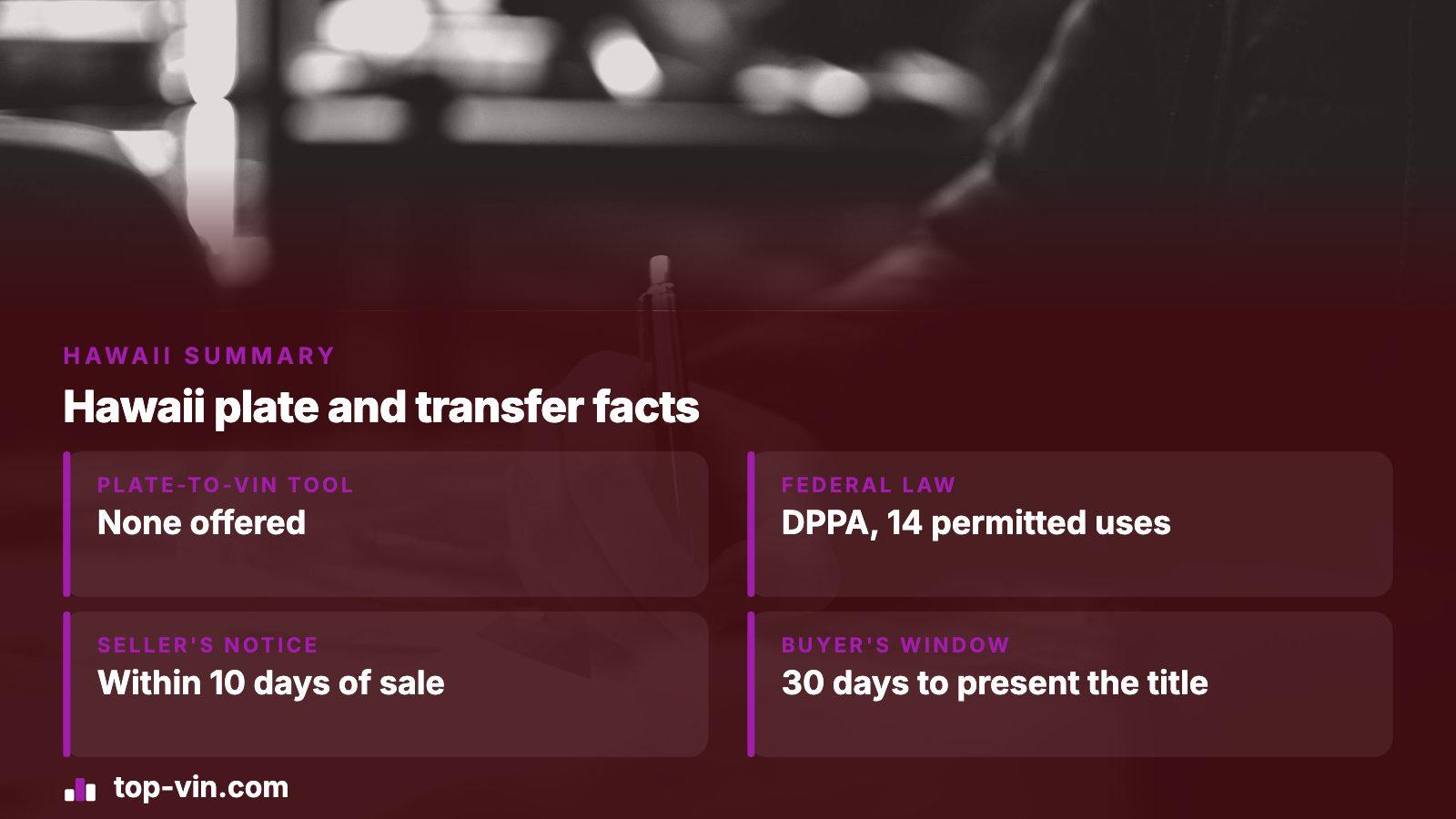
- Driver's Privacy Protection Act, 14 permitted uses
- Seller's notice after a sale
- Within 10 days
- TopVIN check
- Free preview, then one payment
What a Hawaii plate search can and cannot give you
Plenty of websites invite you to type in a Hawaii tag and promise a vehicle report. Doubt any that claim more than a basic make and model. The data behind a plate is a motor vehicle record, and state offices are barred from handing personal information from those records to anyone who asks.
TopVIN works the other way round. A plate follows a registration and may shift between cars, but the VIN is fixed to one vehicle for life. So the sensible order is to collect the VIN honestly, then check the car it identifies. We do not offer plate lookups, owner names or addresses, and a buyer does not need any of them to judge a car.
Five plain ways to get the VIN
For most Hawaii buyers the first or second item settles it. Work further down only if you must.
- Message the seller and request a photo of the dashboard plate plus the face of the title.
- Go and look at the car, write the number down yourself, and cross-check it against another location on the body.
- Read the title, where the VIN sits next to the make and year.
- Check the registration certificate that the owner keeps in the car.
- Open the insurance card or policy page, which normally names the VIN of each insured vehicle.
A seller who stalls on an easy request is telling you something. Two different numbers on one car is worse, and a reason to stop until someone explains it.

What the federal privacy law lets a requester do
The Driver's Privacy Protection Act, found in section 2721 of Title 18, limits what a state motor vehicle office may release. Its default is silence about the people in a record. Section 2721(b) then lists 14 permitted uses, and a request has to fit one.
| Permitted use | Who typically relies on it |
|---|---|
| Government and court functions | Agencies, police, judges |
| Claims, antifraud work, underwriting | Insurers |
| Owner notices for towed or impounded cars | Tow operators |
| Service of process and other legal proceedings | Attorneys, process servers |
| Written consent of the person in the record | Any requester who holds it |
Sizing up a stranger's car for sale is nowhere on that list. The statute also allows a state to charge an administrative fee when it issues a record, so expect one if you qualify.
Asking a Hawaii county office for records
Hawaii has no single statewide DMV counter. Each county runs its own motor vehicle office, and Honolulu's Division of Motor Vehicles covers Oahu. If your purpose really is a permitted one, say an insurer's claim or a lawsuit, you write to the office of the county that registered the car, and its staff judge whether your reason fits.
We did not find a records-request form for plate owners on the Honolulu pages we read, and several other county sites would not open for us. So we cannot give you a form name or a fee. Contact the county office directly and take any form number from its own site on the day you apply. Do not pay a plate-search site to file for you unless it states the permitted use it is acting under. For an ordinary purchase, skip this route altogether.
What the Hawaii paperwork tells you before the report does
Honolulu requires three documents for a car on Oahu: registration, title and a state safety inspection certificate. In a private sale the seller should be able to produce all three, and each gives you something to compare with the VIN.
- The title is held by the owner, or by a lender until a loan is paid off. Ask who has it.
- The registration shows the car is current on its taxes and fees.
- The safety certificate has to be current when ownership moves, since the county looks for an expired one in its records.
- The odometer figure on the title can be compared with the dash reading and, later, with the history report.
A lien changes the sale
If a bank still holds the title, the seller cannot simply sign it over. Ask for the lienholder's release or a lien satisfaction letter before any money moves.
Running the VIN check on a Hawaii car
Enter the VIN at TopVIN and a no-cost preview hints at the record types on file for that car. The purchased report then fills in what a Hawaii shopper cares about: brands on the title from any state, collision entries, how the odometer has moved, salvage or auction sales, open recalls and theft flags.
Federal title data is built to flag fraud and unsafe cars. The government's NMVTIS guidance says it tracks brands such as junk, salvage and flood that any state has applied, along with odometer, total loss and salvage history. That matters in Hawaii because many cars arrive by ship, so a mainland brand can sit in the chain before the car ever got island plates.
Before paying anything, set the number from the vehicle beside the number on the title. When they differ, stop, whatever the report says.
Buying the car: the transfer steps
Honolulu suggests that buyer and seller visit a satellite city hall together, so a document problem is caught while both are present. Together or apart, the order of steps is the same.
- The seller records the odometer on the title, signs it, and has any lienholder complete its section.
- The seller files the Notice of Transfer with the county within 10 days. Skipping it can cost the seller a fine of up to $100.
- The buyer books an appointment and presents the signed-over title, the most recent registration and an up-to-date safety certificate at a satellite city hall within 30 days.
- The title transfer fee is $10 inside that window, and a $50 penalty is added after it.
A car shipped in from another state needs its old title and shipping papers showing the arrival date. Fees and forms change, so confirm them with the county before you go.
What the TopVIN report costs and what to do next
You see the preview without paying. Beyond that, the report is a one-off purchase, and a multi-report pack exists for shoppers sizing up a handful of cars. No plan keeps billing you. Amounts live on the pricing page rather than here.
A workable plan for a Hawaii shopper: get the VIN from the seller, confirm it on the car, run the preview, then hold the title and safety papers up against what the report shows. If any item clashes, make the seller account for it in writing first.
Where this information comes from
- City and County of Honolulu: Buying and selling a car — documents, deadlines and fees for an ownership transfer on Oahu
- City and County of Honolulu: Motor vehicle registration — two plates, shipping papers that carry the VIN
- City and County of Honolulu: License plates — county runs the plate program for the state
- 18 U.S.C. 2721: Driver's Privacy Protection Act — the ban on releasing record data and the permitted uses
- NMVTIS: Understanding a vehicle history report — what the federal title system tracks
Sources and photos: Facts checked against the sources above in November 2026. Photos by Nikolai Kolosov, Miles Loewen and Owen Michael Grech on Unsplash; diagrams by TopVIN.
Keep reading
- License plate to VIN: the lawful ways to find a car's VIN from its plateThe national version of this question, with the same lawful routes.
- California license plate to VIN: lawful ways to get it, then check the carAnother state where plates and registration records work differently.
- How to read a VIN: a left-to-right walkthrough with a worked decodeDecode the characters once you have them in front of you.
- VIN verification: the four checks people mean and what each provesTest whether the stamped number lines up with the documents.
Frequently asked questions
Can I find a VIN from a Hawaii license plate?
Not through any public tool. County offices release record data only for the uses federal law lists, and a casual used-car search does not count. Ask the seller, inspect the car, or look at the title, registration slip or insurance card. Then run the VIN, which is what history records attach to.
Does a Hawaii county office give out plate owner information?
Only to a requester with a permitted purpose under federal law, such as an insurer handling a claim or a party in a court case. We did not find a public request form on the Honolulu pages we read, so ask the county office that registered the car how it handles requests.
Why is a plate not a good way to identify a car?
A plate is tied to a registration, and a registration can change hands, lapse or move. A photo of a tag in a listing may even be from an earlier vehicle. The VIN stays with the car. Read it on the vehicle and compare it with the title.
What should a Hawaii seller give the buyer?
Honolulu lists a signed-over title, the latest registration and a current safety inspection certificate. The seller also files a Notice of Transfer within 10 days. If any item is missing, ask why before paying, and do not accept a promise to send it later.
Is the TopVIN check free?
Looking at the preview costs nothing. After that, the detailed report is bought once and never rebills. Open the pricing page to see what is on offer today.
Now check the car itself
The guide explains what to look for. The report shows what this VIN has on record.