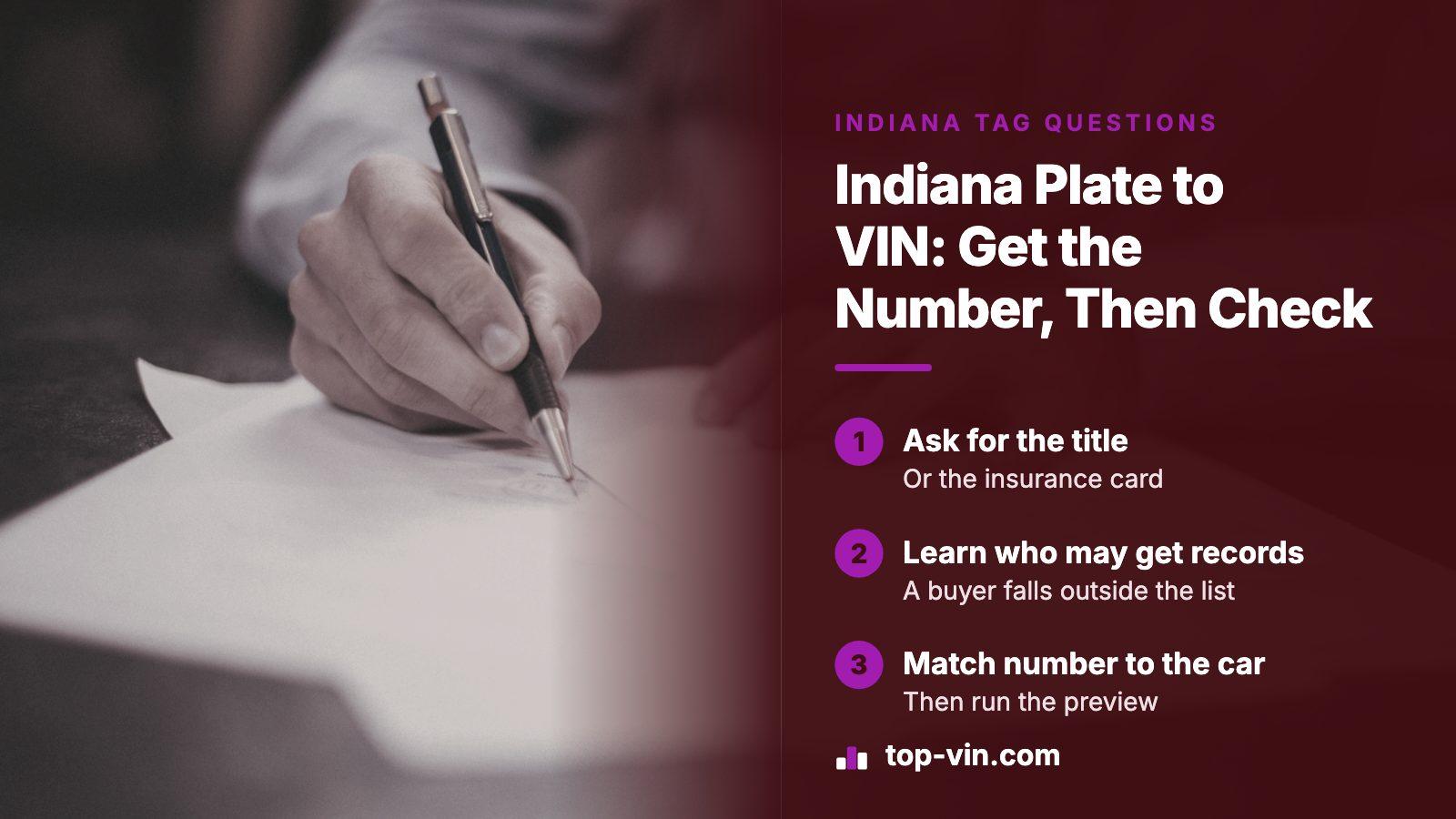
THE SHORT ANSWER
For an ordinary buyer, the dependable way to get a VIN from an Indiana plate is to ask the seller, read the title or insurance card, or look at the car. Federal law lets state agencies hand out owner details only for a short list of uses, and a buyer sizing up a car falls outside it. Run the VIN through a TopVIN preview next.
- Fastest source
- Seller's title or insurance card
- Federal limit
- Driver's Privacy Protection Act
- Buying a car
- Not a listed permitted use
- TopVIN step
- Free preview, then one payment
What an Indiana plate gets you, and what it does not
A plate is a registration tag. It points to a record inside the state's motor vehicle system, and that record links the tag to a vehicle number and to a person. Searches for a plate-to-VIN tool come from buyers who spotted a car at a curb or in a classified photo and want its history before they call. The trouble is that the same lookup, offered to anyone, would also serve someone following a driver home.
We tried to read the Indiana Bureau of Motor Vehicles pages for this guide and could not open them from our end, so we are not going to describe BMV forms, fees or turnaround times. What we can describe is the federal rule every state agency works under, plus the practical routes that need no state request at all. For anything specific to Indiana's own record service, read the BMV's current pages yourself before you rely on it.
The federal privacy law behind every refusal
Section 2721 of Title 18, known as the Driver's Privacy Protection Act, forbids any state motor vehicle office, including staff and outside contractors, from knowingly giving out personal data held in its vehicle files, unless the purpose appears in the statute. Indiana sits under that rule like every other state.
The list is specific. The permitted purposes include court cases, police work, recall and theft matters, emissions programs, insurers working a claim, towing and impound notices, licensed investigators, employers checking commercial driver licenses, and a business confirming details a customer supplied. A request backed by the written or express consent of the person concerned also qualifies. Inspecting a used car before buying it does not appear anywhere on it.
What that means for you
A plate search site that promises the owner's name for a flat fee is not working from a special arrangement with the BMV. If a legitimate need such as a collision claim or a legal case applies, go through the insurer, the police or a lawyer, who can make a proper records request.
Where the VIN is already written down
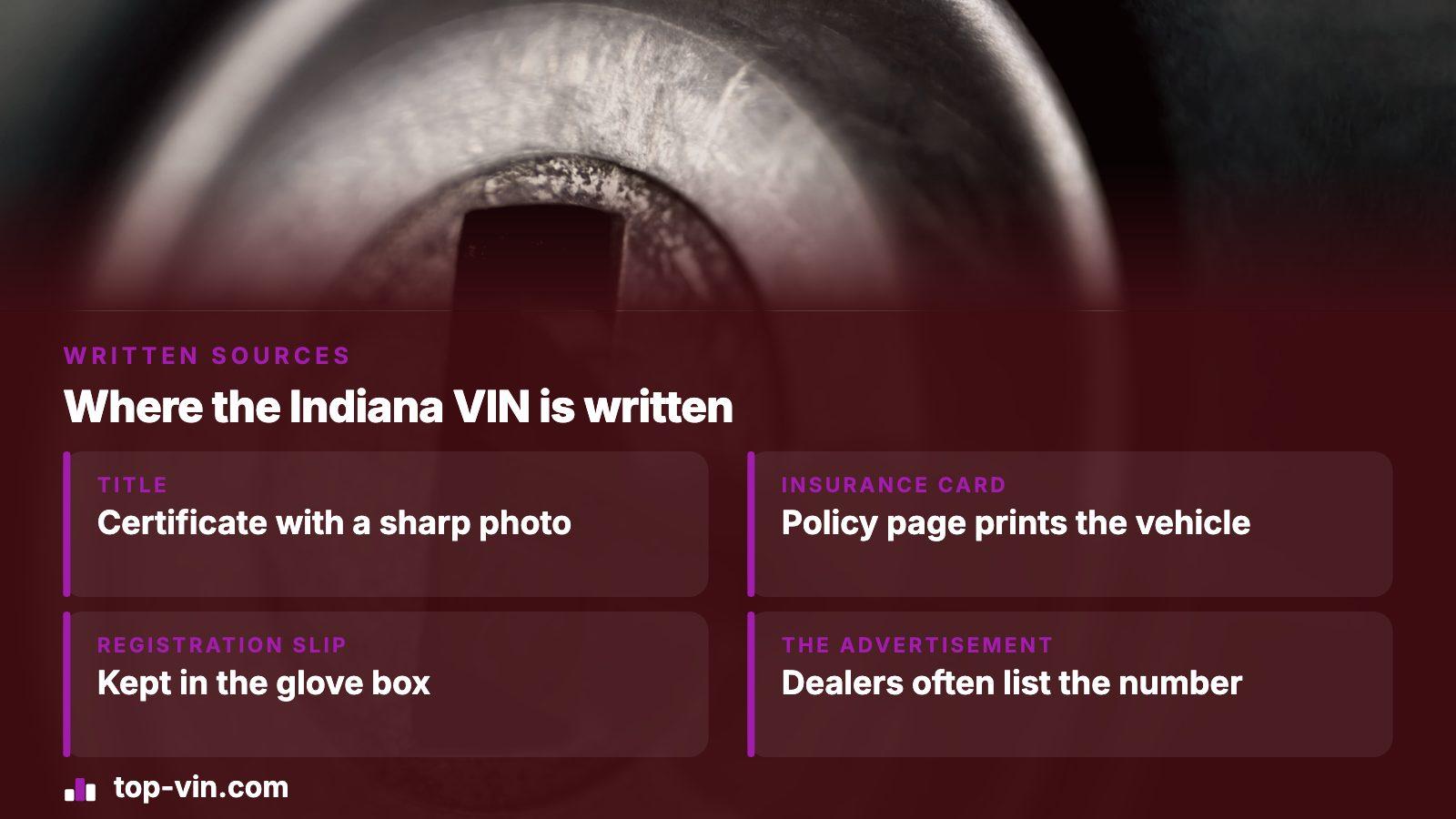
Most buyers have a faster path than any records request. Pick whichever of these is within reach, and try to confirm the number in two places.
- The certificate of title. Have the seller text you a sharp picture of the front before you drive anywhere. The vehicle number and the seller's name are both printed there.
- The insurance card or policy page. Insurers print the vehicle number beside the car's description, and a seller can photograph it in seconds.
- The registration slip kept in the glove box, which lists the plate and the vehicle number side by side.
- The car itself. On the vehicle, read the tag seen through the glass at the dash's driver side, then the sticker where the door latches.
- The advertisement. Dealers often list the number, and a private seller who is serious will send it when asked.
A seller who dodges the question before you have laid eyes on the car is giving you information too. Treat reluctance as a data point, not an inconvenience.
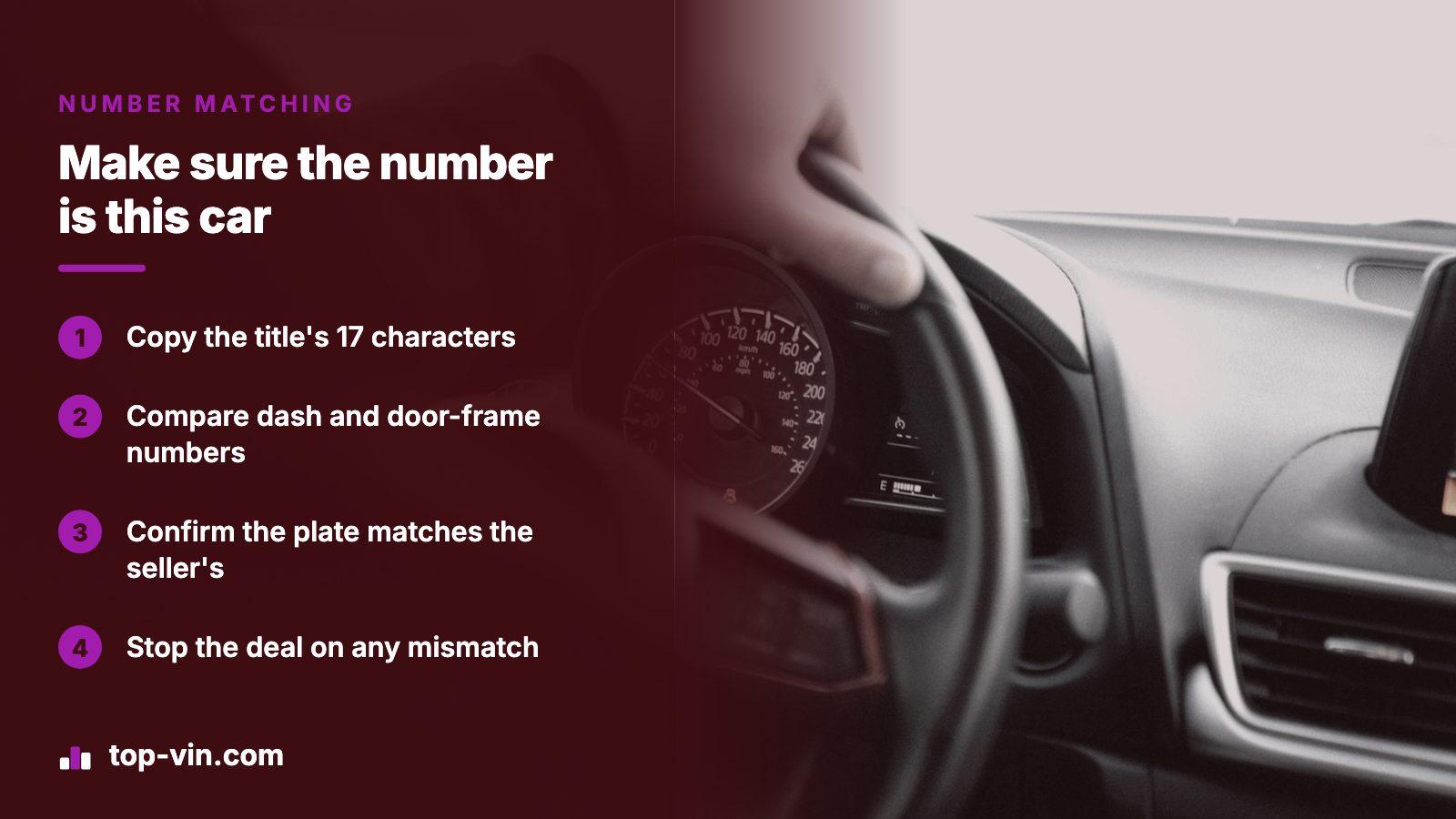
Make sure the number you were given is the car in front of you
Typing a VIN into a check only helps if it belongs to the vehicle you are about to buy. A VIN texted by a seller can be copied from a clean car and pasted onto a listing for a damaged one. So read the dash plate and the door label yourself, then compare both to the title.
- Copy the title's 17 characters onto paper.
- Read the dash and door-frame numbers on the car and compare them character by character.
- Confirm the plate on the car matches the plate the seller names on the registration.
- Stop the deal if any one of those fails to match.
The seller's name on the title should also match the ID of the person handing you the keys. If a different name appears, ask for the paperwork that explains why before anything changes hands.
Running the VIN check in TopVIN
Enter the 17 characters into TopVIN and read the preview. It is free to view, and it tells you whether the record has material worth buying. The full report is a one-time purchase per car, and nothing renews. Packs and prices are listed on the pricing page.
Begin with the entries that can end a deal: brands on the title, crash and damage notes, mileage history, theft or lien flags and unrepaired recalls. A clean-looking listing with a salvage or flood brand in the record is the classic reason shoppers walk away, and the record is where that surfaces.
Title records come from a federal system
The Justice Department presents NMVTIS as a nationwide title database meant to shield shoppers from fraud and dangerous cars. Shoppers get at it through approved providers, and the department's list marks several that serve dealers or commercial accounts only.
Reading what comes back
| What you see | What to do |
|---|---|
| A brand such as salvage or flood | Ask for repair paperwork and an independent inspection, or move on. |
| Odometer reading lower than an earlier one | Treat it as a rollback until the seller documents otherwise. |
| A lien still listed | Do not pay until the lender has released it in writing. |
| An open recall | Ask the seller whether the repair was done, then contact a dealer for that make. |
| A theft entry | Walk away and consider telling the police. |
No report replaces looking at the car. A record shows what was reported to someone, so unreported damage never appears. Add a test drive, and where possible a mechanic you hire yourself.
If the seller will not share a VIN
Sometimes a car has changed hands twice, the seller has gone quiet, or you only saw it parked. In that case the state is rarely your answer, since the permitted uses above do not include curiosity or shopping. If an accident, a hit-and-run or a parked car blocking your property is involved, the police can make the request for you.
For a car that you simply wanted to buy, the cleaner move is to let it go. Another listing for the same model costs you a few minutes and carries far less risk than a purchase built on a number nobody will confirm.
What to do next
Get the VIN from the title or insurance card, confirm it against the car, view the TopVIN preview, then weigh whether the full report earns its cost. If you are dealing with a legitimate legal or insurance matter, route the records request through the insurer, police or attorney involved, and check the BMV's own pages for how Indiana handles it.
Where this information comes from
- 18 U.S.C. 2721, Driver's Privacy Protection Act — The federal prohibition on releasing personal information and the list of permitted uses.
- Justice Department: NMVTIS vehicle history — How the national title information system is described and what it is meant to prevent.
- NMVTIS approved data providers — How consumers reach title data, and which providers serve dealers only.
Sources and photos: Facts checked against the sources above in November 2026. Photos by Scott Graham, Miles Loewen and Derek Nelson on Unsplash; diagrams by TopVIN.
Keep reading
- License plate to VIN: the lawful ways to find a car's VIN from its plateThe same question without a state attached.
- Is the VIN on the insurance card? What to check before you trust itA closer look at one of the quickest sources.
- Where the VIN sits on a title, and what to do nextHow to read the number off the certificate of title.
- License plate lookup privacy laws: what you can and cannot get from a plateWhy plate searches are restricted in the first place.
Frequently asked questions
Can I find a VIN from an Indiana license plate for free?
Not through any public tool we could confirm. The cheapest reliable route is the seller's title photo, the insurance card or the car's own dash and door labels. Those cost nothing and show the number directly, without going through a state records request.
Is it legal to look up the owner of an Indiana plate?
Federal law limits what state agencies release, and the permitted uses are narrow: insurers, courts, police, towing notices and a few others. Curiosity and car shopping are not on that list, so a casual owner lookup is not something the state will do for you.
Does a TopVIN check work with a plate number?
No. The check starts from the VIN, all 17 characters of it. Collect that number first from the seller or the paperwork, then enter it. We do not promise plate searches or owner names, and neither should anyone selling a report.
What if the seller sends a VIN that looks wrong?
Compare it with the dash plate and door label yourself. A mismatch means the paperwork may belong to another car. Ask for a fresh photo of the title, and leave if the answer sounds weak.
Should I check the BMV's own pages too?
Yes. We could not open them while writing this guide, so confirm the current request process, forms and fees there. Whatever you find, the federal permitted-use rules above still decide who can receive personal details.
Now check the car itself
The guide explains what to look for. The report shows what this VIN has on record.