THE SHORT ANSWER
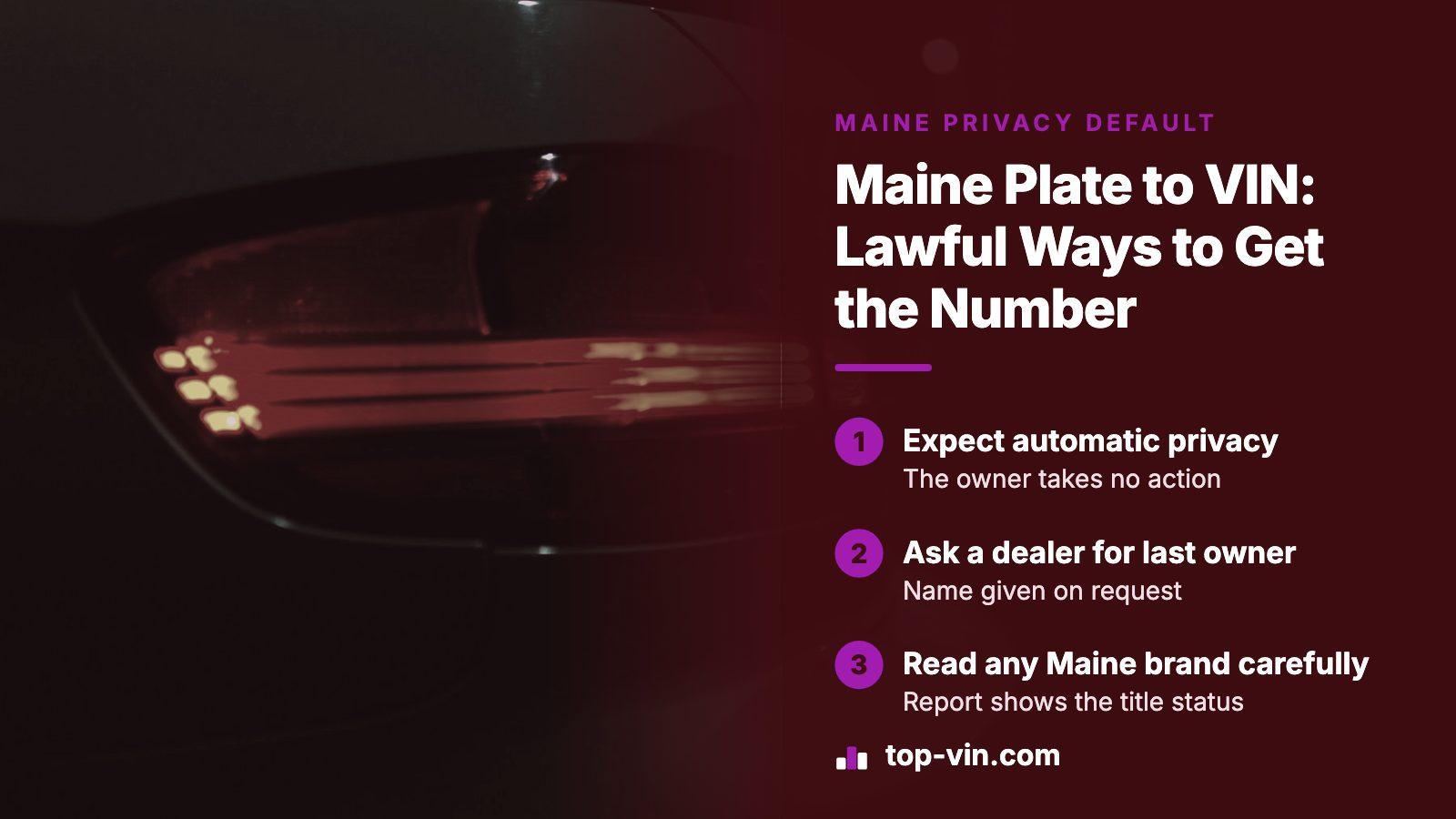
We found no public Maine lookup that swaps a plate for a VIN. The BMV shields personal information on registrations and titles unless a legal purpose applies. Text the seller for the number, find it on the title or an insurance document, or copy it from the vehicle, then start a TopVIN preview.
- Public plate-to-VIN search
- None we could confirm
- Maine privacy default
- Automatic, no action by the owner
- Dealer sales
- Last owner's name on request
- TopVIN
- Free preview, then one payment
A plate opens the owner's file, not the car's history
Maine buyers photograph plates because that is what a car in a driveway shows from the road. The trouble is where a plate leads. It points to a registration record, and that record carries an owner's name and address alongside the vehicle. Everything a shopper actually cares about, like brand status, damage entries, mileage readings and salvage photos, hangs on the vehicle identification number instead.
TopVIN is built around the VIN instead: no plate search, and nothing about who owns the car. Paste in the 17 characters and the preview describes the vehicle.
What the Maine BMV keeps private
The Bureau of Motor Vehicles states on its driver privacy page that personal information from licenses, titles and registrations stays away from marketers and anyone from the public unless the person agrees. Nobody has to opt in for this; the protection applies by default. Under the page's definition, the protected items are a person's name, address, license number, SSN and image.
Some things sit outside that definition. Driving record, accidents, violations and registration status are treated differently, and the BMV says they stay available as Maine's Freedom of Access law allows. None of that gives a stranger a way to start from a plate and finish with a VIN.
Plate sites that promise a Maine owner
A website that claims to turn any Maine plate into a name or a VIN is selling something the state itself does not hand out. TopVIN does not make that promise.
Who the law lets through the door
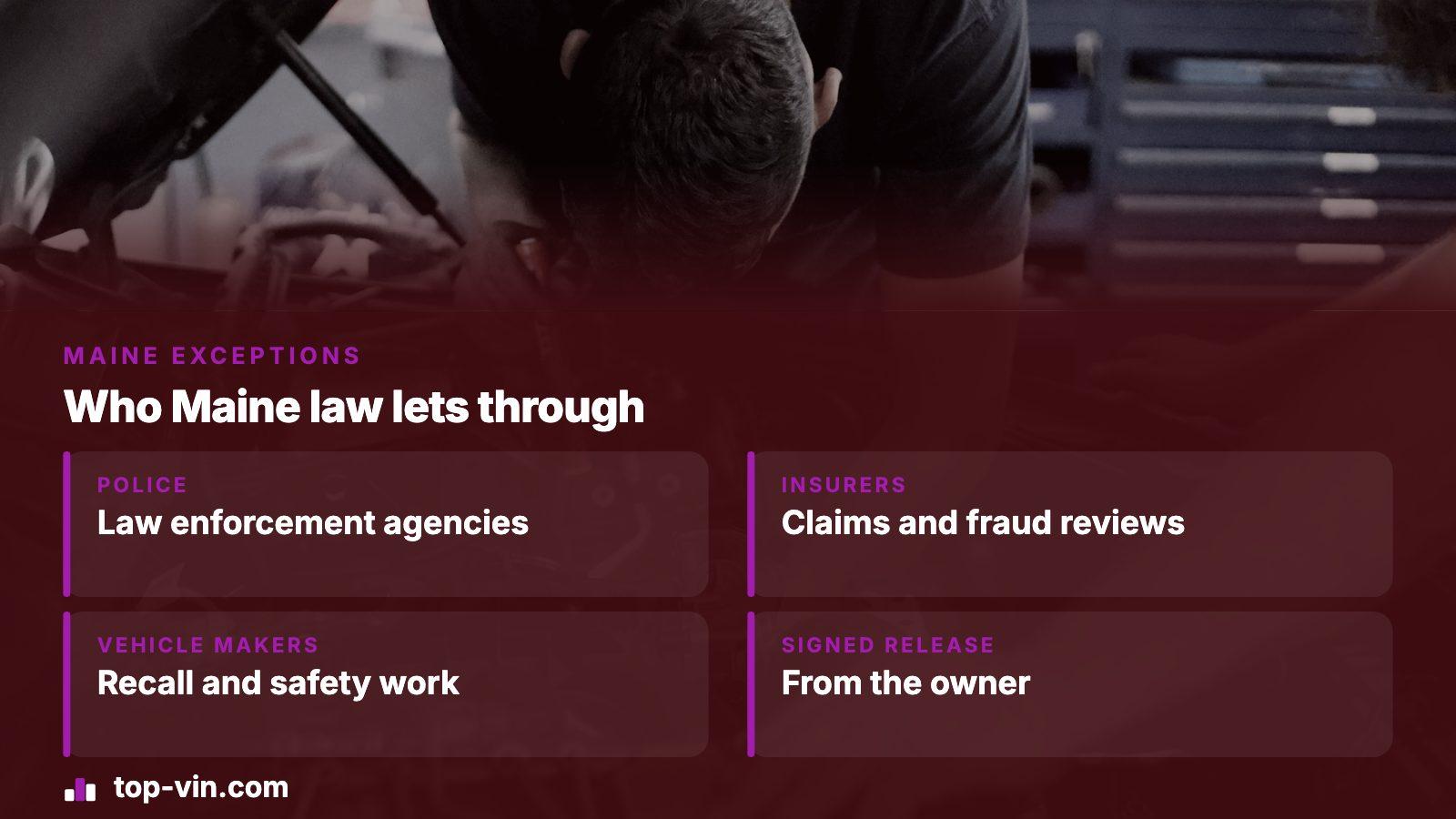
The BMV lists the groups that may receive personal information for safety, theft, recall or court reasons. The federal Driver's Privacy Protection Act sets the national frame, and curiosity about a car you might buy does not qualify you.
- Police and other law enforcement agencies.
- Insurance companies handling claims or fraud reviews.
- Vehicle makers, for recall and safety work.
- Employers and businesses confirming information a person gave them.
- Towing companies that must notify the owner of a towed car.
- Licensed private detective and security agencies.
- Anyone holding the owner's signed release, which the BMV says can stay in effect for 12 months.
Photo, Social Security number and medical data get narrower treatment still, limited to government bodies, courts, insurers, commercial employers and legal proceedings.
Getting the VIN from the seller and the paperwork
In a real purchase, the owner wants to sell you the car and has the number within reach. Try these in order.
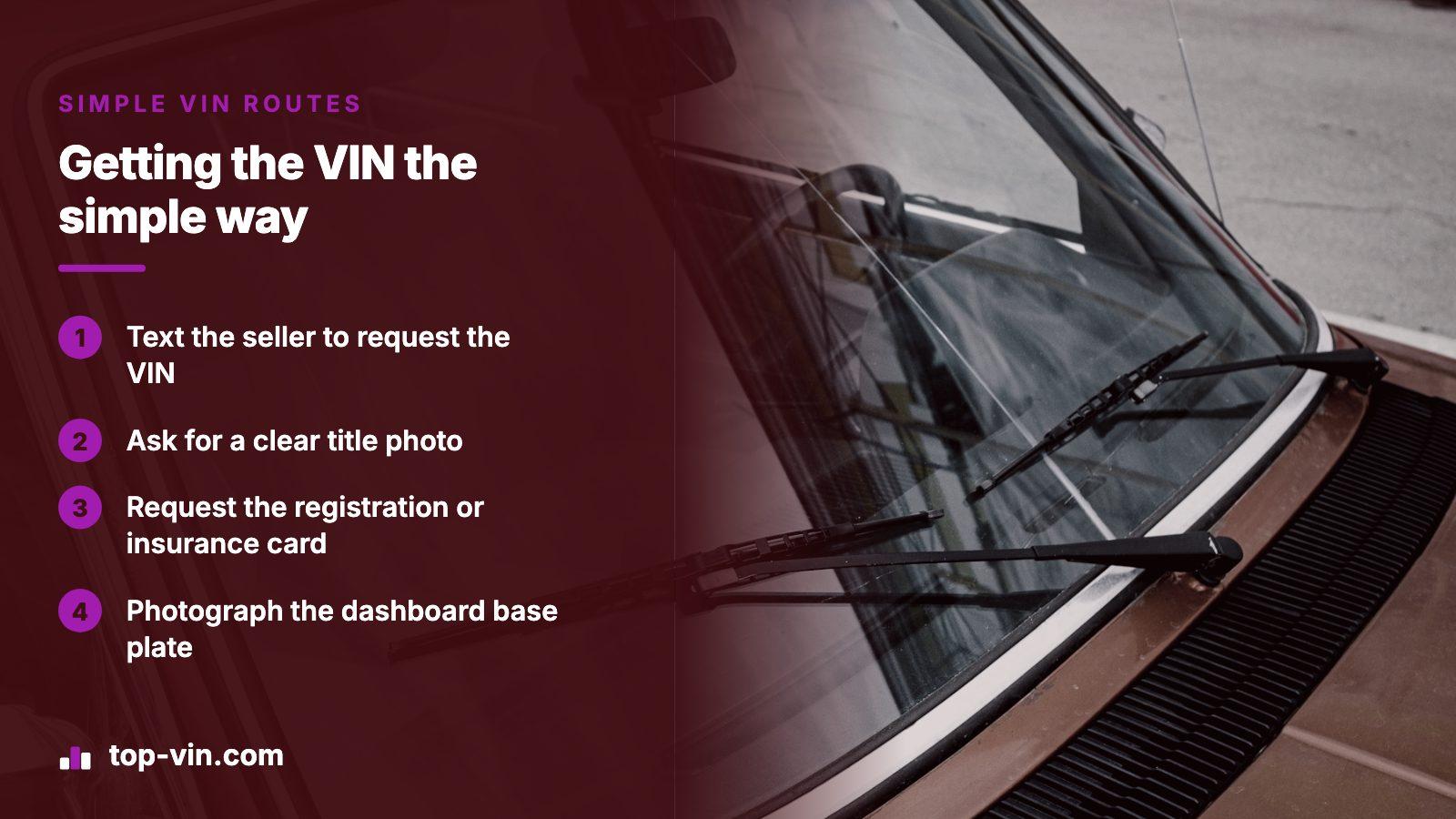
- Text the seller and request the VIN before you make the trip.
- Ask for a clear photo of the front of the title. Maine requires a title for newer vehicles, and the number is printed on it.
- Request the registration slip or the insurance card, both of which name the vehicle.
- At the car, photograph the plate on the dashboard base, then the label on the driver-side door frame, and compare both with the title.
When the numbers disagree
A single swapped digit can be a typo. A mismatch between the car and its papers can also mean a replaced part or an altered document. Resolve it before money changes hands.
Buying from a Maine dealer changes the rules
The BMV's used car buyer's guide covers purchases from licensed dealers, not private sales, and it gives the shopper real bargaining power. A dealer must post a window guide showing the car's earlier use, where the dealer got it (an auction in another state counts), any repossession, big mechanical repairs, and past fire, flood or collision damage above $2,000.
On request, the dealer must also give you the name and address of the last owner. The BMV says this does not violate privacy law. That is the lawful route to a previous owner in Maine, and it applies only at a dealership. A mechanic of your choosing may also inspect it, at your cost.
If you do have a permitted purpose
A few readers really do qualify, such as a claims adjuster, someone involved in a lawsuit, or a tow yard that must reach an owner. The Justice Department's NMVTIS list of state record-request methods names InforME in Augusta as the Maine contact, reachable by mail, phone or email. A request still has to rest on a purpose the law recognizes.
For questions about a specific title, the BMV's Division of Title Services takes calls and email, and asks you to have the title number, the certificate of title application number or the VIN ready. That is a title help desk, not a plate search, and it will not identify an owner for a curious shopper.
Running the VIN through TopVIN
Type the VIN into the TopVIN box. The preview costs nothing and shows that the number decodes and that records exist. If you want everything the VIN has on file, the report is one purchase. Amounts sit on the pricing page.
On a Maine car, begin with brand history, damage and accident entries, odometer readings, and salvage or auction photos. Check liens and theft flags next. Liens matter because the BMV advises buyers to confirm any lien on the title has been released.
How to read a Maine brand on the report
Maine defines its brands on the BMV title page, which helps when a report shows one. Federal NMVTIS records keep brands from every state a car has lived in, so a car that moved to Maine from elsewhere still shows its past.
| Brand | What the BMV says it means |
|---|---|
| Salvage | Damage from collision, fire, flood or similar pushed salvage value plus repair cost above the car's value before the damage. |
| Rebuilt or reconstructed | A salvage-titled car that has been repaired and put back in operation. |
| Junk | Generally not roadworthy, with repair cost above 75% of pre-damage value. |
A rebuilt car can be a fair purchase if the price reflects the brand and a mechanic has checked the structure. A brand the seller never mentioned is a reason to stop and ask.
A short plan before you pay
- Get the VIN as a typed message, then compare it with the title and what is stamped on the car.
- Preview each candidate and keep the paid report for the finalists.
- Compare the odometer on the report with the dash and the title.
- For a dealer car, ask for the window guide and the last owner's name.
- Have a mechanic inspect any car with a brand or a gap in its history.
None of this needs the plate. A seller who dodges the VIN question has answered anyway.
Where this information comes from
- Maine BMV: Driver Privacy — What counts as personal information, who may receive it and how a written release works.
- Maine BMV: Used Car Buyer's Guide — Window guide contents and the dealer's duty to give the last owner's name.
- Maine BMV: Types of Title Certificates — State definitions of salvage, rebuilt and junk.
- DOJ NMVTIS: State Vehicle Record Request Information — The Maine contact for vehicle record requests.
- Federal statute on motor vehicle record privacy (section 2721) — The federal rule and its list of permitted uses.
Sources and photos: Facts checked against the sources above in November 2026. Photos by Johnathan Kaufman, Max Tokarev and Mustafa Sheikhmouss on Unsplash; diagrams by TopVIN.
Keep reading
- License plate to VIN: the lawful ways to find a car's VIN from its plateThe nationwide version of this question, across all states.
- Where the VIN sits on a title, and what to do nextWhere the number sits on a title and what to compare it with.
- Is the VIN on the insurance card? What to check before you trust itAnother paper that names the vehicle and its VIN.
- Motor vehicle records: what a car buyer can see, and what stays closedHow a state record differs from a vehicle history report.
Frequently asked questions
Can I find a VIN from a Maine license plate number?
No public route we could confirm. The BMV protects personal information on registrations by default, and release needs a legal purpose. Buyers usually pull the number from a seller's message, the title, an insurance document or the dashboard, and feed it to a history report.
Does the Maine BMV give out the owner's name from a plate?
Not to the general public. Names and addresses count as personal information. They go to listed groups such as police, insurers and towing companies, or to someone holding the owner's signed release. A dealer must give a buyer the last owner's name on request.
Is a Maine plate lookup website legitimate?
We could not confirm that any site can lawfully return a Maine owner or VIN from a plate alone, so we make no claim either way. Be wary of a paid promise that the BMV itself does not make. Start from the VIN, which the seller can give you.
What if the owner refuses to share the VIN?
Treat it as a warning. The number is printed on the title and the registration, and anyone selling a car can read it off the dashboard. If a seller stalls, a car with a missing or odd history is the likely reason, so walk away.
What does the TopVIN preview show?
The preview is no-cost and confirms that the VIN decodes and history records exist. The full report is purchased once and does not renew. TopVIN has no plate search and shows no owner contact details.
Now check the car itself
The guide explains what to look for. The report shows what this VIN has on record.