
THE SHORT ANSWER
We found no open Michigan service that turns a plate into a VIN. The Department of State sells vehicle records through an online request, and federal law limits who may receive personal details. As a buyer, copy the VIN off the title, the registration slip or the policy card, compare it with the car itself, and run a TopVIN preview on those 17 characters.
- Open plate-to-VIN tool
- None we could confirm
- State record request
- Online, through Record Sales Services
- Plate after a sale
- Stays with the seller
- TopVIN
- Free preview, then one payment
What a Michigan plate can and cannot give you
A plate is a tag the state hands to a person. Michigan treats it that way too: when someone sells a car, the plate comes off and goes with the seller, who may put it on another vehicle later. So the number on the bumper says little about the metal behind it, and it may sit on a different car next year.
The VIN never moves. Brands, damage entries, odometer history and theft flags are filed against it. That is the reason a serious history check asks for the VIN and has no plate field. TopVIN works the same way, returns no owner name or address, and promises nothing about plate searches.
A claim to be wary of
A website that promises a Michigan plate turned into a VIN plus the owner's details for a small fee is offering something the state restricts. We could not confirm that any of them operates lawfully and we give no verdict. Start from the VIN instead.
How Michigan releases vehicle records
The Justice Department's October 2024 list of state record routes describes Michigan's. A person without an account files an online request on the Department of State site: Online Services, then Record Sales Services, then Request Records. Account holders log in through the same area. The list quotes $11 for each searched record and $12 for a certified one, with Michigan government agencies served free through approved accounts.
The entry adds that releases follow the driver privacy statutes. Bulk data is a different product: extracts of header details that carry no driving, title or registration history. We could not open the state's own record pages (they refused our requests), so check the live screen for current fees and the wording of its purpose declaration before you pay anything.
Where the federal privacy law draws the line
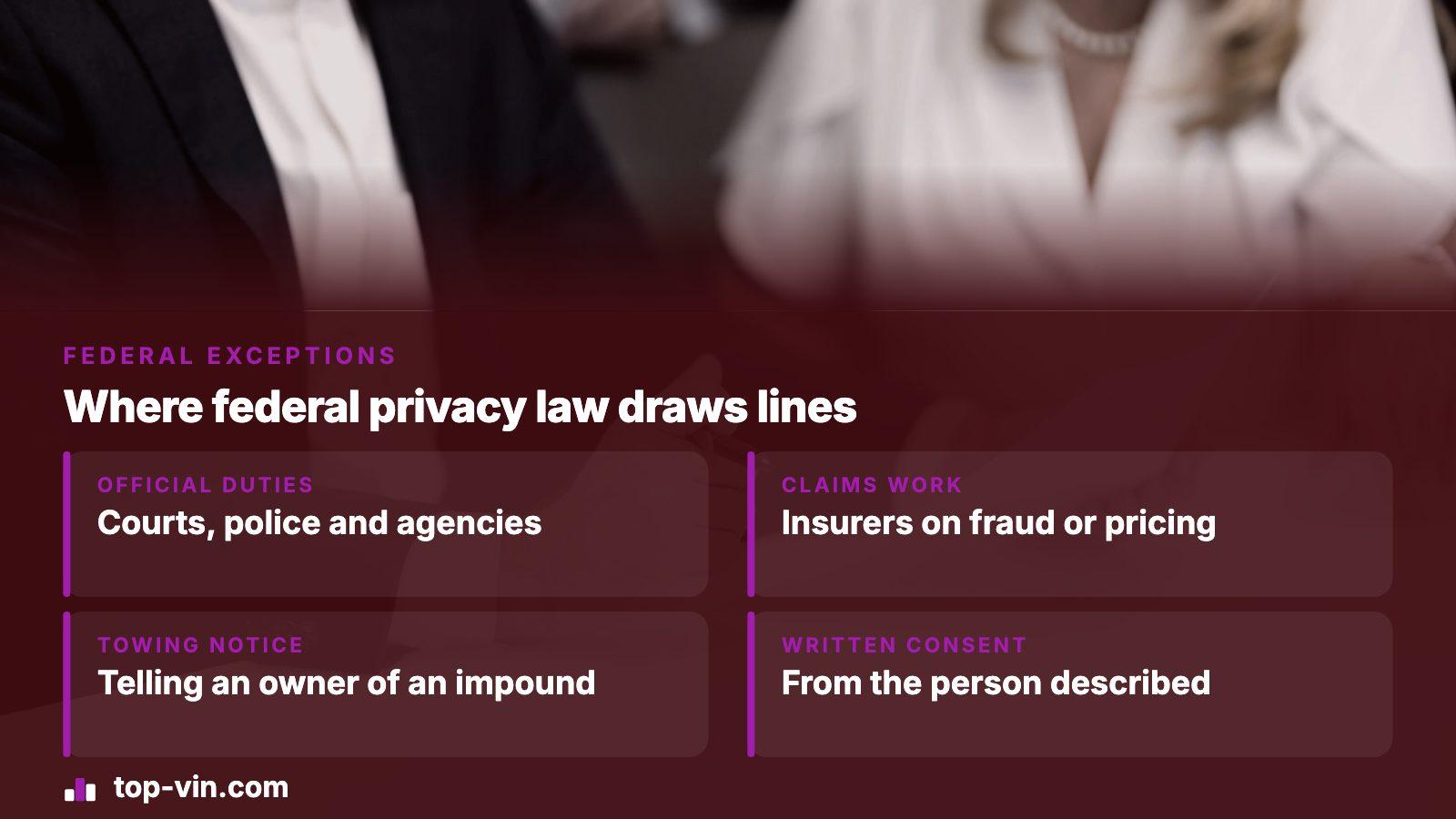
The Driver's Privacy Protection Act, a federal statute, bars a licensing agency from knowingly releasing a person's details held in its files, apart from a short menu of named uses. Interest in a classified ad is not on that menu. The entries a reader is likeliest to meet:
- Courts, police and agencies carrying out official duties.
- Insurers working a claim, a fraud case or a pricing decision.
- Litigants, including anyone delivering court papers.
- Telling an owner that a vehicle was towed or impounded.
- Licensed investigators staying inside one of these uses.
- A requester holding written consent from the person described.
Private used-car shopping does not appear in that list, so do not describe it as a permitted purpose on any form.
Get the VIN from the deal itself
Every seller holds the number in at least three places. Gather them before you drive anywhere.
- Get the seller to text the VIN. Written beats spoken when a B can sound like a D.
- Ask for a picture of the title's face. The registration slip repeats the number.
- Ask to see the policy card, which lists the covered vehicle.
- In person, look for the stamped number on the dash corner nearest the driver, then match the label on the door pillar.
- Compare all copies character by character. They must read the same.
If two copies disagree
One swapped digit might be a typing slip. A car whose dash number differs from the title is a bigger concern: it can mean a replaced part, a paperwork error or a cloned identity. Pause until the seller explains it in writing.

What the TopVIN check looks at on a Michigan car
Reports draw national title data from several kinds of reporters, from titling agencies to scrapyards, so a brand earned in another state follows the car to Michigan. Michigan's own title page points buyers to this kind of national history before a purchase. The entries to read first:
| Entry | What it shows | Your move if it looks off |
|---|---|---|
| Title brand | Whether the car was labeled junk, salvage or flood | Ask for the story and book an inspection of the structure |
| Odometer readings | Whether mileage climbs steadily | Compare with the dash and the title |
| Damage and auction photos | How the car looked after a loss | Match the pictures to the repairs you can see |
| Liens | Whether a lender still has a claim | Do not pay until a release is shown |
| Theft record | Whether a theft report exists | Walk away and tell the police |
When the car arrives with no plate
Because the seller keeps the plate, a Michigan sale often ends with a car that carries none. The state gives a buyer 3 days to drive it home straight to where it will be kept, plateless, with the signed-over title and an insurance document in hand. The seller's plate must not stay on the car for that drive, and the state warns sellers they can be held responsible for tickets earned on their plate.
Run the VIN before that day, not after. Once money has changed hands and the title is signed, a brand or an unpaid lien becomes your problem.
Paperwork to match against the report
At a Secretary of State office the buyer needs the original title signed by both sides, an odometer statement, and proof that any loan was cleared. The state accepts several forms of proof: a termination printed on the title, a lender's dated stamp, or a signed statement or letter naming the VIN.
If the report shows a lien and the seller has none of those papers, you have found the gap before it cost you anything. Ask the lender for the release, not the seller for a promise.
Cost, and your next step
Enter the VIN on the TopVIN home page. The preview costs nothing and shows that the number decodes and that records are on file. Beyond that is one report payment, not a monthly plan, with amounts on the pricing page. Shopping between several cars? Preview each one, then buy the report only for the two you would truly pay for.
- Check the VIN on every paper and on the car.
- Preview each candidate, then pay for the finalists.
- Compare the odometer entries with the dash.
- Demand a lien release before any money moves.
- Have a mechanic look over any car with a brand.
Where this information comes from
- DOJ NMVTIS: State Vehicle Record Request Information — How Michigan's online record request is reached, its listed fees and the bulk data limits.
- DOJ NMVTIS: For Consumers — What national title data covers and what a brand is.
- Michigan Secretary of State: Plate transfer — The seller keeps the plate, and the drive-home allowance for a buyer.
- Michigan Secretary of State: Title transfer and vehicle registration — Title, odometer and lien paperwork, and the state's pointer to national history reports.
- Federal statute on motor vehicle record privacy (section 2721) — The permitted uses under the Driver's Privacy Protection Act.
Sources and photos: Facts checked against the sources above in November 2026. Photos by Brandon Russell, Wesley Tingey and Carrie Allen www.carrieallen.com on Unsplash; diagrams by TopVIN.
Keep reading
- License plate to VIN: the lawful ways to find a car's VIN from its plateThe same question for any state, with the general rules.
- Where the VIN sits on a title, and what to do nextWhere the number sits on a title and what to compare it with.
- Is the VIN on the insurance card? What to check before you trust itAnother document that lists the vehicle and its VIN.
- How to find a VIN without the car in front of youWays to get the number while the car is still elsewhere.
Frequently asked questions
Can I find a VIN from a Michigan license plate?
Not through an open service we could confirm. The state sells records through an online request and federal law limits personal details. A buyer is better off asking the seller for the number or taking it from the paperwork the seller holds, then checking that VIN.
How do I request a vehicle record from Michigan?
The Justice Department's list says non-account users file online through the Department of State site, under Record Sales Services and Request Records, at $11 per searched record. We could not open the state's own pages, so confirm the current fee and the purpose rules on the screen.
Does the plate stay on a car in Michigan after it sells?
No. The state tells sellers to take the plate off at once and keep it for another vehicle. Buyers get 3 days to drive the car home bare, with the signed title and insurance paperwork, and must not borrow the seller's plate.
Is a Michigan plate lookup website trustworthy?
We could not confirm that any website lawfully returns a Michigan VIN or owner from a plate, and we do not rate them. Be careful paying for a result the state does not offer itself. The VIN is the reliable key for a history check.
What does a TopVIN preview show?
You get the preview at no charge: it shows your VIN decodes and that records exist. The report is a separate one-off purchase. TopVIN has no plate search and never displays an owner's contact details, so you need the VIN first.
Now check the car itself
The guide explains what to look for. The report shows what this VIN has on record.