
THE SHORT ANSWER
In Mississippi a plate number alone will not hand an ordinary buyer the VIN. The Department of Revenue follows the federal Driver's Privacy Protection Act and asks qualifying requesters to file Form 77-600. Buying a car is not a qualifying reason. Ask the seller, read the title or look at the dashboard, then feed the number to TopVIN and open the free preview.
- Public plate-to-VIN tool
- None we could confirm
- State records request
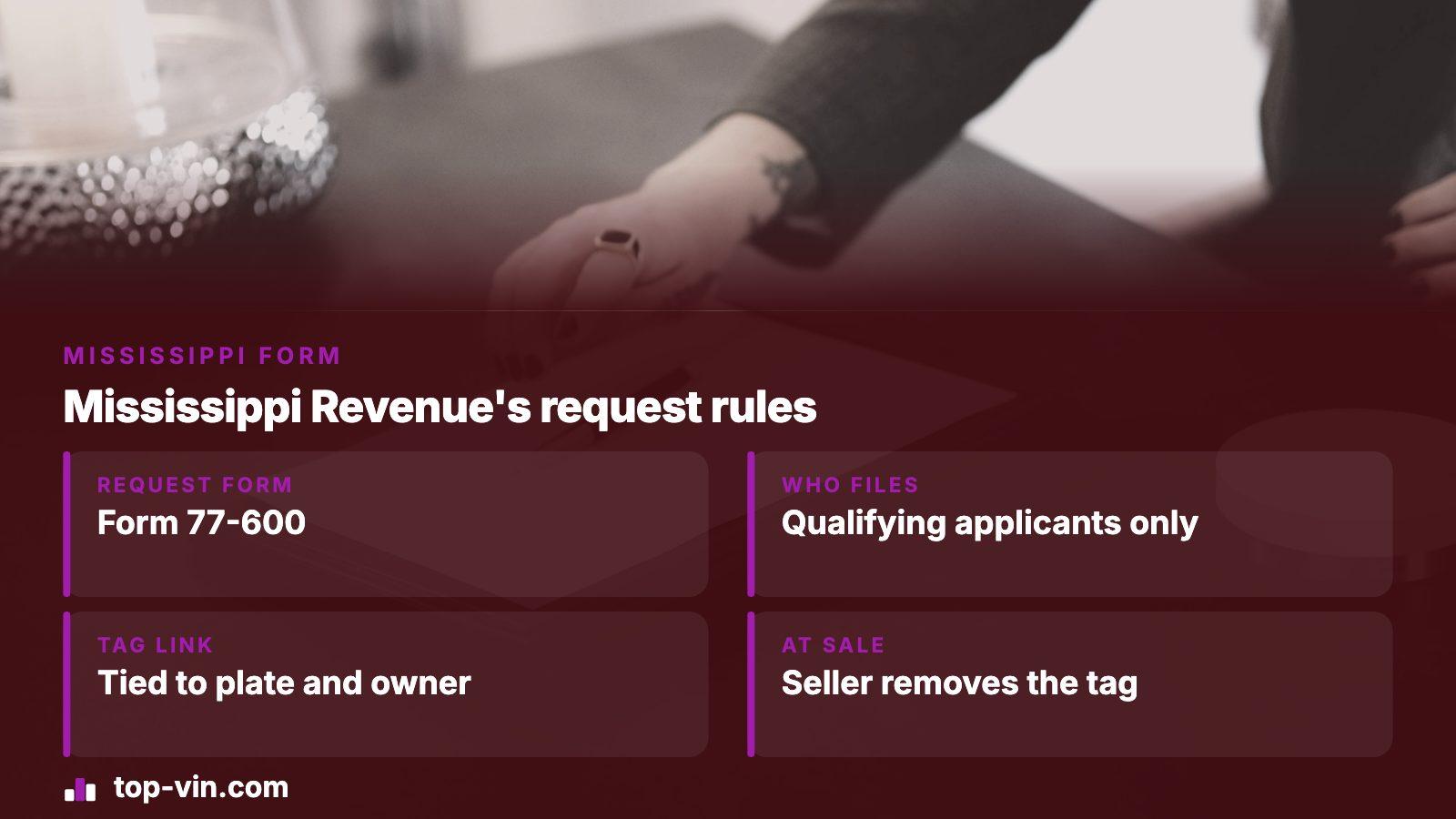
- Form 77-600, qualifying applicants only
- Plate and owner
- Tag is tied to both; seller removes it at sale
- TopVIN
- Free preview, then one payment
What a Mississippi tag tells you, and what stays out of reach
Shoppers type in a plate since it is all they can read from the sidewalk. Mississippi registers the tag to the car and to its owner together. A change in either one means the old tag is pulled and handed in at the county Tax Collector's office. A plate is therefore a poor stand-in for the car itself.
The VIN is different. It stays with the vehicle through every owner and every tag, and every record worth reading, from brands to damage to mileage to theft flags, is indexed by it. TopVIN starts from that number. It does not run plate searches and no owner's name, address or phone number ever comes back.
How the Department of Revenue handles record requests
The department's motor vehicle FAQ has an entry titled finding a vehicle owner. It says the federal privacy act covers personal information in motor vehicle records and that data goes only to applicants who note a qualifying exemption on the Records Request form. That form is the one the department's notice calls Form 77-600.
The same notice explains the process. You complete the form and send it in, and the department replies with the steps for getting the information. A warning follows. What you receive is privileged, sharing it is restricted by the department's rules, and a use outside the permitted list can bring criminal fines and other damages. The department points to its own administrative rule, numbered 35.VII.1.01 in the state code, as the local version of the federal law.
What we could not confirm
The Form 77-600 file would not give up its text to us, so we cannot say what it costs or how long a reply takes. Read the current form on the Department of Revenue site, or call Motor Vehicle Services, before you plan around either.
Who the federal law lets in
The federal act is codified at section 2721 of title 18. It stops a state agency from knowingly releasing personal details from a vehicle record unless a listed purpose applies. The purposes nearest to this topic are below.
- Courts, police and other government bodies doing their official work.
- Matters of vehicle safety, theft, recalls and advisories.
- Insurers handling claims, fraud investigations, pricing or underwriting.
- Legal proceedings, including serving papers on a party.
- Telling an owner where a towed or impounded car went.
- Licensed private investigators acting for one of the permitted purposes.
- A requester holding written consent from the individual in the file.
Inspecting a used car before you pay for it is not among them. A recipient who passes the data along must also keep a record of who got it and why, and show that record to the motor vehicle agency when asked. That obligation is five years long.
Getting the VIN without a records request
A buyer rarely needs the state's help. Go down the list and stop once one source gives you a clear 17-character number.
- Have the seller send the VIN by text or email ahead of any test drive.
- Read it from the Mississippi title and compare it with the plate holder's description of the car.
- Ask for the insurance card or a registration receipt, both of which carry it.
- Look at the car: the driver's side of the dash by the glass, or the sticker in the door frame.
- Compare every source. Two numbers that disagree are a reason to stop the deal.
Someone who refuses to put the number in writing has told you what you need to know. Keep your money in your pocket until the number and the paperwork agree.

Mississippi paperwork details that matter at the curb
State rules shape what you will see when you meet a seller. The title must be assigned to the buyer, with every section filled in except the buyer's printed name and signature. The seller pulls the plate when the title is assigned and the keys are handed over, and you should plan to collect a car with no tag on it.
| At the meeting | What Mississippi says | What to do |
|---|---|---|
| Seller's plate still on the car | The tag belongs to the old owner and the old vehicle record | Do not drive off on it |
| Seller has no title in hand | A title bond route exists, with a surety bond, affidavit and bill of sale | Ask why, and pause |
| Short-term travel tag offered | A temporary drive-out tag runs 7 days from purchase | Confirm with the dealer what it covers |
| Number on the title differs from the car | No rule excuses a mismatch | Stop and investigate |
Putting the number into TopVIN
Type the 17 characters in and the preview loads without payment. If the car still deserves a closer look, pay once for a report and see the pricing page for the choices. For a Mississippi car, read the brand history, the mileage trail, any auction photos and the theft and lien lines first.
The federal NMVTIS program, run by the Department of Justice, points to flooded vehicles that left Louisiana for other states after Hurricane Katrina. Its consumer page adds that salt water leaves wiring and airbag sensors more prone to failure. A Gulf Coast state is a fair place to read the brand history with extra care.
Warning signs in the results
- A flood, salvage or junk brand that the seller never mentioned.
- An odometer reading that drops between two dated records.
- An open lien on a car the seller calls paid off.
- Auction photos showing damage that the car no longer seems to have.
- Two clean-looking histories for one VIN, which can point to a cloned number.
Cloning is when a stolen vehicle carries a number lifted from a different car matching its make, model and year. NMVTIS describes one multistate case where about 250 such vehicles were recovered. If the VIN plate on the car looks altered, or the physical number disagrees with the title, do not buy.
Cost and next step
The preview is the free part and asks for no card. After it, one payment buys a report, or a bundle of several if you are comparing cars. Check the pricing page for amounts rather than relying on a number you saw elsewhere.
After the report, ask the Tax Collector in the buyer's county about tagging, and keep the title assignment copy. If the VIN history and the seller's story disagree, the history is the document to believe.
Where this information comes from
- Mississippi Department of Revenue: motor vehicle FAQ — The finding-a-vehicle-owner entry, tag rules and title transfer steps.
- Mississippi Department of Revenue: notice on record requests — Form 77-600, the state regulation and the misuse warning.
- Mississippi Department of Revenue: motor vehicle titles — Title transfer basics for a buyer and seller.
- Federal driver privacy law, 18 U.S.C. 2721 — The permitted purposes and the redisclosure record rule.
- NMVTIS for consumers, vehiclehistory.gov — What the federal title system covers, flood and cloning examples.
Sources and photos: Facts checked against the sources above in November 2026. Photos by Miles Loewen, Dylan Michaud and Annika Wischnewsky on Unsplash; diagrams by TopVIN.
Keep reading
- License plate to VIN: the lawful ways to find a car's VIN from its plateThe national picture behind every state plate rule.
- Where the VIN sits on a title, and what to do nextReading the number printed on a title.
- Is the VIN on the insurance card? What to check before you trust itAnother document that carries the VIN.
- License plate lookup privacy laws: what you can and cannot get from a plateWhy owner data stays out of reach.
Frequently asked questions
Can I find a VIN from a Mississippi license plate number?
Not through a public tool we could confirm. The Department of Revenue gives out record data only to qualifying applicants under the federal privacy act. Buyers are better off asking the seller, reading the title, or checking the car, then running a history check on that number.
What is Form 77-600?
It is the form the Department of Revenue's notice names for anyone wanting information from an individual motor vehicle record. You complete it and send it in, and the department answers with the steps to follow. We could not read its fee or turnaround, so check the current form.
Does the plate stay on a Mississippi car I buy?
No. Mississippi links every tag to one vehicle and one owner. The seller takes it off when the title is assigned, it is turned in at the county level, and it cannot be reused on another car.
Will a VIN check show the owner's name?
No. TopVIN does not return personal details about owners. It shows the car's own records, such as title brands, odometer readings, damage and theft entries, so you judge the vehicle rather than the person selling it.
Is the TopVIN report free?
Seeing the preview is free. A report is paid for once, alone or in a pack, with no renewal. Current amounts are on the pricing page.
Now check the car itself
The guide explains what to look for. The report shows what this VIN has on record.