THE SHORT ANSWER
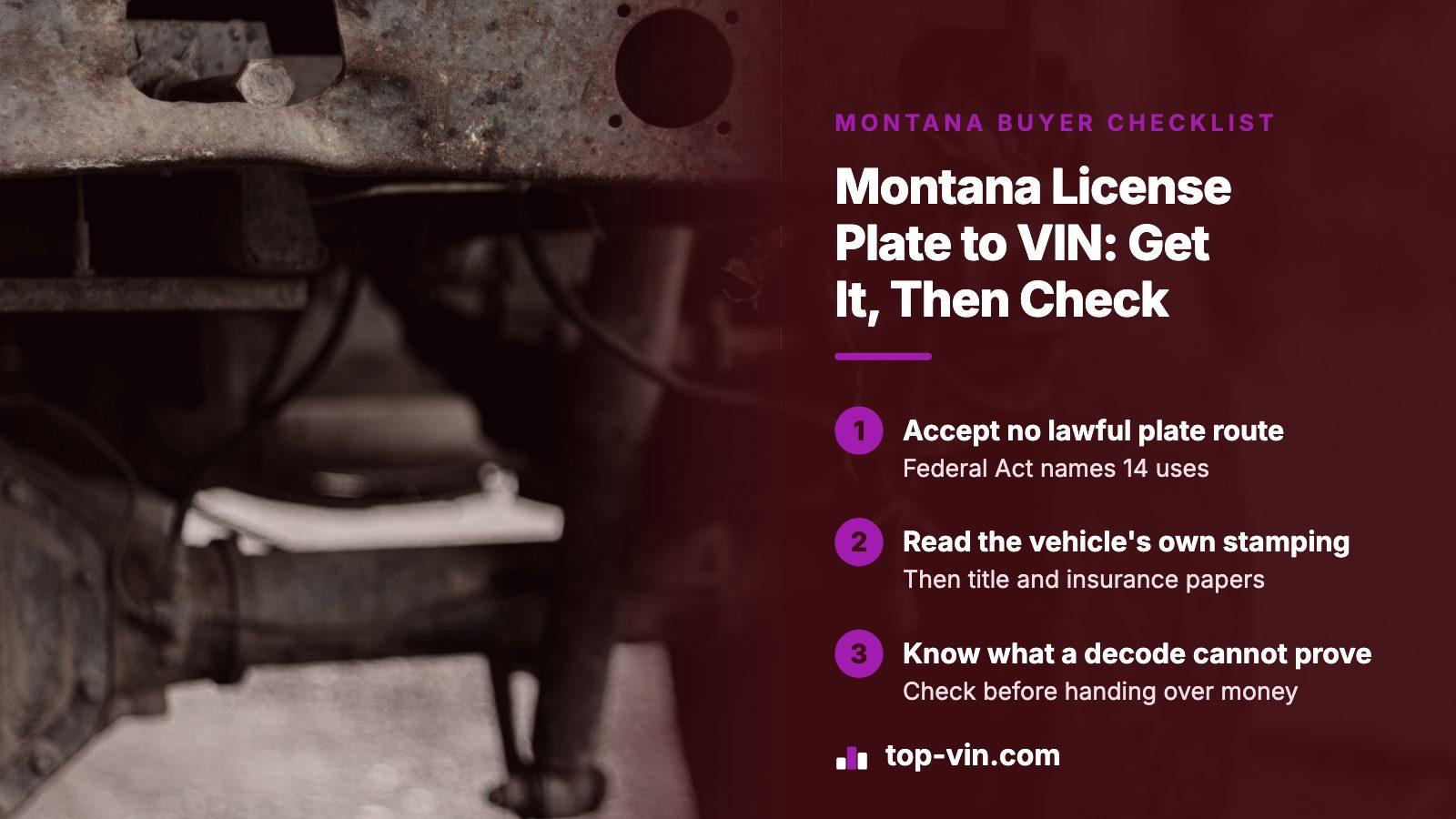
Montana offers a private buyer no lawful plate-to-VIN route. The number comes from the seller, a title, a registration or insurance document, or the vehicle's own stamping. Only requesters with a permitted purpose under the Driver's Privacy Protection Act can obtain state records. Run the VIN for a TopVIN preview that costs nothing, then weigh the full report.
- Public plate-to-VIN search
- None we could confirm
- Federal law that limits records
- Driver's Privacy Protection Act
- Permitted uses in the Act
- 14, and buying a car is not named
- TopVIN check
- Free preview, then one payment
Why a Montana plate is the wrong key
A plate tells a clerk which registration record to open. It says very little about the car's past. Branded titles, crash files, odometer entries and theft flags are filed under the vehicle identification number, so every serious history database asks for that number first.
That is the reason searches like this one send people in circles. The plate is what you can read from the street, while the VIN is what unlocks anything useful. TopVIN starts from the VIN, describes the vehicle, and does not return an owner's name, address or phone number.
What federal law says about releasing the record
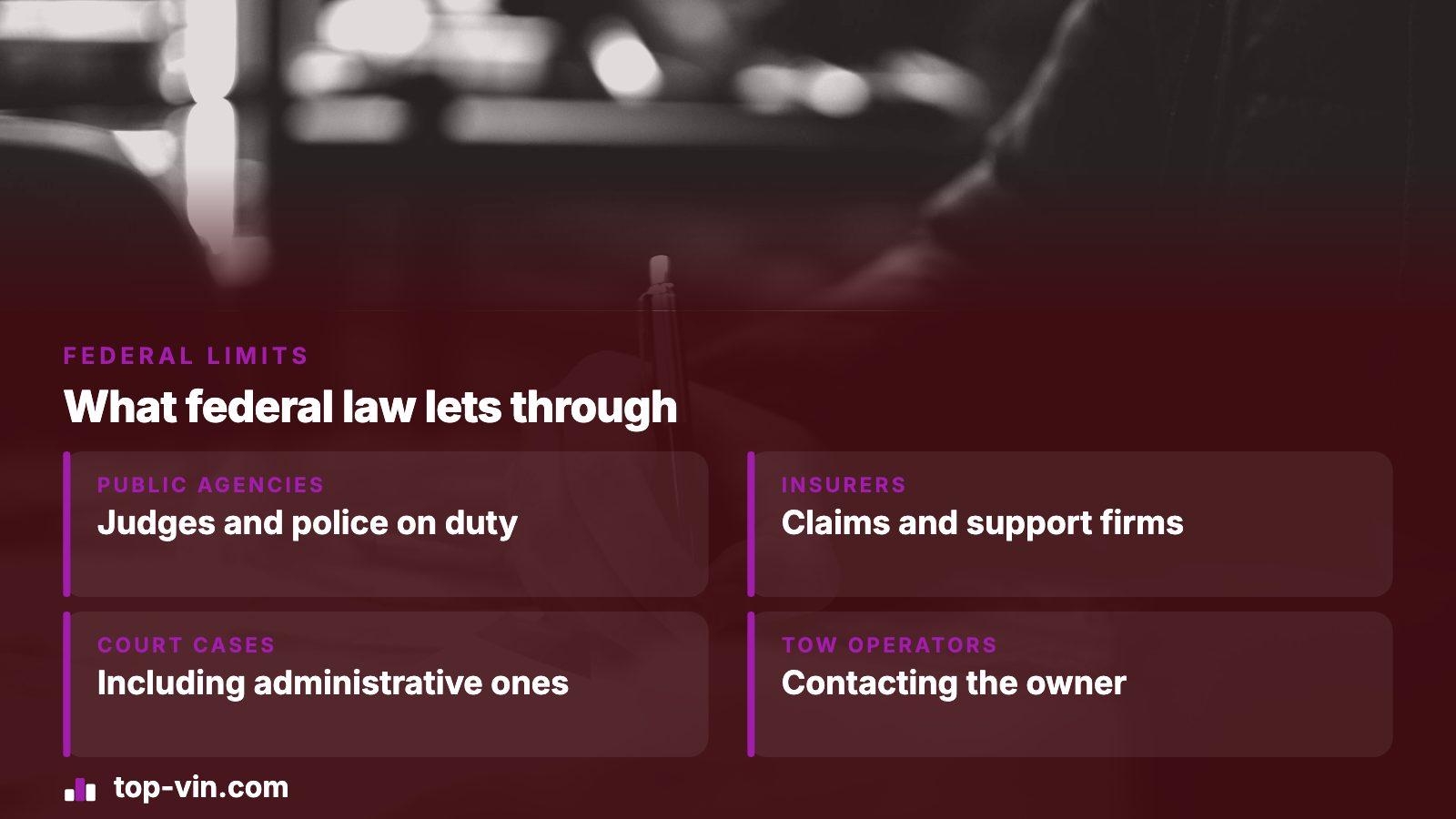
The Driver's Privacy Protection Act sits at 18 U.S.C. section 2721. It tells a state motor vehicle department, and anyone working for it, not to knowingly hand out personal information from a motor vehicle record unless the statute makes room for the request. The section lists 14 permitted uses. A shopper sizing up a used car for private purposes is not one of them.
- Public agencies, judges and police working within their duties.
- Insurance companies and their support firms handling claims, fraud screening or rating.
- People involved in a court or administrative case, including process servers.
- A tow or impound operator contacting the vehicle's owner.
- Licensed investigators, for a purpose the section itself accepts.
- Someone carrying written consent from the person the record describes.
Beyond that list, a state can recognize one more use under its own law when it ties to driving or public safety. It can also bill an administrative fee for a record, and it can set up a waiver step that notifies the person named in the file before anything goes out.
What we could not confirm about Montana's own process
The statute is federal, but the request form, the fee and the turnaround belong to Montana's motor vehicle agency. Its website refused our automated reading with a bot check, and we do not work around those. So this page names no Montana form, office, price or processing time.
Before you file anything
Open the Montana agency's records page yourself and read the current steps. Any request form will ask you to state which permitted use applies. Certify only a purpose that is true for you, because a false statement to obtain a record can create legal trouble of its own.
Getting the VIN without a records request
Most Montana buyers skip the state entirely. The number is printed on paperwork the seller already holds, and it is stamped on the car. Work down this list until you have it from two places.
- Get the VIN from the seller by text or email before you travel, above all when the drive across the state is a long one.
- Request a photo of the title and compare the printed number with the one on the listing.
- Ask for the registration slip, which should repeat the same characters.
- Have the seller send the insurance card or a policy screenshot showing the insured vehicle.
- Standing at the car, read the number off the vehicle and photograph it yourself.
Two sources that disagree call for a pause. A simple typo is common, yet a gap between them can also mean a swapped part, a cloned identity or an edited document.
When the seller will not share the number
Read a refusal as a signal. Every title carries the VIN and so does the car, which leaves a seller little reason to keep it back. A few offer a plate photo as a substitute and hope you stop asking.
Do not try to fill the gap with a site promising an owner lookup from a plate. Such promises run into the same federal limits described above, and anything that does come back may be stale or about a different car, since plates move between vehicles. Offer to meet at the car, read the number there, and leave if the seller still balks.
Running the VIN through TopVIN
Enter all 17 characters and the preview appears first, at no charge. Use it as a sanity test: the decoded year, make and model should match the listing and the car in front of you. If they do not, stop and sort out the number before spending money.
If the preview lines up, you buy the full report a single time and nothing renews afterward. The pricing page shows current amounts. The preview is no charge; the report itself is the paid part.
Reading the report like a buyer
| Finding | Sensible response |
|---|---|
| Salvage, flood or other title brand | Get the backstory and repair invoices, then value it as a branded car or step away. |
| Mileage lower than an earlier entry | Suspect a rollback and ask for service receipts. |
| Lien listed | Insist on a written release from the lender before payment. |
| Theft record | Halt, and check with police or the insurer before anything else. |
| Open recall | Book the fix with a brand dealer once the car is yours. |
Title records in reports like this trace back to NMVTIS, a Justice Department program aimed at fraud, hazardous cars and the resale of stolen ones. Every one of the 50 jurisdictions was reporting by May 23, 2022. A clean result lowers risk, but a test drive and a mechanic's inspection still matter.
What a decode cannot prove
The vPIC decoder at NHTSA returns the specification manufacturers filed for a VIN, and it takes partial numbers with a star standing in for unknown characters. A decode describes the car as built. It cannot say whether the plate screwed on today belongs to it, since plates get swapped, lost and sometimes stolen.
Build every check around the number stamped into the vehicle. Match it to the title, then to the report, and treat the plate as a loose hint about registration, never proof of identity.
Your checklist before you hand over money
- Gather the VIN from two separate places and confirm each character matches.
- Open the no-cost TopVIN preview and hold it against the listing.
- Buy the full report only when the preview matches the car.
- Inspect the original title and any lien release in person.
- Book an independent inspection, especially after a brand or damage record.

Where this information comes from
- Driver's Privacy Protection Act, 18 U.S.C. 2721 — The federal list of permitted uses and the state fee and waiver provisions.
- NMVTIS consumer information, vehiclehistory.gov — What the federal title system is for and its 50-jurisdiction milestone.
- NHTSA vPIC VIN decoder API — How the decoder treats full and partial VINs.
Sources and photos: Facts checked against the sources above in November 2026. Photos by Zoshua Colah, Mustafa Sheikhmouss and Owen Michael Grech on Unsplash; diagrams by TopVIN.
Keep reading
- License plate to VIN: the lawful ways to find a car's VIN from its plateThe nationwide version of this question, beyond Montana.
- Where the VIN sits on a title, and what to do nextWhere the number appears on a title and what to compare it against.
- Is the VIN on the insurance card? What to check before you trust itUsing the policy paperwork as a second source for the VIN.
- License plate lookup privacy laws: what you can and cannot get from a plateWhy owner details stay out of reach for ordinary buyers.
Frequently asked questions
Can I find a VIN from a Montana license plate?
Not by any public search we could confirm. Federal law restricts what a state may release, so buyers collect the VIN from the seller, title, registration or insurance paperwork, or the vehicle itself, then run a history check.
Does TopVIN accept a Montana plate number?
No. TopVIN starts from the VIN and never returns owner names or addresses. Type the 17 characters to see a preview at no cost; the full history is a separate one-time purchase.
Who can request Montana motor vehicle records?
The federal Act names agencies, insurers, litigants, investigators and anyone with the record subject's written consent, among others. Montana's own form, fee and timing were not readable for us, so confirm them with the state agency.
Is the VIN on the plate or the registration?
Not on the plate. The registration slip and the title carry the number, and so does the car. If you only have a plate photo, ask the seller for the title or registration before you commit to a visit.
Is the TopVIN report free?
No. The preview alone costs nothing. Purchasing the full report happens once with no recurring fee, and Montana buyers can see today's options on the pricing page.
Now check the car itself
The guide explains what to look for. The report shows what this VIN has on record.