THE SHORT ANSWER
A private buyer cannot get a Nevada plate converted to a VIN through the DMV, because the federal Driver's Privacy Protection Act confines record releases to a short list of purposes, and vetting a purchase never made it onto the list. Get the 17 characters from the seller's title, the insurance card or the car itself, then run them through a TopVIN preview.
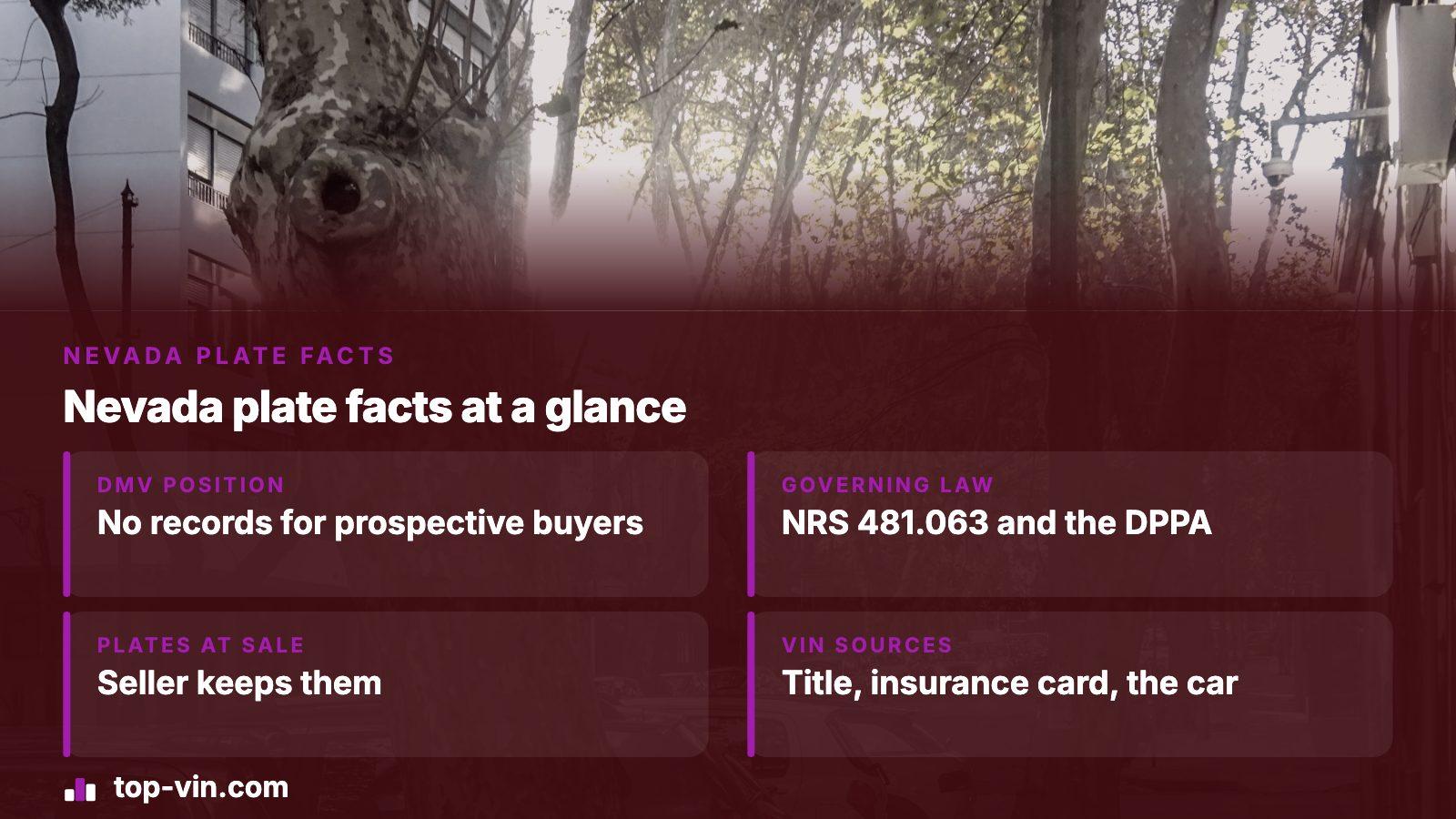
- DMV position
- No vehicle records for prospective buyers
- Governing law
- NRS 481.063 and the federal DPPA
- Plates at sale
- Seller keeps them
- TopVIN preview
- Free to view, then one payment
What the Nevada DMV says about records and buyers
Many shoppers key a plate into a search bar and hope a VIN appears. The Nevada DMV closes that door on its records page in plain words: vehicle records are not something it supplies to people who are only thinking of buying. Personal details are also off the table by phone or email unless state law permits, and a legitimate request has to arrive through official channels, backed by identification, authorization and an electronic notary.
Three laws control what the agency can hand out, per its own page: NRS 481.063, a set of Nevada administrative code sections on records, plus the federal Driver's Privacy Protection Act. Files on abandoned vehicles or ones involved in crashes are reserved for approved outside parties, among them insurers, tow yards and attorneys.
Where the DMV points buyers
The same page lists outside tools for car shoppers: NICB's VIN check for stolen and salvage vehicles, the NHTSA decoder, NMVTIS for title records from every state, and the safety recall lookup. Every one of them starts from a VIN, not a plate.
The federal limit that shapes every state answer
Under section 2721 of Title 18, a state motor vehicle agency may not knowingly disclose personal information from its records except for uses the statute lists. The list includes government and court work, theft and safety matters, recalls, insurer claims and fraud work, notice to owners of towed vehicles, licensed investigators, commercial driver checks, and requests backed by the person's own written consent.
Sizing up a used car before you buy simply is not among those uses. So a website cannot lawfully offer you a Nevada owner's name for a flat fee, and why a business that does resell DMV data must keep five years of records on who received it and why. If you have a real need, such as a collision claim or a lawsuit, an insurer, a police officer or an attorney can make the request on your behalf.
Getting the VIN without the DMV
The seller already holds the number in several places. Ask for it before you drive across town, and take it from two sources if you can.
- The title. Nevada requires a private seller to supply one, and a receipt on its own will not satisfy the DMV. Ask for a sharp photo of the front.
- The insurance paperwork, which lists the vehicle alongside its number.
- The registration card, which also lets you confirm that the plate on the car belongs with the vehicle.
- The vehicle itself, read by you in person rather than relayed by text.
- The classified ad, since dealers print it and private sellers can reply with it in a minute.
A seller who dodges a plain request for the number is giving you information too. The DMV's own advice for private-party deals is to accept no excuses when the title is missing and to walk away.
Why Nevada plates can mislead you at a sale
In Nevada the seller keeps the plates. The DMV tells sellers to cancel the registration, then put the plates on a different vehicle or hand them in, by post or at an office, and to file a resale notification so the record shows the car is no longer theirs. A car that changes hands should therefore leave without its old metal.
So treat plates still bolted to a car you are viewing as a small question mark, not proof of anything. A seller may have released them to you on an SP-67 form, which carries its own deadline: 60 days for standard plates and 30 for specialty ones. Either way, a plate tells you little about the car, and the VIN tells you a lot.
Matching the number to the car and the paperwork
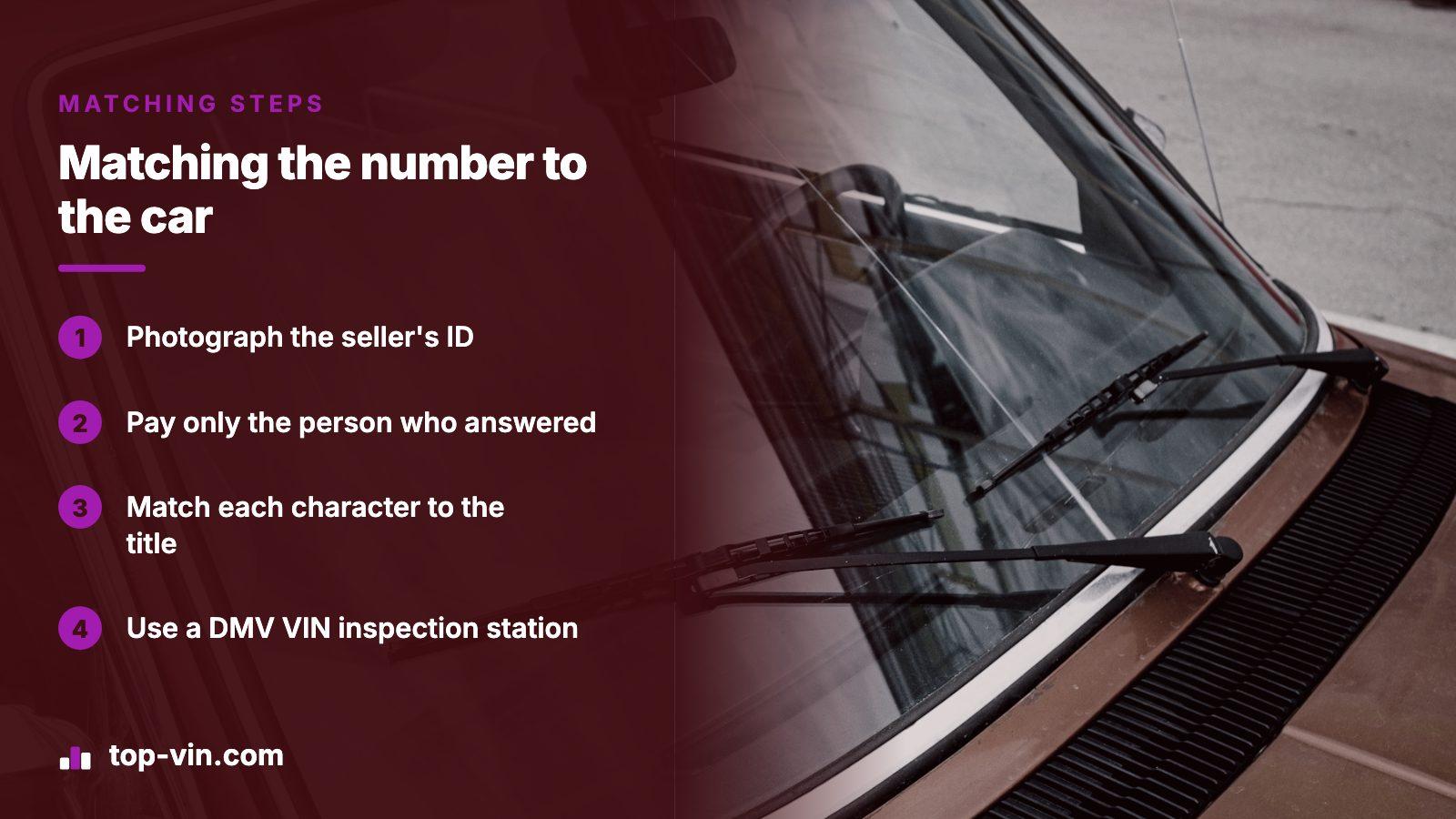
The DMV warns that cash-only, too-good-to-be-true listings on social media are often vehicles that were stolen or had their VINs switched or odometers rolled back. Its advice reads like a checklist.
- Photograph the seller's identification and save their phone and address.
- Hand money to nobody except the person who answered your first message.
- Read the stamped number on the vehicle, then match each character with what the title prints.
- Meet at a DMV VIN inspection station, or lean on a history report when you cannot.
A vehicle that has never been titled or registered in the state also needs a Vehicle Inspection Certificate, Form VP 015, before it can be registered here.
Running the VIN in TopVIN
Enter the 17 characters at TopVIN and open the preview, which is free and tells you whether the record holds anything worth reading in full. Buying the full report is one payment for one vehicle, with nothing recurring, and multi-report packs are listed on the pricing page.
| Look for | Why it matters on a Nevada car |
|---|---|
| Title brands | Salvage, rebuilt and flood brands made elsewhere still follow the car into Nevada |
| Theft record | A stolen car can carry paperwork that looks tidy |
| Odometer readings | A drop or a long gap between entries needs an explanation |
| Liens | Nevada says any loan must be paid off before a sale |
| Open recalls | Repairs the maker may owe you |
Nevada's salvage rules and what a brand means
In the DMV's definition, a salvage vehicle has been written off as a total loss, flooded, or declared non-repairable, or has had a salvage label put on a title. A write-off means the estimated repair bill tops 65% of the car's market value from before the damage, with paint left out of the sum. A car on an orange salvage title may not be sold to an individual until it has been rebuilt and passed inspection.
Once rebuilt, the car gets a branded title, and the DMV says that brand cannot be removed. That is why a history check matters: a car may arrive from another state with a brand that the seller never mentions. Pair the TopVIN preview with the free NICB check the DMV recommends, and compare what each one shows.
Read the brand, then the price
A rebuilt car can be a sensible buy at the right price with a thorough inspection. A seller who hid the brand cannot be trusted with the rest of the story.
Insurance and registration once you decide to buy
Plan the paperwork before you hand over money. Nevada does not accept out-of-state insurance: the policy must come from a Nevada-licensed carrier, carry your name exactly as it will appear on the title and registration, and take effect on or before the registration date. Private-party buyers may be able to register online through the DMV's Rapid Registration option.
- Make sure the name on the title matches the person selling.
- Ask for the loan payoff to be settled before the sale.
- Keep the report, the title copy and the bill of sale together.
- Do not drive on the seller's leftover registration.
Where this information comes from
- Nevada DMV: Records — Its position on buyers, the privacy laws and the request forms.
- Nevada DMV: Register a Vehicle — Title, insurance and scam guidance for private-party purchases.
- Nevada DMV: Registration cancellation — What happens to plates and registration when a car is sold.
- Nevada DMV: Salvage vehicles — Definitions and rules for salvage and rebuilt titles.
- 18 U.S.C. 2721 on GovInfo — The federal limits and the permitted uses.
Sources and photos: Facts checked against the sources above in November 2026. Photos by Derek Nelson, Max Tokarev and Nikolai Kolosov on Unsplash; diagrams by TopVIN.
Keep reading
- License plate to VIN: the lawful ways to find a car's VIN from its plateThe national picture of plate searches and why they fall short.
- Where the VIN sits on a title, and what to do nextHow to read the number printed on a title.
- Is the VIN on the insurance card? What to check before you trust itUsing an insurance card to find the number.
- VIN cloning: why a VIN check can pass a stolen car and what catches itHow switched numbers hide stolen cars.
Frequently asked questions
Can I find a VIN from a Nevada license plate number?
Not through the DMV if you are a private buyer. The state says its vehicle records are not meant for would-be purchasers, and federal law limits release to listed purposes. Ask the seller, read the title or insurance paperwork, or look at the car, then run that number.
Does a Nevada plate show the owner's name?
Not to the public. Personal information in motor vehicle records is protected, and the DMV releases it only for permitted uses with identification and authorization. A website promising an owner's name for a fee is not offering a lawful shortcut.
Who keeps the plates after a Nevada car sale?
The seller. Nevada law has sellers keep their plates, cancel the registration, and then reuse the plates or turn them in. The DMV also suggests a resale notification so the record shows you no longer own the vehicle.
Is there a free way to check a Nevada car once I have the VIN?
Yes, in part. The DMV lists NICB's check for stolen and salvage vehicles and the recall lookup as free. A TopVIN preview is also free to view, and the full report adds title, odometer and other records for one payment.
What if the seller has no title?
Walk away, in the DMV's words. Sellers must provide a title in a private sale, and a receipt by itself does not do. A missing title can be replaced by applying for a duplicate from the state that last issued one.
Now check the car itself
The guide explains what to look for. The report shows what this VIN has on record.