THE SHORT ANSWER
A New Hampshire plate cannot be exchanged for a VIN through any lawful public lookup we found. The DMV releases personal data only for purposes federal law lists, and a shopper sizing up a used car is not on that list. Ask the seller, read the title, registration or insurance card, or copy it from the car, then run the preview.
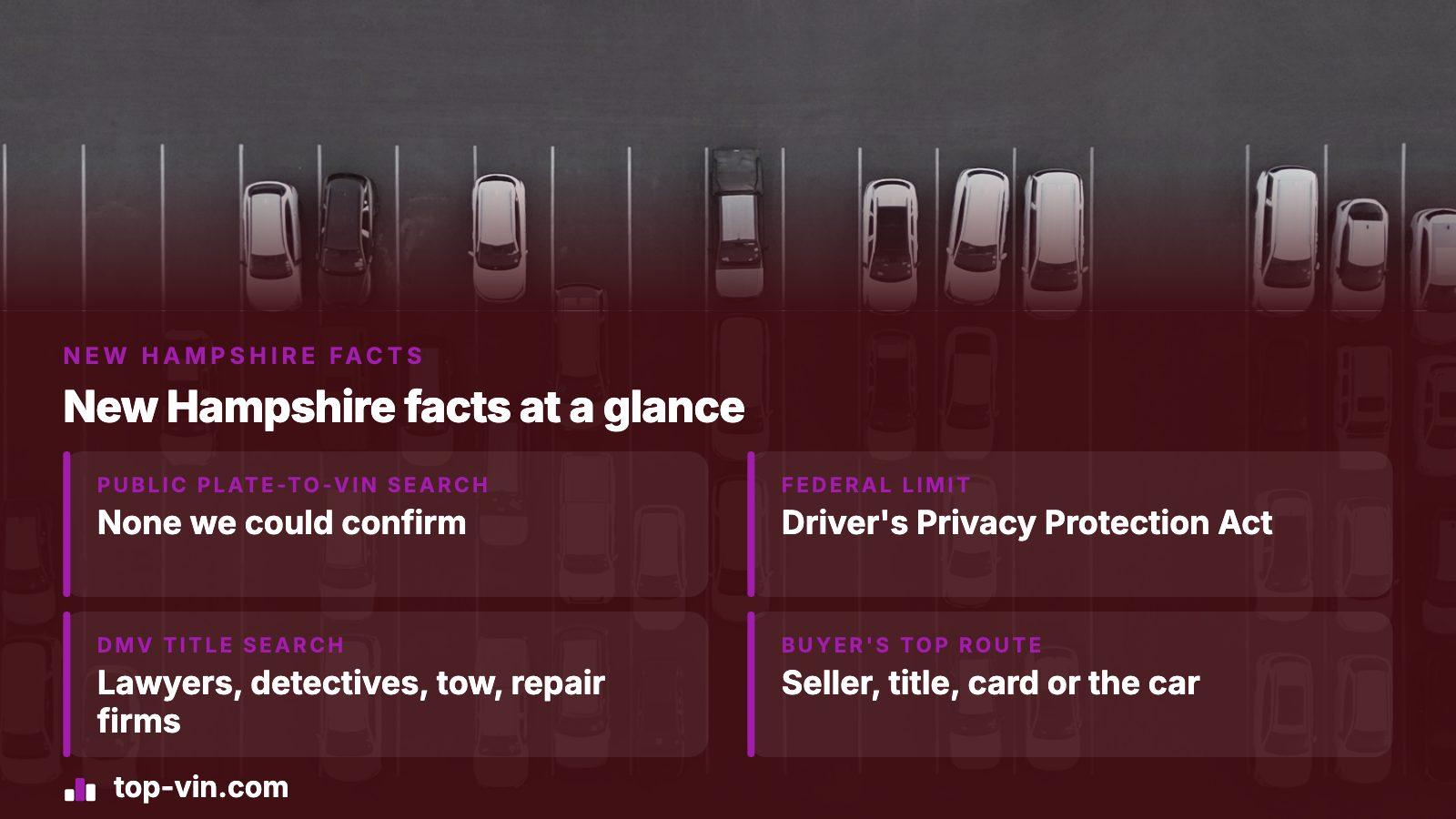
- Public plate-to-VIN search
- None we could confirm
- Federal limit
- Driver's Privacy Protection Act
- DMV title search
- Lawyers, detectives, tow and repair firms
- TopVIN
- Free preview, then one payment
Why the plate does not open the file you want
A plate sits in the DMV's registration records next to a person: a name, a street address, a license number. Federal law, the Driver's Privacy Protection Act, tells every state motor vehicle department not to hand that kind of detail to just anyone. The statute lists the allowed purposes one by one, and the department may release only inside that list.
That is why sites advertising a New Hampshire plate search tend to promise more than they can legally deliver. TopVIN works the other way around. It starts with the VIN, the identifier that describes the car itself, and it never returns an owner's name, address or any other personal detail.
Who the DMV can release records to
The statute names a list of permitted uses. A few of them show how narrow the door is.
- Courts, police and other government bodies doing their jobs.
- Insurers and anti-fraud units handling claims or setting rates.
- People involved in lawsuits and administrative cases, including those serving papers.
- Tow operators who must notify the owner of an impounded car.
- Licensed private investigators working for one of the permitted reasons.
- A requester who can show the written consent of the person in the record.
- Any other use New Hampshire's own law approves, tied to driving or public safety.
Checking out a car you might buy appears nowhere on it. That gap, not a missing website feature, explains why no ordinary buyer can get a VIN out of a plate.
What the New Hampshire title search is, and who it is for
The state does run a title search service. According to the DMV, it answers five questions: how many owners a vehicle has had, who the lienholder is, the exact mileage, proof of the title and when it was issued, and the brand. Four groups are named as eligible: lawyers, private detectives, tow firms and repair shops. A person shopping for a car is absent from that roster.
Applicants fill in form DSMV 505, the Request for Motor Vehicle Records, and send it to the DMV Title office in Concord along with a Certificate of Authority and the $20.00 charge. That certificate is a company's own signed letter listing staff cleared to receive records, and it has to be renewed each calendar year. If your business fits, read the DMV's current page first, since fees and forms change.
Getting the VIN without involving the state
In a real purchase the number is already within reach. Go through these in order and compare what you collect.
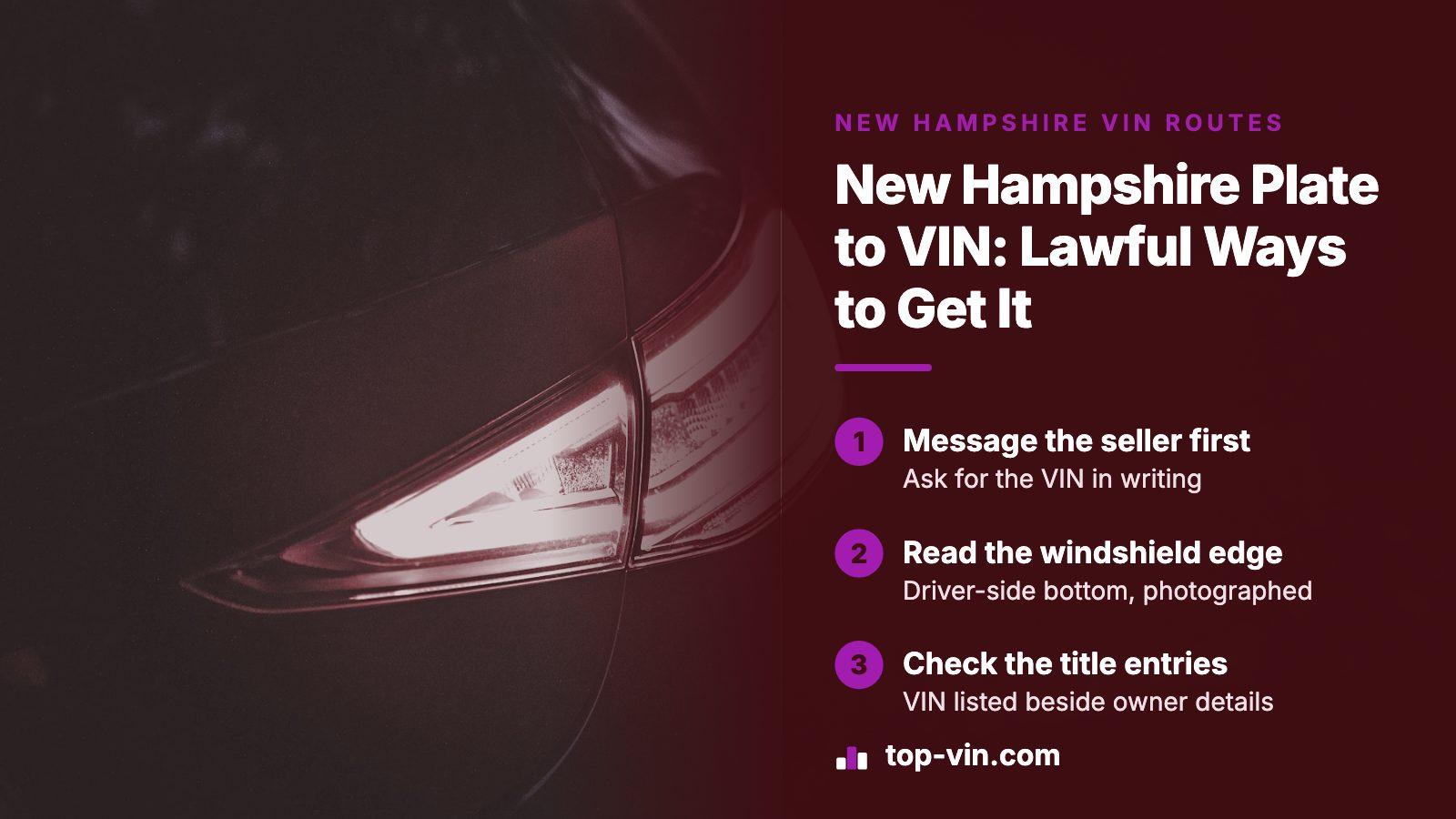
- Message the seller and ask for the VIN in writing before you drive out. A seller who stalls on a number printed on the title tells you something.
- Request a clear photo of the New Hampshire title. The DMV lists the VIN among the minimum entries on every title, alongside the owner's details and any lender.
- Ask to see the registration card. NHTSA says the number appears there as well.
- Ask for the insurance card, where the number often, though not always, appears.
- At the car, stand outside and read the windshield's driver-side bottom edge, which NHTSA names as the spot for the 17 characters, and photograph it.
When two sources disagree
A single swapped character may be a typo on a text message. A mismatch between the car and its title is different, and it can mean a replaced part or an altered document. Resolve it before payment.

What the clerk's counter means for a private purchase
Registering in New Hampshire is a two-part job. Apart from mopeds, it begins at the office of the clerk in your home town or city, and that clerk may finish the state half for an added fee. For a private sale, you bring a properly assigned title. Ordering plates for the first time adds an $8.00 plate fee to the registration charges.
Use that as a checkpoint. The seller should hold a title in their own name to sign over, and the number on it must match the car. If the vehicle is exempt from titling, the DMV asks for proof of the VIN instead, such as an earlier registration or a completed verification form. A seller who cannot produce either has not proven the car is theirs to sell.
Running the check once you hold the number
Type the VIN into TopVIN and a free preview appears first. Compare the model year, make and model with the listing and the car in front of you. If those line up, you can open the full report with a single payment. The pricing page shows the amount, and there is no subscription.
On a car from a New Hampshire seller, read the title brands first, then damage and accident entries, the sequence of odometer readings, salvage or auction photos, and liens. NHTSA's recall search is a free companion step, though it lists only unrepaired recalls and skips those over 15 years old unless the maker covers them.
What to do with what the report shows
| What turns up | Reasonable next move |
|---|---|
| Salvage, junk or flood brand | Get the repair paperwork, then value it as a branded vehicle or leave it. |
| Odometer reading lower than an earlier one | Request dated service invoices before discussing price. |
| Open lien | Do not pay until the lender's release is in your hands. |
| Theft record | Stop and confirm with police or the insurer. |
| Unrepaired recall | Book the free manufacturer fix at a dealer after purchase. |
Federal title records keep every brand any reporting state has applied, so moving a car over a state line does not erase it. States set their own damage thresholds, which means one may brand a car that another would not.
Where a plate or a report falls short
Plates travel between vehicles, so one on a car is only a clue to what that car is. The stamped VIN and the title outrank it. A report also cannot hold what nobody recorded, such as a repair paid in cash or damage fixed without an insurance claim.
Back up the paperwork and the report with a drive and a mechanic's inspection.
Where this information comes from
- NH DMV: Title Search — Who may request a title search, the form and the mailing address.
- NH DMV: Vehicle Registrations — How registration starts at the clerk and what a private buyer presents.
- NH DMV: Apply for a Title — What information a New Hampshire title carries, including the VIN.
- Driver's Privacy Protection Act, 18 U.S.C. 2721 — The ban on release and the list of permitted uses.
- NHTSA: Check for Recalls — Where the VIN is found and what the recall search leaves out.
Sources and photos: Facts checked against the sources above in November 2026. Photos by Maurice Sahl, Alejandro Escamilla and Iain on Unsplash; diagrams by TopVIN.
Keep reading
- Where the VIN sits on a title, and what to do nextReading the VIN on a title and spotting a mismatch.
- VIN Lookup by License Plate in Maine: What Works and What Does NotThe same question for a car bought across the northern border.
- VIN Lookup by License Plate in Massachusetts: What Works and What Doesn'tPlate and VIN rules for a Massachusetts car.
- DMV VIN check compared: what the state shows and what to run beside itWhat a DMV can and cannot tell you about a VIN.
Frequently asked questions
Can I get a VIN from a New Hampshire license plate number?
Not through a public lookup we could confirm. Federal law restricts what the DMV may release from registration records, and a private buyer's curiosity is not a listed purpose. Most shoppers get the number from the seller, the title, the registration or insurance card, or the windshield, then run it through a history check.
Can I request a New Hampshire title search as a buyer?
The DMV's page names lawyers, detectives, tow firms and repair shops as the groups that can ask for one. Individual shoppers are not mentioned. If you think you qualify, read the current instructions on the DMV site before sending the form or the fee.
Where is the VIN on a car?
NHTSA directs owners to the bottom left of the windshield for a string of 17 characters. You will also find it printed on the registration, and sometimes on proof of insurance. Compare two of them, because any difference deserves a question.
Does TopVIN search by plate or show owner names?
No. It works from the VIN and describes the vehicle, not the person. A free preview comes first. Opening everything afterward costs a single payment, nothing recurs, and the amounts sit on the pricing page.
What if the seller refuses to share the VIN?
Treat that as a warning. The number is printed on the title and the registration, so there is little honest reason to withhold it. Pause the deal until you can read the number on the vehicle and confirm it against the paperwork.
Now check the car itself
The guide explains what to look for. The report shows what this VIN has on record.