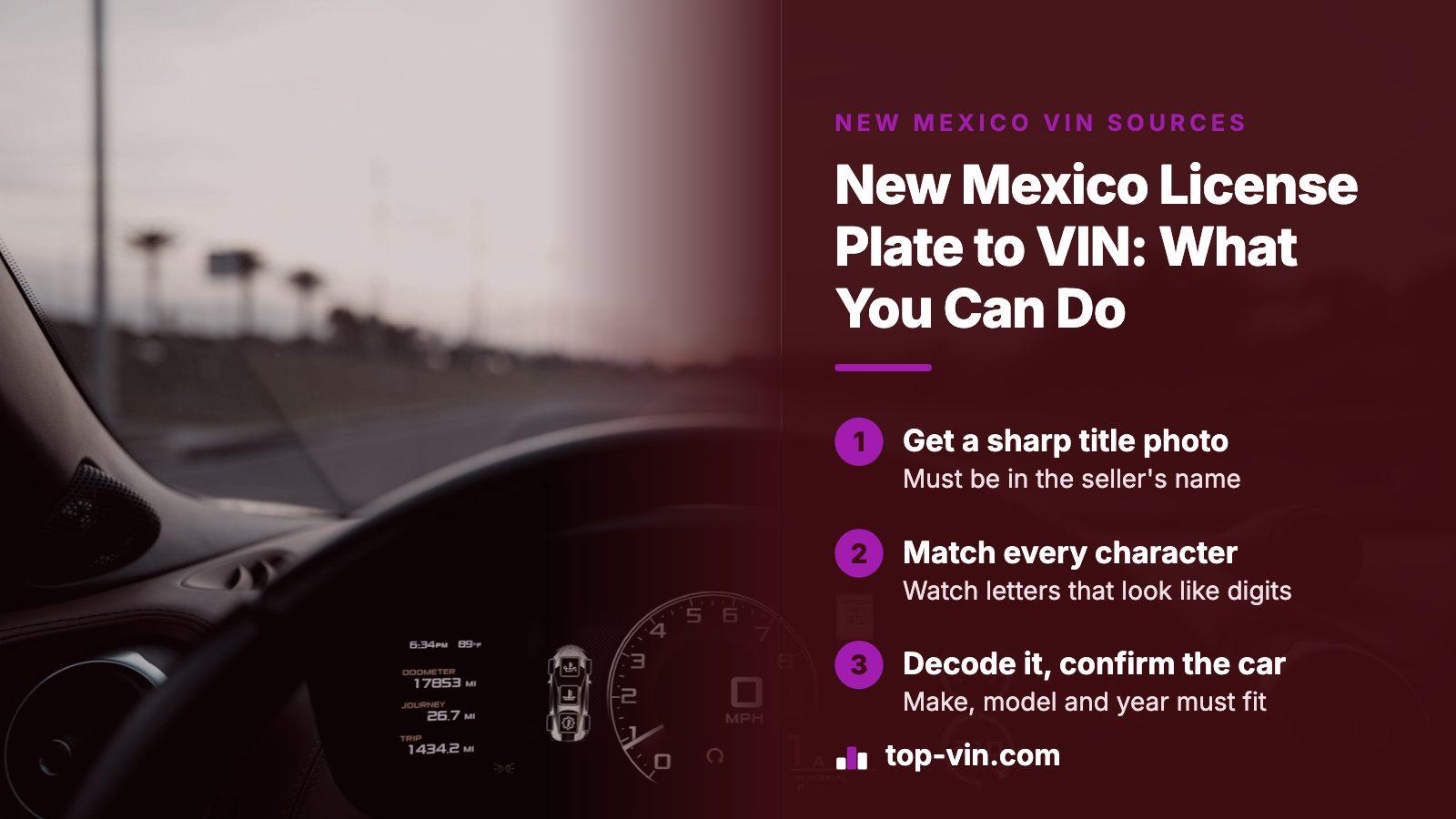
THE SHORT ANSWER
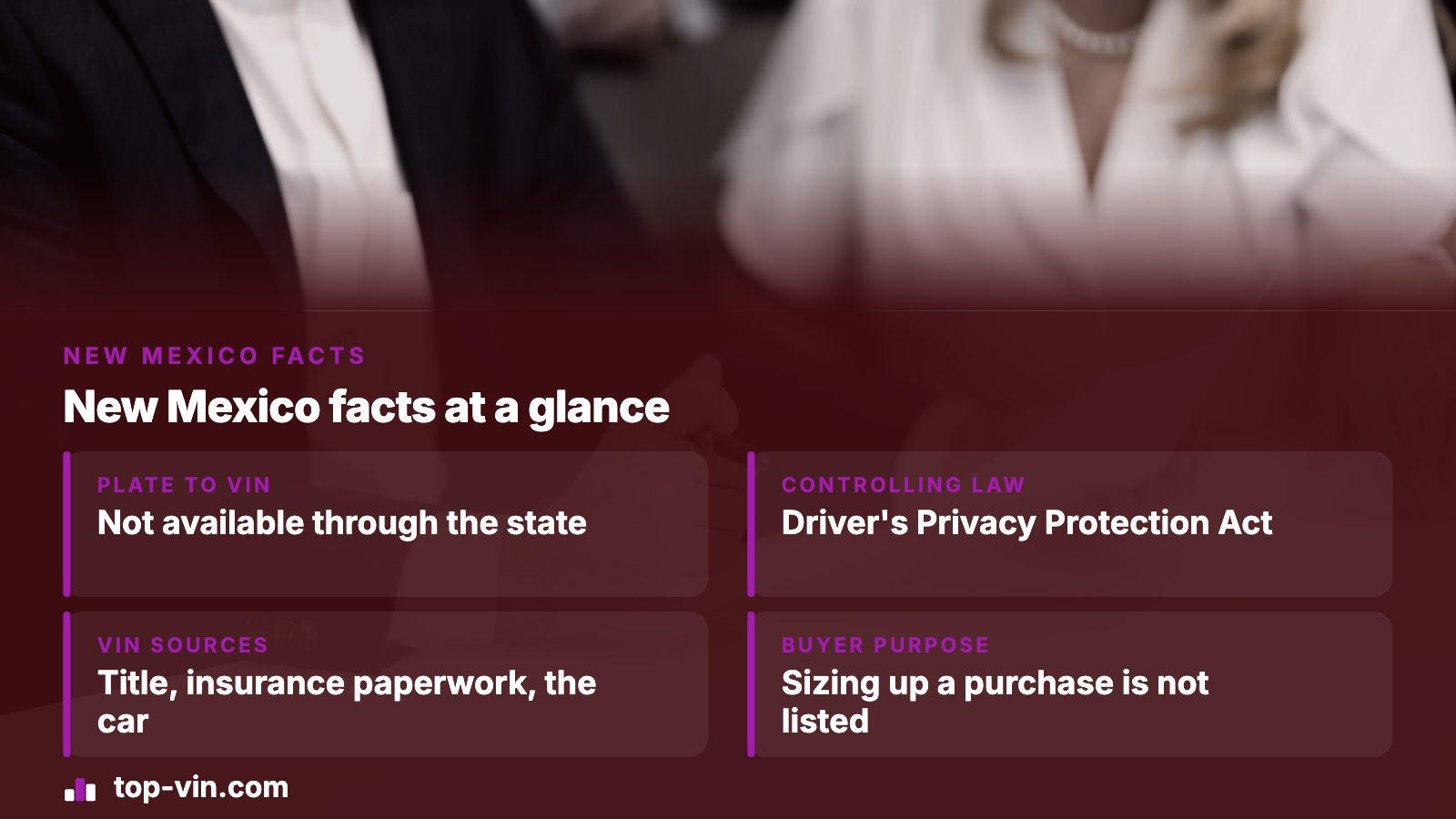
Shoppers cannot lawfully pull a VIN from a New Mexico plate through a state records office, because the federal Driver's Privacy Protection Act lists the only purposes for which motor vehicle records may be released, and sizing up a purchase is not one. Read the number off the title, the insurance paperwork or the car, then check it with a TopVIN preview.
- Plate to VIN for buyers
- Not available through the state
- Controlling law
- Federal Driver's Privacy Protection Act
- Reliable sources of the VIN
- Title, insurance paperwork, the car
- TopVIN preview
- Free to view, then one payment
What a New Mexico plate search can and cannot deliver
Plenty of sites invite you to type a New Mexico plate and promise a VIN, an owner and a history in seconds. The part they skip is where that data would come from. A plate belongs to a registration record held by the state, and the state is not free to pass such records to anyone who asks.
A VIN, by contrast, is the vehicle's own serial number, and every serious history source is built around it. That is why this page does not offer a plate box. TopVIN starts from the 17 characters. What follows covers collecting them honestly before any money moves.
A warning sign
A site selling a New Mexico owner's name or street address off a plate, for a small fee, is either guessing, reselling data it may not be allowed to resell, or collecting your card details. Treat the promise itself as the red flag.
The federal rule behind the refusal
Under section 2721 of Title 18, a state motor vehicle department and its staff and contractors may not knowingly make personal information from a vehicle record available, except for uses the statute names. Those uses are a mix of public and commercial work.
- Public agencies, judges and police officers at work.
- Safety, theft, emissions and recall matters.
- Insurers handling claims, fraud work, rating and underwriting.
- Letters to people whose cars were towed or impounded.
- Licensed investigators acting for a permitted reason.
- Court and administrative proceedings, including serving papers.
- Requests backed by the person's own written consent.
Looking over a used car before paying for it does not appear on the list. Anyone who legitimately receives the data and passes it along must also keep a record for 5 years of who got it and why. A person with a genuine need, such as a collision claim or a lawsuit, usually works through an insurer, an officer or an attorney.
How far my reading of New Mexico's own process went
The Motor Vehicle Division's website refused every automated read during research, so this page does not quote its records-request form, its fee or its turnaround. What can be confirmed is that the Justice Department's list of state title-record requests points to a single MVD web page for New Mexico, headed access to driver and vehicle data, and that the page sits in the section for dealers and auto recyclers.
For you, that means the sensible assumption is that releases are aimed at business and government requesters with a permitted use. If you believe you qualify, read the MVD's page directly and ask the division which form applies. Do not rely on a third party's summary of the process, including this one.
Where the VIN actually comes from
The seller can hand you the number in minutes, and the car carries it too. Ask before you travel, and try to get it from two places so you can compare.
- The title, which must be in the seller's name. Ask for a sharp photo of the front.
- The insurance document the seller carries, which lists the vehicle it covers.
- The registration paperwork, which also shows whether the plate on the car matches the vehicle.
- The vehicle itself, read in person, character by character.
- The listing, since dealers publish it and a private seller can text it back right away.
If the seller stalls on a simple request for the number, treat that as information. Someone with a clean, titled car has no reason to hold it back.
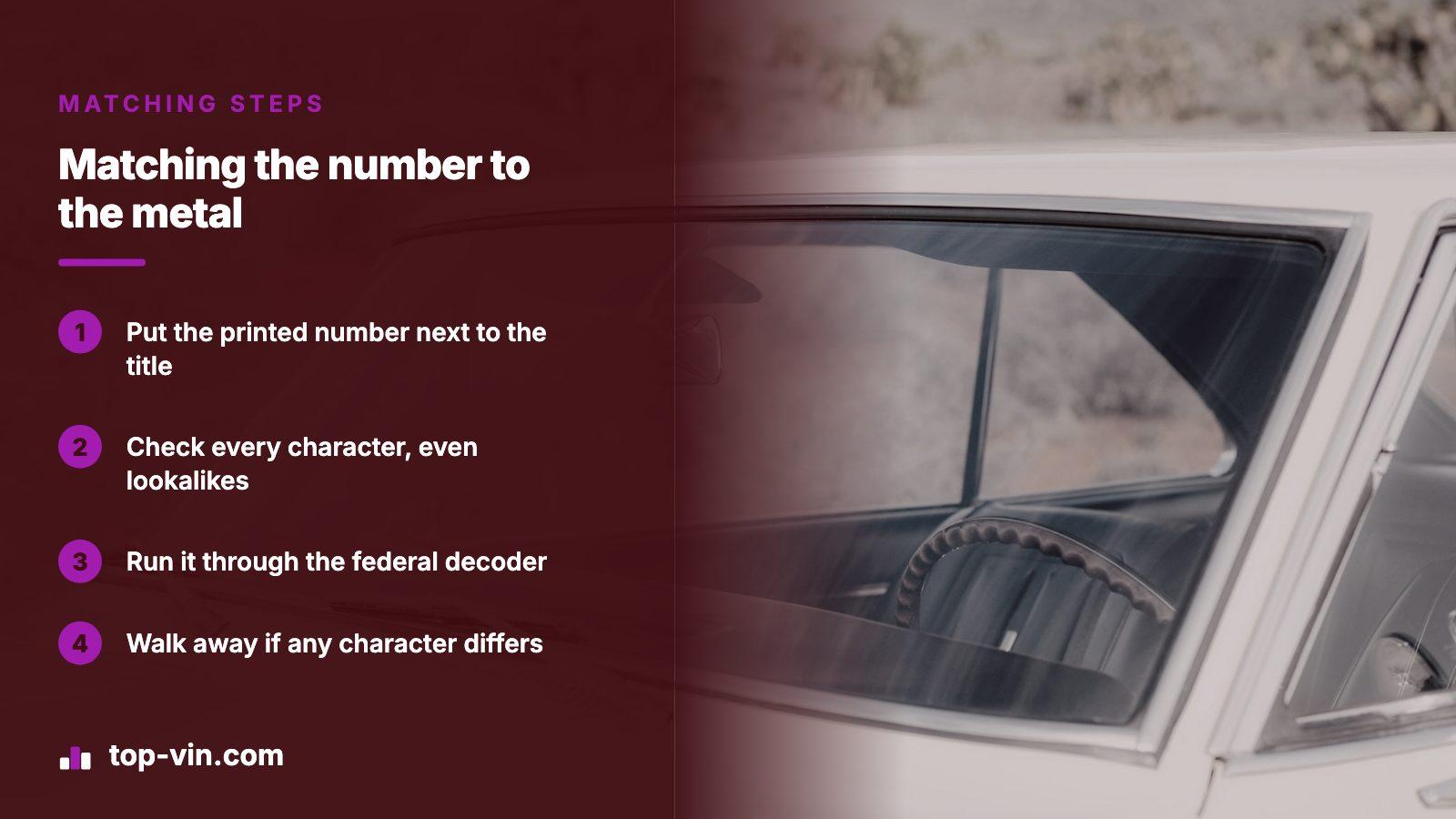
Matching the number to the metal
A VIN typed into a form tells you about whatever car owns that number. It tells you nothing about the car in the driveway unless the two agree, so compare them yourself before paying.
- Put the number printed on the vehicle next to the title's entry.
- Check that every character in the title matches, including letters that look like digits.
- Run the number through the decoder from NHTSA and confirm the make, model and year fit the car you are viewing.
- Walk away if any character differs, or if the seller will not let you look.
Registration can call for a VIN and safety-equipment inspection, and New Mexico allows approved outside inspectors to carry it out in place of division staff. If a car has been rebuilt or assembled from parts, an inspection like this is a reasonable extra step.
Running the VIN through TopVIN
Enter the 17 characters on TopVIN and open the preview. Viewing it costs nothing, and it hints at whether the record is worth reading in detail. The complete report is bought once per vehicle, no subscription attached, and the pricing page lists the pack sizes.
| Record to look at | Why it matters on a New Mexico car |
|---|---|
| Title brands | Salvage, flood and other brands follow the car from the state that applied them |
| Theft record | A stolen car can arrive with paperwork that looks tidy |
| Odometer readings | A drop, or a long gap between entries, needs an explanation |
| Liens | A loan on the car can complicate a private sale |
| Open recalls | Safety repairs the maker may still owe the vehicle |
Salvage titles in New Mexico and why the history matters
State code gives salvage vehicles their own paper trail. Transferring one requires a salvage title, and once a title carries the brand, every later transfer has to use a branded title. A non-repairable car can go only to a licensed recycler, while the seller of a car not yet branded must mark the face of the title by hand in large lettering.
The rules above come from a copy of the code whose salvage sections were last amended long ago, so confirm what applies today with the MVD. Meanwhile the Justice Department notes that the title system keeps a brand once any state has applied it, so a car sold in New Mexico may wear a brand applied in another state. Pulling the history is the fastest way to find out.
Read the brand before the price
A rebuilt car can be a fair purchase when the price reflects the brand and a mechanic has gone over the repair work. A seller who concealed the brand deserves little trust on everything else.
What no VIN report replaces
The national system holds a slice of what a state keeps on file, so the Justice Department suggests buyers also request the state's fuller title record. It also recommends an independent inspection alongside any history report. A clean preview is a good sign, not a verdict.
- Have a mechanic examine the car before you pay.
- Confirm the seller is the named titleholder and read each brand on the title.
- Keep the report, a photo of the title and the bill of sale together.
- Check open recalls with NHTSA, which costs nothing.
Where this information comes from
- 18 U.S.C. 2721 on GovInfo — The federal limits on releasing vehicle record data and the permitted uses.
- New Mexico Administrative Code 18.19.3 — Salvage title handling and authorized VIN inspectors.
- NMVTIS for consumers — What national title data holds and why brands persist.
- State vehicle record request information — How the federal list treats New Mexico's records page.
- NHTSA vPIC VIN decoder — The free decoder for matching a VIN to make, model and year.
Sources and photos: Facts checked against the sources above in November 2026. Photos by Dennis Eusebio, Wesley Tingey and Carrie Allen www.carrieallen.com on Unsplash; diagrams by TopVIN.
Keep reading
- License plate to VIN: the lawful ways to find a car's VIN from its plateThe national picture of plate searches and why they fall short.
- Where the VIN sits on a title, and what to do nextHow to read the number printed on a title.
- Is the VIN on the insurance card? What to check before you trust itPulling the number from an insurance card.
- VIN inspection: what the inspector checks and what a VIN check addsWhen and why a physical VIN inspection helps.
Frequently asked questions
Can I get a VIN from a New Mexico license plate?
Not through the state, if you are a private shopper. Federal law restricts vehicle record data to a list of purposes, and vetting a possible purchase is missing from it. Get the characters from the seller, the title, the insurance papers or the vehicle.
Does a plate lookup reveal the owner's name?
Not lawfully for a shopper. Personal information in motor vehicle records is protected, and the consumer side of the national title system withholds owner identity as well. A site selling a name for a fee is not offering a legitimate shortcut.
Is there a free way to check a car once I have the VIN?
Partly. The federal decoder and recall lookup carry no charge, and the TopVIN preview is free to view. Title, odometer and further records sit in the full report, paid once.
Why would a New Mexico car carry a salvage brand I did not expect?
Brands travel. The national title system keeps a brand once any state applies it, so a car titled elsewhere and sold here can still show one. Seller silence is common, which is the reason to run the VIN before you pay.
What if the plate on the car does not match the paperwork?
Pause and ask the seller to explain it in writing. Lay the registration, the title and the stamped number side by side. A seller with no account of the gap is a reason to leave, since swapped plates can cover a car with a troubled past.
Now check the car itself
The guide explains what to look for. The report shows what this VIN has on record.