THE SHORT ANSWER
Ordinary members of the public cannot search a North Carolina plate for a VIN. The state releases personal vehicle information only to requesters who certify a permitted use under the federal Driver's Privacy Protection Act. Buyers are better served by asking the seller, checking the title or an insurance card, or reading the stamped number on the car, and then trying a TopVIN preview.
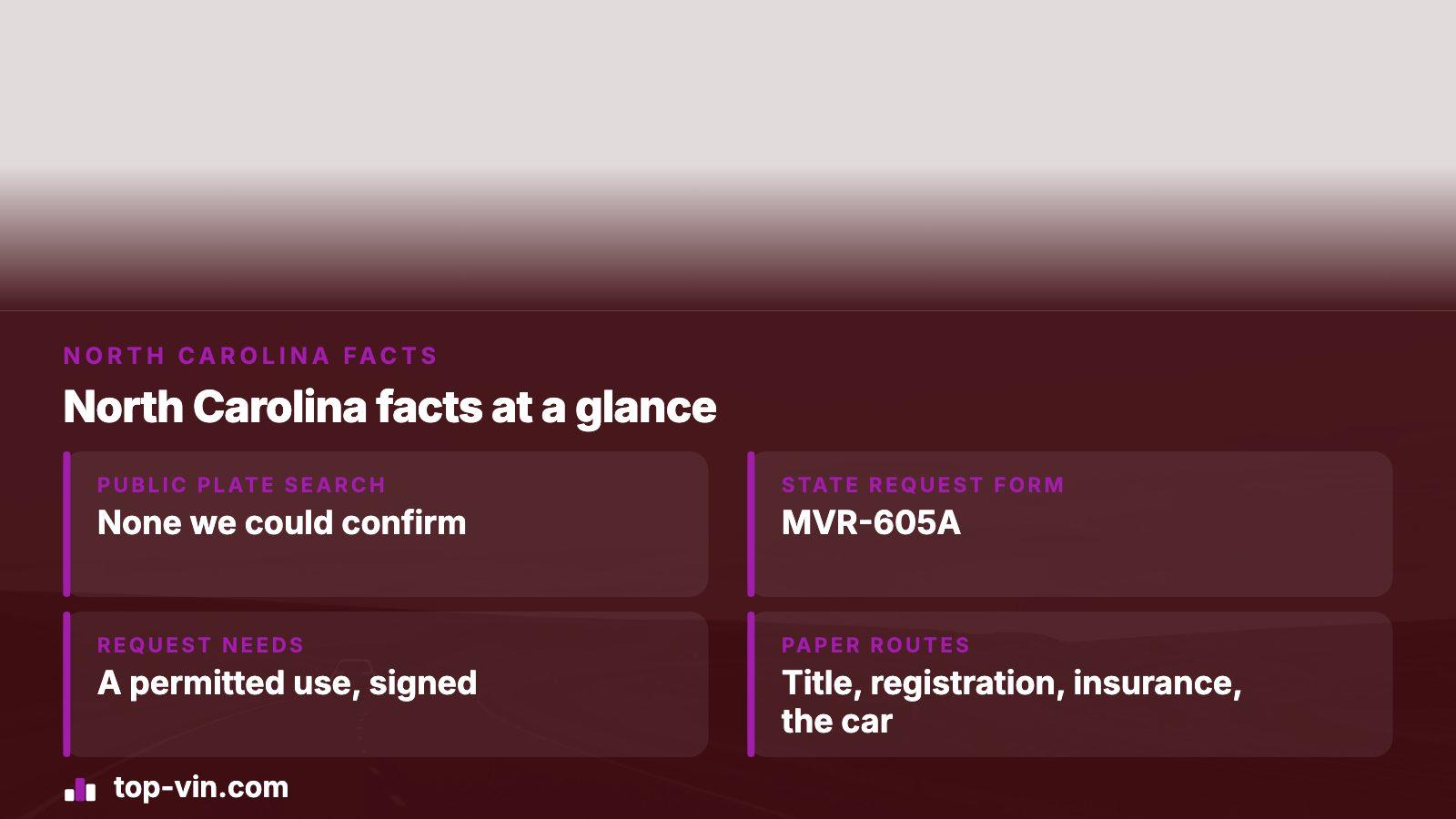
- Public plate search
- None we could confirm
- State request form
- MVR-605A
- Request needs
- A permitted use, signed
- TopVIN
- Free preview, then one payment
Why the plate is the wrong number to start from
TopVIN is built around the VIN, because that is the identifier title agencies, insurers and salvage yards file their records under. A plate is different: it belongs to a registration, it can be moved to another vehicle, and in North Carolina it often comes off the car when the seller is done with it. Two cars can wear the same plate in the span of a year.
That matters when you are standing in a driveway in Raleigh or Charlotte with a plate photo and no number. The photo tells you very little about the vehicle's past. The VIN stamped on the car does, so the whole job is getting that number in a way that is lawful and that you can trust.
What NCDMV's records request actually is
The state's route is a paper form, MVR-605A, titled Request for Motor Vehicle Information. Its check boxes let a qualified person ask NCDMV to identify a record by plate number, vehicle number, registered name, or insurer and policy number. A separate box orders a certified title history, whole or partial.
It is not a search box. The first lines say federal law keeps personal details in motor vehicle files shut to the public, and the back lists fourteen exceptions. You initial the one that fits you, give your reason and sign. Lying to get information is labeled a Class 2 misdemeanor.
| Request | Fee on the form | Where it is mailed |
|---|---|---|
| Vehicle information | $1.25 | RTP Unit, 3148 Mail Service Center, Raleigh |
| Certified title history copy | $16.75 | 3157 Mail Service Center, Raleigh |
The state's records page also lets you hand the form over at the Raleigh or Huntersville plate agencies. A handful of records can be filled while you wait; anything mailed needs about 10 business days once it arrives.
Who the federal rule lets through
The Driver's Privacy Protection Act decides who receives personal data, and the form reprints the allowed purposes. Vetting a car you might buy is absent from the list. These are the purposes ordinary people ask about most.
- An insurer handling a claim, a fraud inquiry or a rating decision.
- A side in a lawsuit or hearing, including enforcing a judgment.
- Reaching the owner after a tow or impound.
- A licensed investigator or security service.
- Anyone holding the record subject's written consent.
- A business confirming details it already has, to stop fraud or collect a debt.
The form flags two catch-all exceptions, open-ended use and bulk marketing, as barred under North Carolina statute. A website that promises an owner's name and address from a plate for a few dollars is offering what the state will not release on those terms.
The paperwork routes that cost nothing
A serious seller already has the number. Request it by text before you drive anywhere, then test it against a second document instead of trusting the message alone.
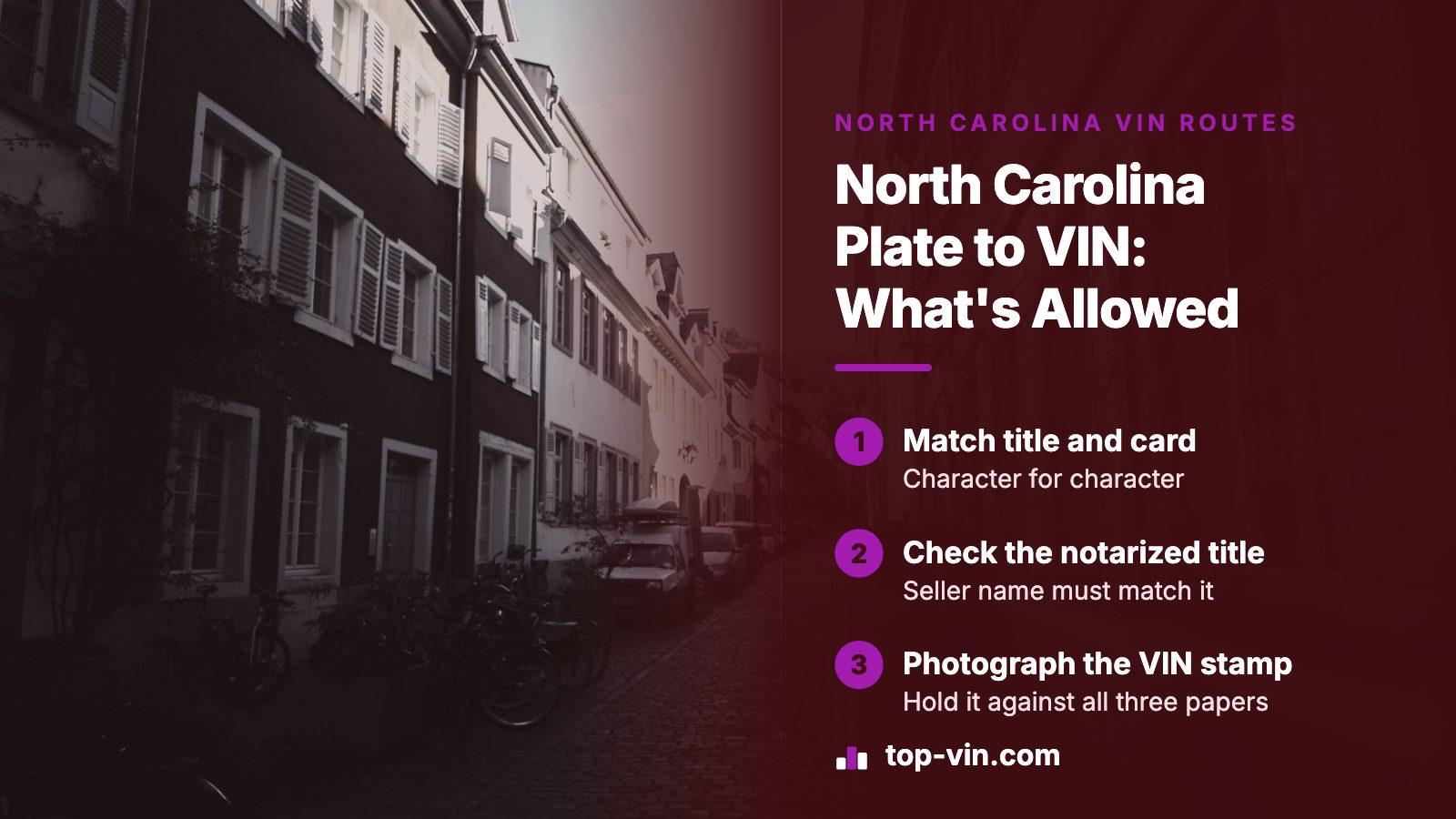
- The title. In this state both parties fill in the back at sale, and the front carries the vehicle's number.
- The registration card, which should agree with the title character for character.
- An insurance card, or the policy screen on the seller's phone, which names the insured vehicle.
- The car itself. Photograph its stamped number and hold it up against all three documents.
When two numbers disagree
One wrong character could be a slip of the thumb. It could equally be a sign that a panel was swapped or a form was edited by hand. Sort it out first, and keep the seller's answer in writing.
North Carolina plate habits that affect a private sale
Do not expect the plate to come with the car. An owner who sells without moving the plate to another vehicle has to turn it in at once, and NCDMV tells them to do that before cancelling coverage. Because insurers tell the state about cancellations and lapses, sellers have a reason to act quickly.
Moving a plate to another car has its own conditions: coverage on both, a current inspection on the receiving car, and a license name matching the title. The buyer's takeaway is simple. A bare rear bumper at pickup is normal, and a seller who offers their plate for the drive home is asking you to lean on insurance that is not yours.
From VIN in hand to a finished check
Put the VIN into the TopVIN search box and the preview opens before any payment step. Check that it describes the same model year, make and model as the listing. When it does, buy the full report in one payment for a single vehicle, or take a multi-vehicle pack when you are shopping around. No plan renews behind your back; amounts sit on the pricing page.
For a North Carolina purchase, read the title brand entries first, then accident and damage records, odometer readings, liens and any salvage or auction photos. A lien matters since the lender must sign off before the seller can pass along an unencumbered title. TopVIN has no plate search and gives back no personal details about an owner.
Reading what comes back
| Finding | Sensible next step |
|---|---|
| Salvage or other title brand | Ask for repair paperwork and price the car as branded, or leave it. |
| Odometer lower than an earlier reading | Suspect a rollback and ask for maintenance receipts. |
| Open lien | Require the lender's release before you pay. |
| Theft record | Stop and verify with police or the insurer. |
| Nothing found | Good news, but not a guarantee; inspect the car. |
The federal NMVTIS program feeds the title side of such reports. The program's consumer page cautions that a spotless result is no promise of a complete history. Coverage stands near 87 percent of U.S. vehicles by its own estimate, and each state sets its own branding standards. Pair any report with a mechanic's inspection.
A short plan before you hand over money
- Get the VIN in writing, then hold it against the title and the car.
- Try the TopVIN preview and see whether it agrees with the ad.
- If it agrees, order the report and start with title, damage and lien entries.
- Inspect the notarized title before paying and confirm the seller's name matches it.
- Have an independent shop look at the car, particularly if anything was flagged.

Where this information comes from
- NCDMV: Request for Motor Vehicle Information (MVR-605A) — form fields, fees and the permitted-use exceptions
- NCDMV: Records and reports — how vehicle records are requested and how long mail takes
- NCDMV: Vehicle titles — what both parties complete on a title transfer and notarization
- NCDMV: License plates — plate surrender and transfer rules when a vehicle is sold
- NMVTIS: Information for consumers — scope and gaps of the national title database
Sources and photos: Facts checked against the sources above in November 2026. Photos by Karwin Luo, Jakub Żerdzicki and John Kakuk on Unsplash; diagrams by TopVIN.
Keep reading
- License plate to VIN: the lawful ways to find a car's VIN from its plateThe same question for any state's plates.
- Where the VIN sits on a title, and what to do nextLocating the number on a title and reading it.
- Is the VIN on the insurance card? What to check before you trust itAnother paper source when the seller is slow to share the number.
- VIN lookup by owner name: what the law lets a buyer seeWhy a name is no better than a plate as a starting point.
Frequently asked questions
Can I find a VIN from a North Carolina license plate for free?
Not through any public lookup we could confirm. NCDMV's records request is for qualified requesters and carries a fee. For a car you are thinking of buying, the free route is the seller, the title, the registration or insurance card, or the stamped number on the vehicle.
Is it legal to ask NCDMV for a VIN using a plate number?
It is legal if you truly fit a permitted use and say so honestly on the form. The form warns that false representation is a misdemeanor. Simply wanting to vet a used car is not one of the listed uses, so most buyers should use other sources.
Does a North Carolina plate stay with the car I buy?
Usually not. NCDMV tells sellers to surrender a plate that is not moved to another vehicle. You register the car yourself and get your own plate, so confirm the title is notarized and the paperwork lines up before you pay.
Will TopVIN tell me who owns a plate?
No. TopVIN does not search plates and does not return owner names, addresses or other personal data. Its starting point is the VIN, and its output describes the car: brands, damage, mileage and liens.
Is the TopVIN report free?
The preview costs nothing. After that, a single report or a pack is bought once and never rebills. The pricing page lists the figures ahead of any purchase.
Now check the car itself
The guide explains what to look for. The report shows what this VIN has on record.