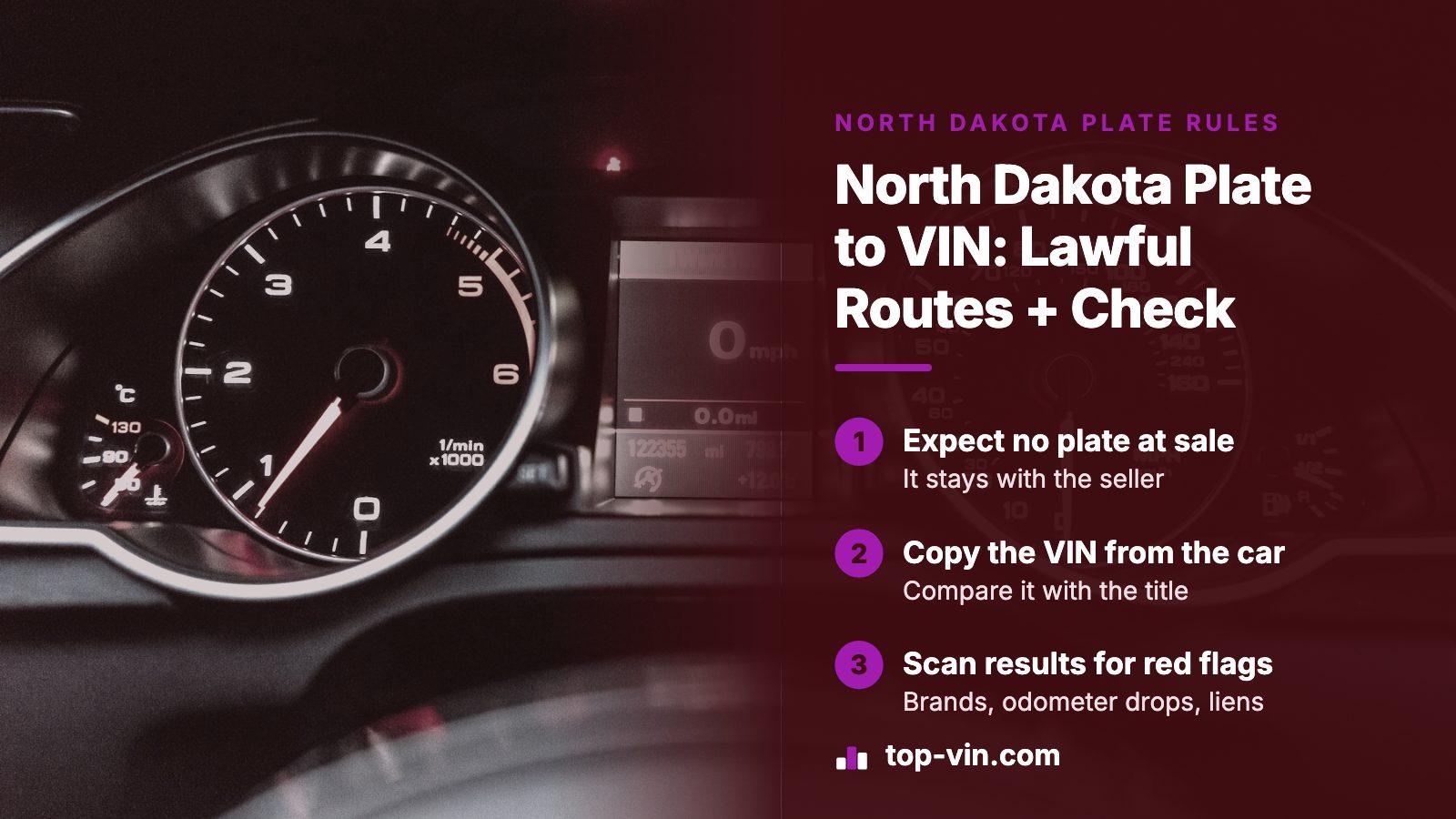
THE SHORT ANSWER
There is no public North Dakota search that converts a plate into a VIN. Have the seller send a picture of the title, copy the number from the vehicle itself, or pull it from the registration or insurance card. The state's Request for Vehicle Information form exists, but release depends on a permitted use. With the VIN in hand, run the check; the preview costs nothing.
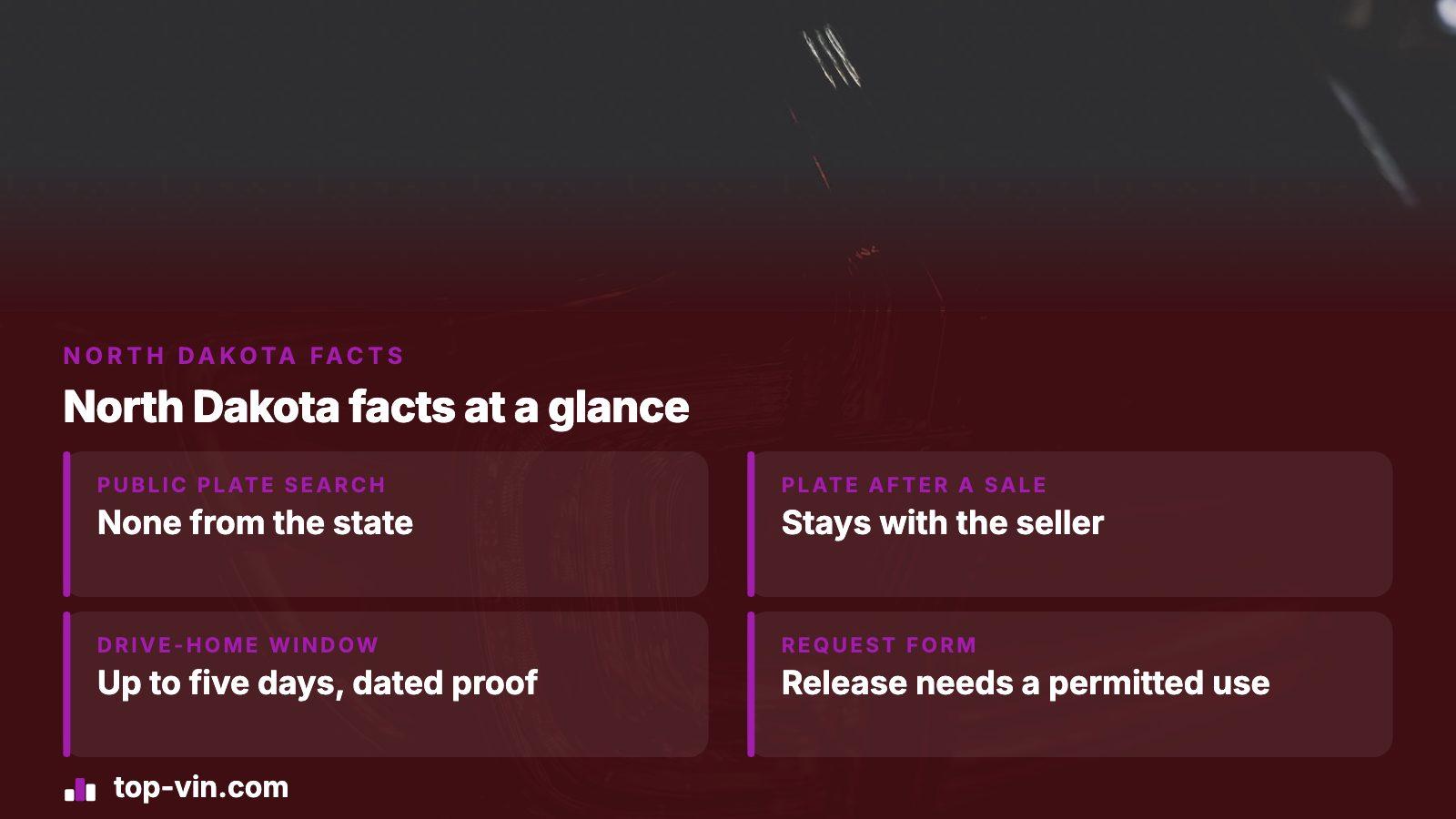
- Public plate search
- None from the state
- Plate after a sale
- Stays with the seller
- Buyer drive-home window
- Up to five days with dated proof
- TopVIN check
- Free preview, then one payment
What a North Dakota plate actually gets you
Sites that advertise an instant VIN, owner name and address for any North Dakota tag are promising something the state does not provide. A plate is a registration tag, and the record behind it holds personal details that federal law restricts. The VIN is different: it is a printed identifier on the car itself, and every serious history database is organized around it.
TopVIN works from the VIN for that reason. It never searches by plate and never returns an owner. The job on this page is to get the 17 characters honestly, from a source that cannot mislead you, and then run the check on the exact vehicle you plan to buy.
Why the plate is often missing in North Dakota
North Dakota follows a plate-with-owner rule. When an owner sells or otherwise transfers a vehicle, the owner takes the plates off, and the car is then treated as unlicensed. So a buyer who walks up to a used car in a driveway will often see no plate to look up at all, and the one on a car still listed for sale may belong to someone who has not yet finished the paperwork.
For a shopper this changes the order of operations. Do not treat a plate in a listing photo as the identity of the car. The identity of the car is the number stamped on it and printed on its title; the plate is only a loose clue.
Plate and VIN disagree? Stop there
Three sources should give one answer: the title, the car and whatever the seller texts you. When they differ, keep your money in your pocket. Ask for an explanation in writing and have the vehicle inspected before you go further.
Five lawful ways to get the VIN
Work through these in order. The first four are free, quick and enough for nearly every buyer.
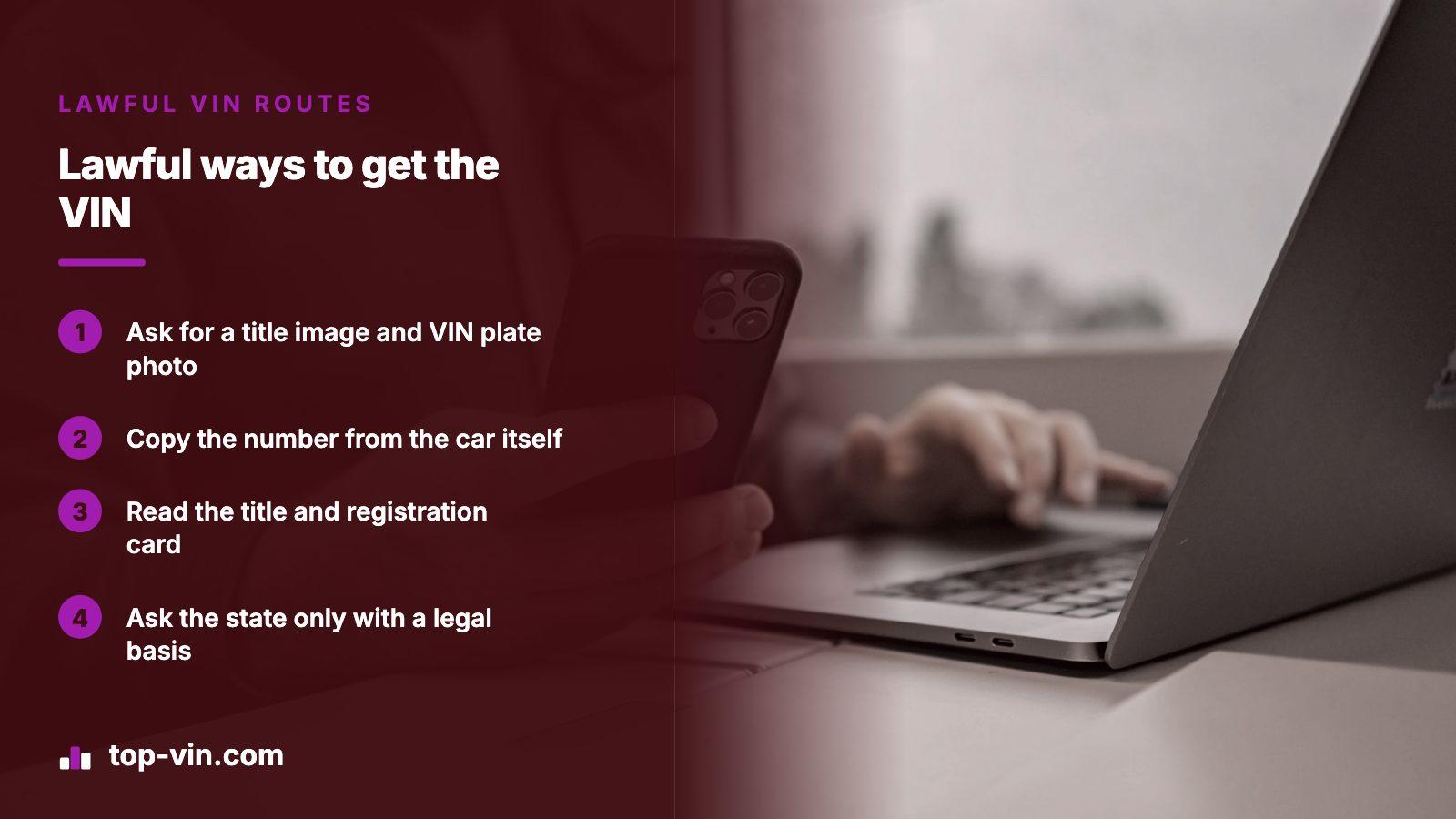
- Ask the seller to send a sharp image of the title's front side and of the VIN plate on the car.
- Go to the car and copy the number yourself, then compare it with the title.
- Read the title, which sits the VIN beside the make and model year.
- Check the registration card or the insurance card, both of which normally list it.
- If you have a legal basis, ask the North Dakota Motor Vehicle Division for the record through its own process.
Items one through four put the proof in your hands. A seller who stalls on a simple photo has told you something useful before any report runs.
The state records route and its limits
The division's Request for Vehicle Information, SFN 51269, is the paper trail for establishing the current registered owner, address and any lienholder. The registration manual mentions a $3 processing fee in the context of a mobile home lien. That is one example, not a price list for every request, so confirm the current terms and whether you qualify before you send anything.
The DOT pages that describe records and history reports did not open for our automated read, so we cannot tell you the full steps, turnaround or who gets approved. Call the division and ask. The answer depends on your reason, because release is governed by the Driver's Privacy Protection Act rather than by the state's goodwill.
What the Driver's Privacy Protection Act allows
Section 2721 of the federal criminal code, the Driver's Privacy Protection Act, forbids a state DMV to knowingly release personal details from a vehicle record unless one of its listed purposes fits. Curiosity and a wish to find out who owns a car are not on the list. The permitted uses are narrower and tied to a purpose.
| Permitted use | Plain meaning |
|---|---|
| Government and courts | Agencies and law enforcement doing their work |
| Safety, theft and recalls | Matters of vehicle safety, theft, emissions and advisories |
| Legal proceedings | Service of process and investigation tied to a case |
| Insurers | Claims, antifraud, rating and underwriting |
| Towed or impounded vehicles | Notice to the owner |
| Written consent | A requester who shows the individual agreed |
Anyone who resells or passes along the information has to keep records of who received it and why for 5 years. A buyer sizing up a used car almost never fits one of these categories, which is exactly why the VIN routes above matter.
Run the VIN through TopVIN
Enter the VIN at TopVIN and the free preview shows what car it decodes to before any money changes hands. When make, model and year fit the listing, you may buy the full report as one payment, with no subscription attached. See the pricing page for amounts; only the preview costs nothing.
The report is most useful for the things a plate can never tell you: title brands such as salvage, odometer readings across years, accident and damage records, liens, theft entries and open recalls. Those attach to the VIN and follow the car across state lines, which matters in a state where vehicles often arrive from elsewhere.
Warning signs in the results
- A brand such as salvage or flood on the title history of a car sold as clean.
- Odometer readings that go down between entries or stall for years.
- An open lien on a car the seller calls paid off.
- A theft record, or a make and model that does not match the VIN decode.
- Open recalls the seller never mentioned.
One flag is a question for the seller. Several together are a reason to walk. Remember that a history report only shows what was reported, so pair it with an in-person inspection.
Buying paperwork and the drive-home window
Once you own the car, North Dakota lets you drive it for as long as five days from acquisition with no registration showing, so long as dated proof of ownership rides along. A dated bill of sale or a dated copy of the title counts. The division also offers a self-issuing temporary permit valid 75 days from acquisition.
Title transfer goes through the state's title and registration application, form SFN 2872, and the license fee for a full year comes due then, minus any credit. Where a lien is on record, the title goes to the lienholder. Check the VIN and the title before you pay, not after.
Free tools that start from the VIN
North Dakota's online title status search takes a VIN, letters and digits only with no dashes or spaces, and reports the processing status of a title. NHTSA's vPIC decoder turns a VIN into manufacturer-submitted specifications, and the federal NMVTIS site explains the national title database.
What the free tools do not do
They will not list accident history, odometer entries over time or a full record of title brands in one place. That gap is where a paid report earns its place, after the free preview shows the VIN matches.
Where this information comes from
- NDDOT: Motor Vehicle Registration Manual — Plate-with-owner rule, drive-home window, temporary permit, title form and records request form.
- NDDOT: Online Title Status Search — A state tool that starts from a VIN to show title processing status.
- 18 U.S.C. 2721 on govinfo.gov — The federal rule on releasing personal information from motor vehicle records.
- vehiclehistory.gov: NMVTIS — What the national title information system is for.
- NHTSA: vPIC API — VIN decoding from manufacturer-submitted data.
Sources and photos: Facts checked against the sources above in November 2026. Photos by Ambitious Studio* | Rick Barrett, Anastasiia Nelen and A n v e s h on Unsplash; diagrams by TopVIN.
Keep reading
- License plate to VIN: the lawful ways to find a car's VIN from its plateThe general version of this question for any state.
- License plate lookup privacy laws: what you can and cannot get from a plateWhy owner details are protected and what that means for you.
- Where the VIN sits on a title, and what to do nextReading the VIN printed on a title.
- South Dakota license plate to VIN: the lawful routes, then the checkThe same question for the neighboring state.
Frequently asked questions
Can I find a VIN from a North Dakota license plate?
Not through a public state tool. The state does not offer one, and federal law limits release of personal details. Ask the seller, read the number off the vehicle, or find it on the title, registration or insurance card, then check that VIN.
Does TopVIN look up North Dakota plates?
No. TopVIN starts from the VIN and never returns an owner name or address. If you only have a plate, use the lawful routes on this page to get the number first, then run the preview.
Is the TopVIN report free?
The free part is the preview alone. The complete report is bought once, with no subscription, and the amounts are published on the pricing page.
Why does the car I am looking at have no plate?
North Dakota requires the owner to remove plates when a vehicle is sold or transferred. A plateless car is normal, so rely on the VIN on the title and the vehicle instead.
Can the state tell me who owns a car?
Only for a permitted use under the Driver's Privacy Protection Act, such as a court matter or written consent. Call the Motor Vehicle Division to ask whether your reason qualifies before filing a request.
Now check the car itself
The guide explains what to look for. The report shows what this VIN has on record.