THE SHORT ANSWER
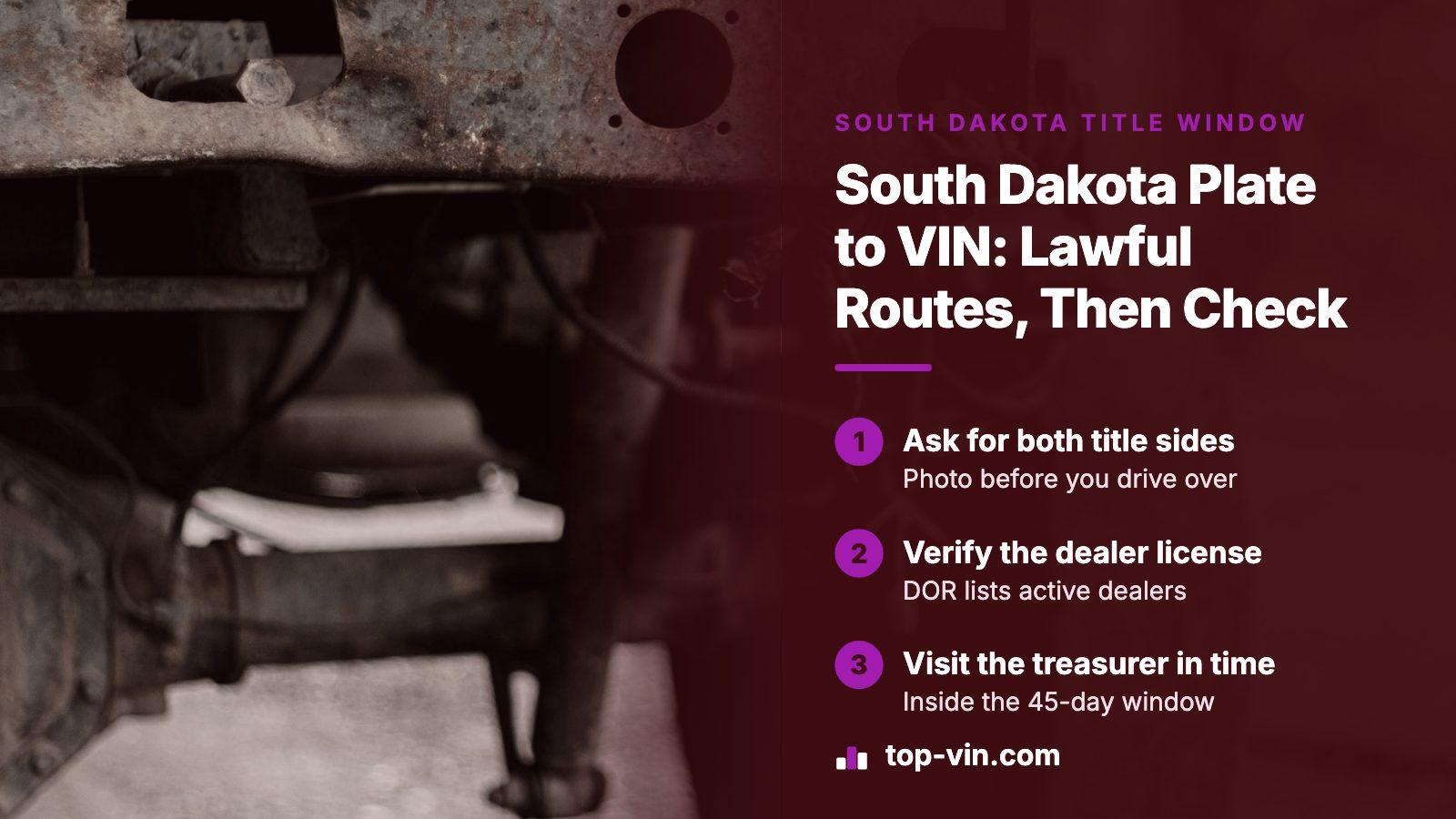
There is no instant plate lookup for private buyers in South Dakota. The Motor Vehicle Division requires a written form, the Secured Vehicle Information Request (DPPA) Form, before records are released, and the federal Driver's Privacy Protection Act narrows who qualifies. A shopper's practical path is the seller's title or the car itself, then a TopVIN preview of the number.
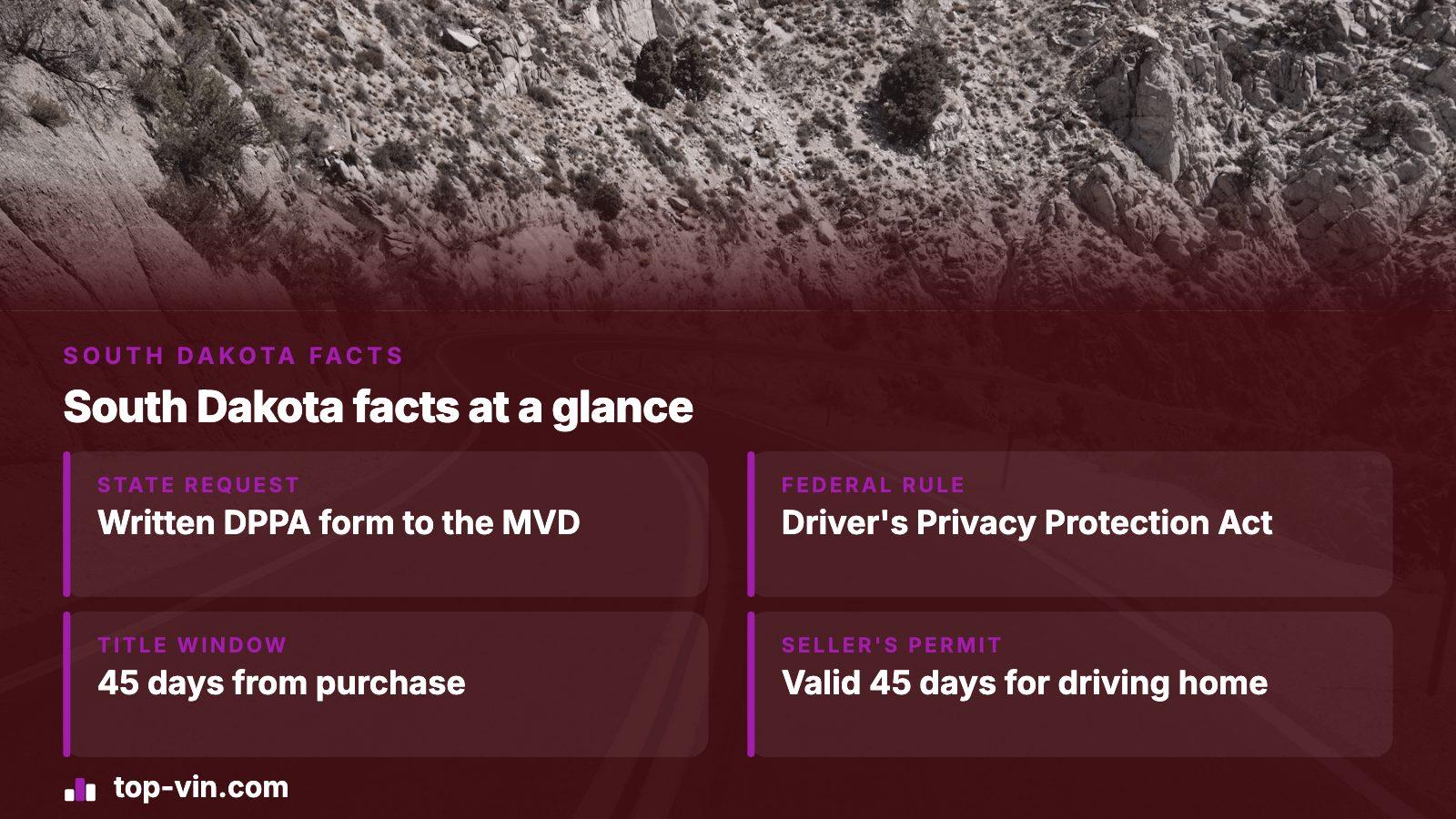
- State request
- Written DPPA form to the Motor Vehicle Division
- Federal rule
- Driver's Privacy Protection Act, 18 U.S.C. 2721
- Buyer's title window
- 45 days from purchase
- TopVIN step
- Free preview, then one payment
What South Dakota asks for before it releases a record
A listing photo shows a plate, the ad leaves out the VIN, and the natural thought is that the state can fill the gap. The Department of Revenue's Motor Vehicle Division keeps and maintains the vehicle records, but its own page says a written form has to reach the division before any motor vehicle record is released. That form is called the Secured Vehicle Information Request (DPPA) Form.
There is no search box where a plate number returns a VIN on the spot. We could not open the form page itself, which refused automated readers, so we cannot tell you its fields, its fee or how long a request takes. For questions about the form, the division lists a phone number on its page, 605-773-3541.
Why the state is so strict about it
The form exists because of the Driver's Privacy Protection Act, section 2721 of title 18 of the federal code. A state motor vehicle agency, its employees and its contractors may not knowingly hand out personal information from a vehicle record unless one of the permitted uses applies. Allowed users include courts and agencies, insurers handling claims, anyone notifying owners of towed cars, licensed private investigators, and a requester carrying the individual's signed consent.
Business use is allowed, but narrowly: a company may confirm what a customer told it, and correct it if wrong, to head off fraud or recover a debt. Sizing up a car before paying for it is not on the list. A website that sells the owner behind a South Dakota plate is offering something the state could not lawfully give you, so treat any such promise with suspicion.
Places the VIN is already sitting
The plate is a poor handle on a car anyway. The vehicle number appears in several places that a buyer can reach with a phone call or a flashlight.
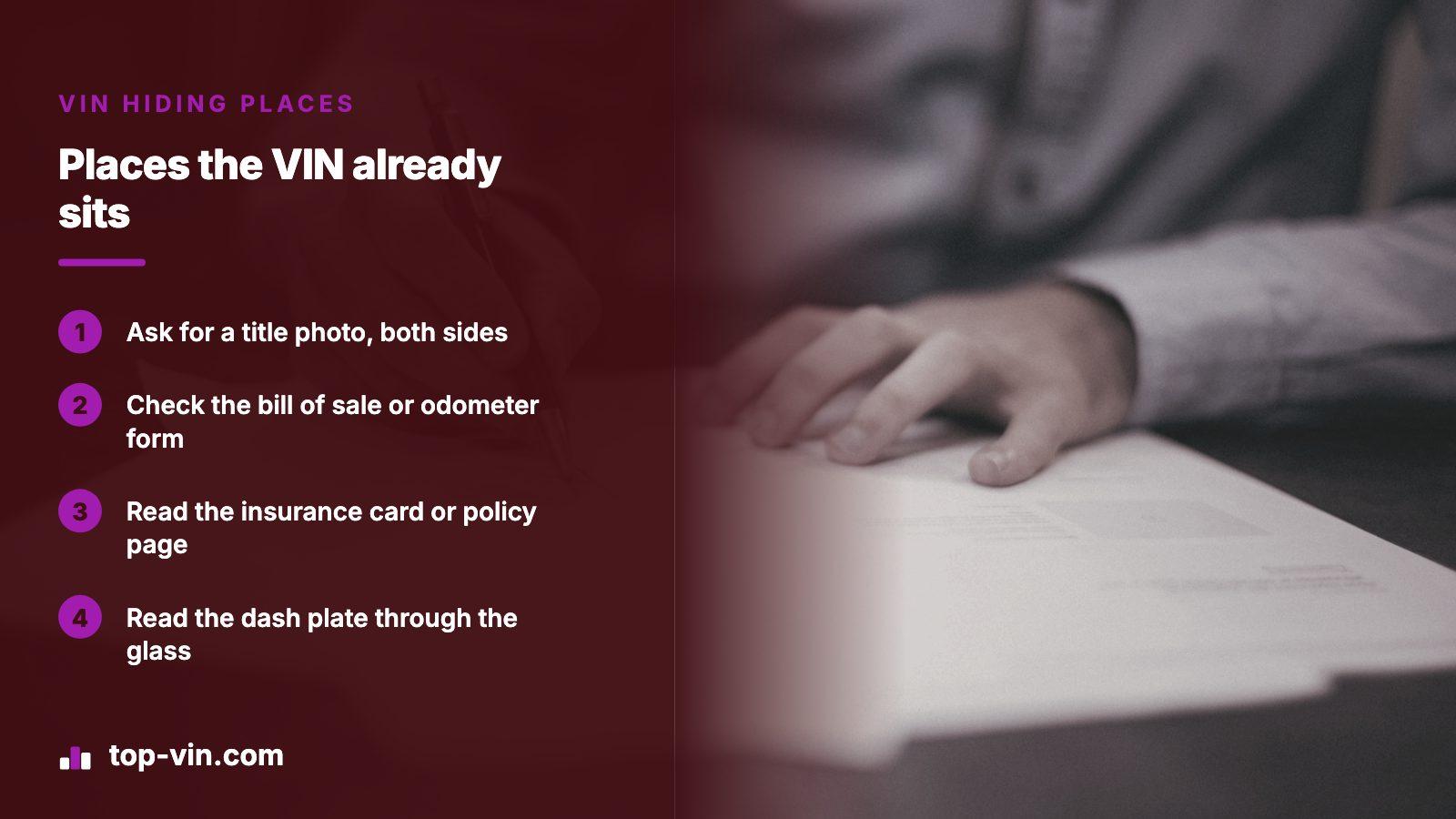
- The South Dakota title. The state describes it as the legal record of each ownership change, and it prints the make, model year and VIN. Ask for a photo of both sides before you drive over.
- A bill of sale or an odometer disclosure, which DOR offers as online forms and which sellers often fill in with the number.
- The insurance card or policy page the seller carries.
- The stamped plate on the dashboard corner nearest the driver, which you can read through the glass.
- A dealer's own paperwork. DOR publishes an active dealer list, updated daily, so you can confirm that a seller with a lot is licensed.
Make the numbers agree
Line up three readings: the dashboard plate, the door-post sticker and the title. One wrong character is a reason to pause the sale. It could be a clerical slip, or it could be a replaced part or a different car than advertised.
What a TopVIN check adds once you hold the number
Enter the VIN at TopVIN and you get a preview at no charge. It confirms that the make and year fit the ad and shows which record groups the lookup found. Each purchase option is listed on the pricing page, and a full report is a one-time buy that never renews.
On a South Dakota car, start with title brands, then damage and salvage entries, odometer readings and liens. Those sections settle questions a plate cannot: was the car a total loss, did its mileage ever drop, and does a lender hold a claim.
Reading the results like a buyer
Titling agencies stamp a car with a brand when it is, or once was, junk, salvage or flooded. Every state sets its own threshold, so the same wreck might be branded where it happened and escape a label somewhere else. A clean South Dakota paper title therefore proves less than it appears to.
| What shows up | What it may mean | Next step |
|---|---|---|
| Brand from another state | History the seller left out | Ask for the earlier title and an explanation |
| Total loss entry on an ad that says clean | An insurer wrote it off before resale | Walk away or price in the repair risk |
| An earlier reading higher than the latest | A possible rollback, or a clerk's typing mistake | Request service records that list odometer readings |
| Open lien | A lender may still hold the title | Get a written release before you pay |
Liens and the electronic title
South Dakota runs an electronic lien and title system. With a lien on record, the state prints no paper title unless a legal exception applies, so an owner who is still paying off the car may have nothing physical to hand you. Once the last payment arrives, the lender must release the lien within 20 days, free of charge.
When a seller claims the loan is cleared, ask to see the lender's release or a title issued afterward. An open lien in a history report is the fastest way to learn that the claim and the record disagree.
South Dakota's rules after you buy
A buyer has 45 days from the purchase date to update the title, and the application goes through the county treasurer's office, signed by the record owner or an agent with a power of attorney. DOR lists a $10 title fee, a motor vehicle excise tax of 4% of the purchase price and a $2 technology fee. Confirm current amounts with the treasurer before you go.
- A private seller must hand over a free seller's permit, valid 45 days, so the buyer can drive until the title is done. Skipping it is a class 2 misdemeanor.
- A buyer who needs longer can buy a temporary permit for 5 to 15 days at $1 a day.
- Late titling adds $1 for each week past the grace period, capped at $50.
- Someone with no South Dakota license or ID and no street address in the state pays an extra $100, and a P.O. box or mail forwarding address is not accepted as one.
If a plate really is all you have
Sometimes there is no seller to ask: a car abandoned near your property, a hit-and-run, a repossession. Those cases belong to the people the privacy law names. Police can pursue a plate through their own channels, an insurer working a claim has its own permitted use, and a court can order records inside a case.
If you think you qualify, the written request to the Motor Vehicle Division is the route, and you will need to state a use that matches the federal list. Shopping for a purchase will not match. A request that misstates the reason causes more trouble than a missing VIN ever could.
What to do with what you find
A clean report means keep looking, not sign. Add a test drive, a look under the car and an independent mechanic. The national title system itself cautions that a search may come back empty when a source has not reported, so a clean result is useful but never final.
- Run the VIN yourself instead of accepting a screenshot from the seller.
- Confirm that the make, model and year in the report fit the vehicle sitting in front of you.
- Settle any lien before money moves, and keep the lender's release.
- Book the county treasurer visit inside the 45-day window.
Where this information comes from
- South Dakota DOR: Motor Vehicle Division — The written DPPA request rule, the form's name and the division's contact number.
- South Dakota DOR: title, fees and registration — The 45-day window, listed fees, the non-resident fee and electronic lien rules.
- South Dakota DOR: cars, trucks and vans — Seller's permit, temporary permits, dealer list and county treasurer titling.
- 18 U.S.C. 2721, Driver's Privacy Protection Act — The federal limit on releasing personal information and its permitted uses.
- NMVTIS for consumers — What a brand is, why states differ and why a search can miss records.
Sources and photos: Facts checked against the sources above in November 2026. Photos by Zoshua Colah, Scott Graham and Will Truettner on Unsplash; diagrams by TopVIN.
Keep reading
- License plate to VIN: the lawful ways to find a car's VIN from its plateThe same question for any state, and why the answer rarely changes.
- License plate lookup privacy laws: what you can and cannot get from a plateWhy plate searches are restricted and what sites cannot lawfully sell.
- Motor vehicle records: what a car buyer can see, and what stays closedHow a state record differs from a history report.
- How to read a VIN: a left-to-right walkthrough with a worked decodeRead the number you collected, position by position.
Frequently asked questions
Can I look up a VIN by license plate in South Dakota?
Not on demand as a private buyer. The Motor Vehicle Division asks for a written form before it releases records, and the federal privacy law limits who qualifies. Shoppers get the VIN from the seller, the title or the car itself, then check that number.
Is there a free South Dakota plate to VIN tool?
None that we could confirm from official pages. Sites that claim to return an owner from a South Dakota plate are not selling what the state may release. Tools that do work start from a VIN, and a TopVIN preview is free to view.
Does the privacy law stop me from checking a car?
No. The act protects personal information about people in motor vehicle records. A VIN check looks at the vehicle, not the owner, so you can run any number you hold. That is why asking the seller for it is the usual route.
How long do I have to title a vehicle I buy in South Dakota?
DOR says 45 days from the purchase date, handled through the county treasurer. Late applications add a weekly penalty after the grace period. Check the current fees with the treasurer, since listed amounts can change.
Is the TopVIN report free?
No, only the preview carries no charge. The complete report is bought once and does not rebill. Look at the pricing page to see what each option covers before you pay.
Now check the car itself
The guide explains what to look for. The report shows what this VIN has on record.