
THE SHORT ANSWER
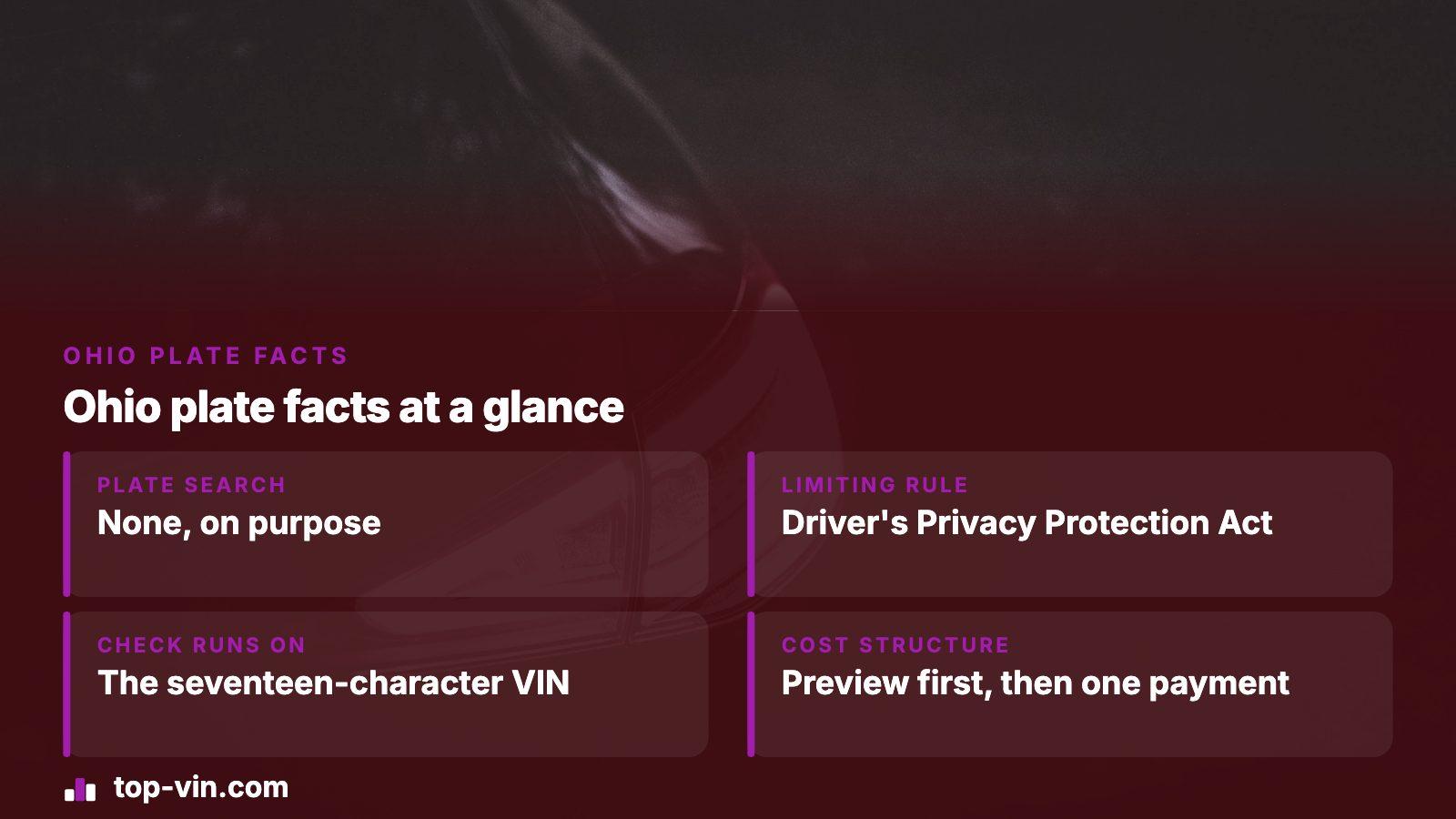
Skip the plate-search sites. Ohio releases personal record data only for purposes federal law lists, and vetting a car you might buy is not among them. Instead, have the seller send the VIN as text, confirm it against the title and the car, and enter it at TopVIN. A preview appears first, costing nothing; the complete report is one payment.
- Ohio plate search at TopVIN
- None, on purpose
- Rule that limits record releases
- Federal Driver's Privacy Protection Act
- What the check runs on
- The seventeen-character VIN, not the plate
- Cost structure
- Free preview, then a single payment
The short version for an Ohio buyer
You are standing in a driveway in Ohio, or looking at a listing photo, and the only identifier you have is the plate. It feels like enough. It is not, because a plate belongs to a registration record and can move from one vehicle to another, while the VIN stays with one specific car for life.
The practical route is short. Collect the VIN from the person selling the car, confirm it against paper and metal, and run the check on the number. Everything a buyer worries about, from brands on the title to odometer entries to theft flags, is indexed by VIN, so the plate adds nothing once you hold it.
Why a public Ohio plate-to-VIN tool does not exist
Under federal law, specifically the Driver's Privacy Protection Act in Title 18, a state motor vehicle department and its staff and contractors cannot knowingly release personal details from a vehicle or license record unless a listed purpose applies. Those details are a name, a street address (the five-digit ZIP is excluded), a phone number, a driver ID number, a photo, a Social Security number and medical information.
Running a plate search amounts to asking someone to open that file. The statute's purposes revolve around official duties and legal matters, and a shopper sizing up a used car is not on the list. For that reason TopVIN has no plate search and never shows who owns a car. A site claiming otherwise is guessing, or selling stale data.
Who the federal statute does allow in
Only a few permitted purposes come near a plate request, and each turns on what the requester is actually doing:
- Courts, police and agencies carrying out government work.
- Insurers handling a claim, hunting fraud or pricing a policy.
- People in a lawsuit or hearing, such as someone delivering court papers.
- Notifying whoever owns a vehicle that was towed or impounded.
- Licensed private investigators working under one of the other purposes.
- Matters of safety, theft, emissions and recalls.
- A requester who has the person's own signed permission.
A company that receives such data and resells it is bound by the same list, and must keep a log of who got it and why for 5 years. That obligation is the reason proper channels ask what you plan to do with the record.
Ohio's records process: verified and unverified
When a permitted purpose genuinely applies to you, say a claim file or a lawsuit, the request goes to whichever Ohio agency keeps vehicle records. Federal law lets the state charge an administrative fee for producing a record, and forbids it from making a person obtain consent before getting their own.
What we could not confirm
Ohio's Bureau of Motor Vehicles website refused our automated reading on every page we tried, and the state's online law library was rejected or missing too. We therefore cannot quote an Ohio form name, a fee, a processing time or an Ohio statute. Read the agency's current instructions before filing, and certify a purpose only if it is honestly yours.
Four lawful ways to get the VIN in Ohio
None of these needs a records request, and most take less than five minutes. Stop once two independent sources agree.
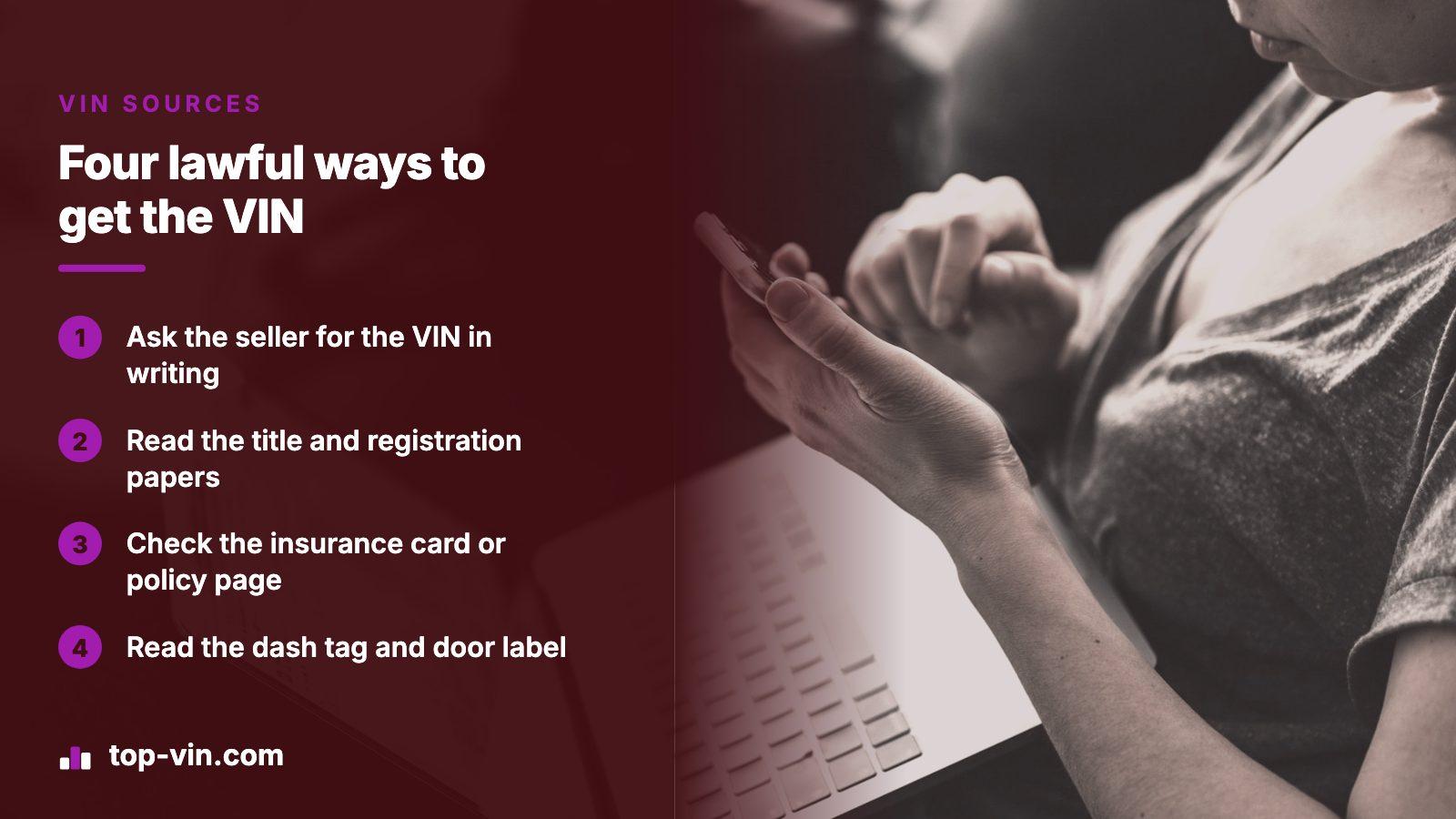
- Ask the seller to send the VIN in writing before you drive out. A private seller or dealer with an honest car has no reason to refuse.
- Read it from the title in the seller's hands or from the registration papers, and see whether both agree.
- Check the insurance card or policy page, where the owner's carrier usually lists the insured vehicle.
- Look at the vehicle: the metal plate at the base of the windshield on the dash corner, plus the sticker on the driver-side door pillar.
Spend a minute comparing every character. A transposed digit returns a different car, or none at all, and a mismatch between the paper and the metal is a finding in its own right.
Running the check on the number you collected
Enter the VIN at TopVIN and the preview opens with no payment. It tells you whether the car matches its listing, a quick first filter: if the ad claims one model year and the decode returns another, you learned that before spending a cent.
If the preview matches, the complete report costs one purchase and nothing recurs afterward. On an Ohio car, read these parts first: title brands, damage and total-loss records, odometer entries, and any theft or lien flag. Cars cross state lines often, so history logged elsewhere can matter more than anything recorded in Ohio. Current costs live on the pricing page.
Reading the results and spotting red flags
| What shows up | What it suggests | Next step |
|---|---|---|
| A salvage, junk or flood brand | A state title office has marked the car as damaged or written off | Walk away or get a price that reflects the brand and a full inspection |
| Mileage that drops between entries | Possible odometer tampering or a reporting error | Ask for service records that show the true readings |
| Theft record or open lien | The seller may not be free to sell it | Do not pay until it is cleared in writing |
| Decoded model differs from the ad | Wrong listing details or a swapped identity | Re-check the VIN on the car and ask why |
| A clean report | Nothing adverse was reported, which differs from nothing having happened | Get an inspection anyway |
The federal title system describes brands as labels applied by state titling agencies, and it keeps the brand history from any state that applied one. It also notes that a clean report is good news but that repair and maintenance histories sit outside what it is built to hold.
A last pass before any cash changes hands
- Match the VIN given by the seller against the paperwork and the vehicle itself.
- Open the preview and compare it line by line with the advertisement.
- Should the car still suit you, order the full report and start with the title entries.
- Inspect the paper title in person, and demand a written lien release when a lender appears.
- Hire a mechanic for an independent look, then test drive on city streets, an interstate and in heavy traffic.
- Request maintenance records, and speak with the earlier owner if one is reachable.
Inspection, a test drive and a history report together mirror the federal used-car advice, which adds that a title-system report costs only a small fee.
Where this information comes from
- Driver's Privacy Protection Act, 18 U.S.C. 2721 — The release ban, the permitted purposes, the five-year record duty and the fee rule.
- DPPA definitions, 18 U.S.C. 2725 — What counts as personal information.
- Understanding an NMVTIS vehicle history report — What the federal title report covers, and what brands mean.
- Used car buying tips, vehiclehistory.gov — Inspection, test drive and records advice.
- NHTSA vPIC VIN decoder — A VIN decodes to make, model, year and plant.
Sources and photos: Facts checked against the sources above in November 2026. Photos by John Kakuk, Michal Biernat and Maurice Sahl on Unsplash; diagrams by TopVIN.
Keep reading
- License plate to VIN: the lawful ways to find a car's VIN from its plateThe nationwide picture of why plates and VINs differ.
- Where the VIN sits on a title, and what to do nextWhere to read the number on the paper title.
- Is the VIN on the insurance card? What to check before you trust itUsing the insurance card as a second source.
- VIN Lookup by License Plate in Michigan: Get the Number, Then Check ItThe same question for the neighboring state to the north.
Frequently asked questions
Can a free Ohio plate search give me a VIN?
Not through a public tool we could confirm. Federal law restricts what states release from vehicle records, and car shopping is not a listed purpose. The seller can send the VIN, or you can read it from the title or the car. The TopVIN preview for that number is free, though the full report is paid.
Is it legal to find the owner of an Ohio plate?
Only for the purposes the federal statute lists, for example an insurance claim, a court case, police work or the owner's signed consent. Curiosity and shopping do not qualify. With a genuine permitted purpose, apply through the state agency, state it truthfully and accept that misuse carries legal risk.
Why does a plate site show a VIN for an Ohio car?
Some sites resell old or partial data or infer from public listings. Treat any number from them as unverified, and match it against the title, registration and dashboard plate before using it. Never pay for a history report on a VIN nobody has matched to the actual car.
What should I do if the seller refuses to share the VIN?
Read that as a warning. An honest seller can copy the number off the dash in seconds. If they stall, refuse or send digits that fail to match the car, leave. Other cars are for sale, and no report can repair a seller who hides the identifier.
Is a spotless TopVIN report proof the car is safe?
No. Spotless means nothing negative was reported against that VIN, and the federal title system itself says repair and maintenance histories are outside its scope. Use the report to weed out bad cars, then pay a mechanic to inspect the one you like.
Now check the car itself
The guide explains what to look for. The report shows what this VIN has on record.