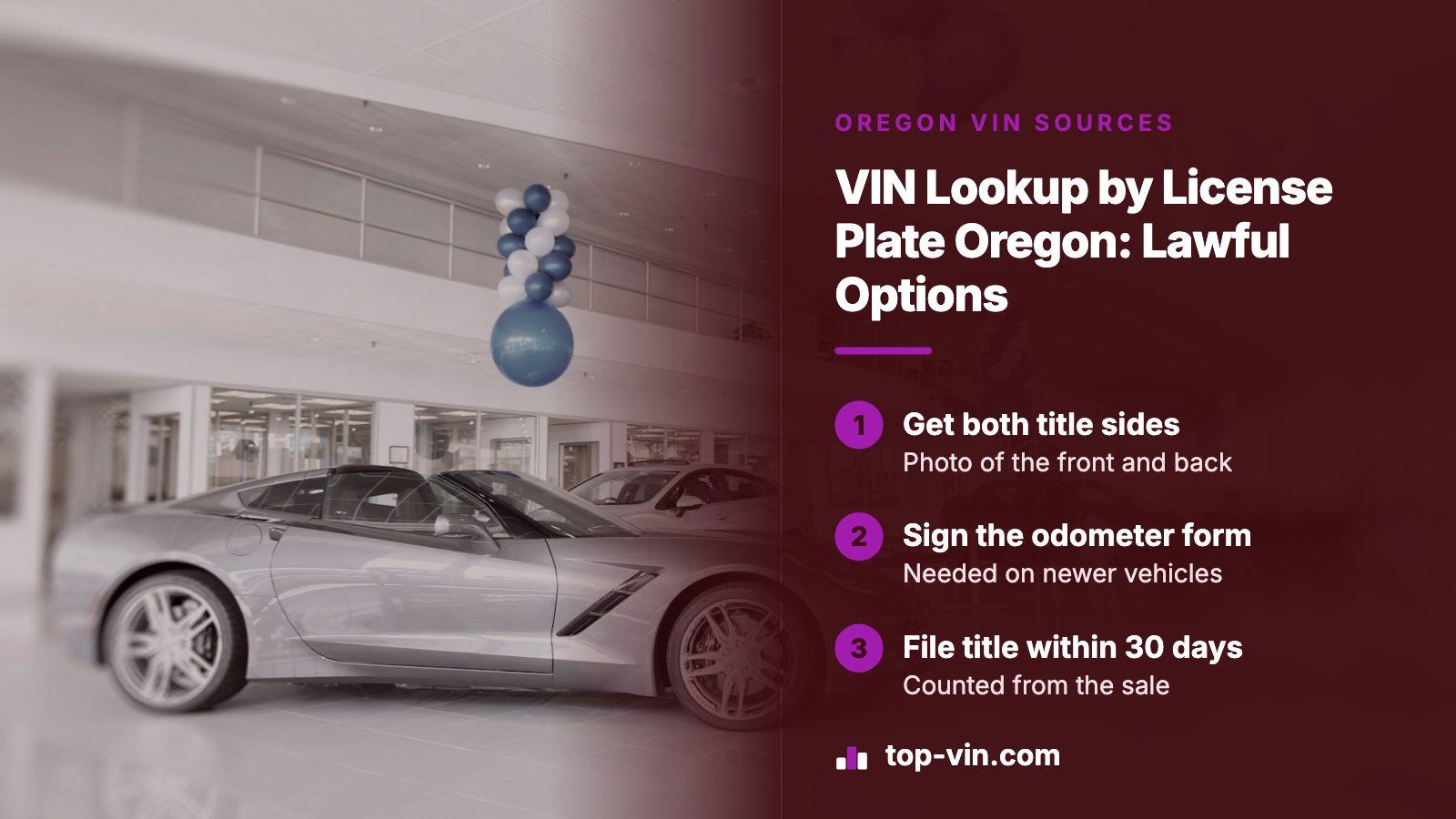
THE SHORT ANSWER
An Oregon plate cannot be converted into a VIN by a private car shopper through the DMV. Requests for personal data must come from someone who qualifies under ORS 802.175 to 802.191, and everyone else gets a record with personal details stripped out. Get the 17 characters from the title, the insurance card, the registration or the vehicle, then run them through a TopVIN preview.
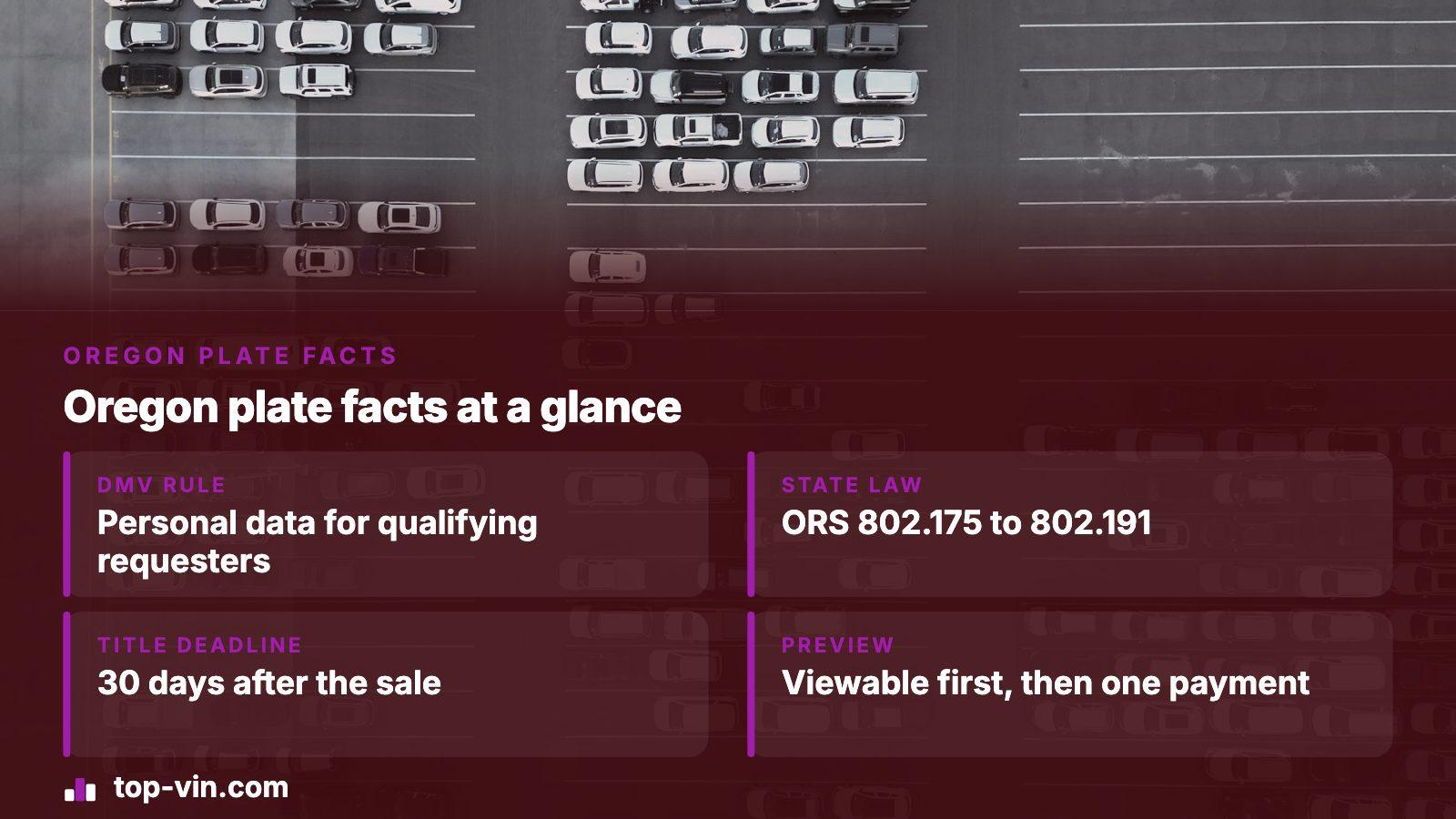
- DMV rule
- Personal data only for qualifying requesters
- State law
- ORS 802.175 to 802.191
- Title deadline
- 30 days after the sale
- TopVIN preview
- Free to view, then one payment
What Oregon DMV does with a plate-number request
Plenty of shoppers key an Oregon plate into a search field and wait for a VIN. The state is built differently. Whoever orders DMV records has to meet the tests in ORS 802.175 through 802.191, and when the test is failed, DMV rejects the order and refunds the money.
Personal information, in DMV's wording, means a license or ID number, a name, an address and a phone number. Someone outside those tests can still mail in an order, but the file comes back sanitized, with everything personal removed apart from the person's own details. Facts that are not personal, odometer readings among them, stay in.
The practical result
A shopper who mails a plate number to DMV does not get a stranger's name and address back. At best the shopper gets a stripped record, and a shopper who signs a request form without a qualifying purpose takes on legal risk.
The federal law behind the refusal
Under 18 U.S.C. 2721, a DMV cannot knowingly hand over personal data held in a vehicle file unless the use appears in the statute. The permitted uses include public agencies and courts, vehicle safety and theft work, recalls, insurers handling claims or fraud, owner notices after a tow, licensed private investigators, employer checks on commercial drivers, toll roads, and any request backed by the person's express consent.
Sizing up a used car before you pay is not on it. That is why a site that promises an Oregon owner's identity for a small fee deserves doubt. Oregon's own request form adds a warning: using DMV personal data in breach of the state statutes can bring a prosecution or a civil suit. The requester signs and must spell out the intended use.
Who can order, and what DMV charges
A DMV leaflet on requests lists who may qualify for personal data: lawyers, legitimate firms, insurers, police and other government bodies. Those requesters mail Form 735-7122 with proof and a check. Another path is a Record Inquiry Account, which has a $70 application fee that is not refunded, and the account is billed monthly.
Fees on DMV's list give a sense of what the records are, even when you cannot receive the personal parts.
| Record | DMV fee |
|---|---|
| Record print for one vehicle | $4 ($2.50 if none is found) |
| Letter on the last title change | $14 |
| Letter covering every title change | $22.50 |
| Insurer and policy lookup | $10 |
| Past odometer readings | $25 |
If you really do have a covered purpose, such as a collision claim or a lawsuit, an insurer, an attorney or the police can make the request for you.
Getting the VIN without a plate search
The person selling the car already has the number several times over. Ask before you drive across town, and confirm it from two places.
- The Oregon title, which must carry the same VIN as the vehicle. Ask for a sharp photo of the front and back.
- The insurance card or policy page, which names the car it covers.
- The registration card, useful for confirming the plate on the car belongs with it.
- The vehicle itself, read in person instead of copied from a text message.
- The listing, where dealers print it and private sellers can reply with it in a minute.
A seller who dodges a plain request for the number has told you something. Walking away costs nothing.
Matching the number to the car and the paperwork
DMV's buying tips read like a short checklist, and each step is easier once you hold the VIN.
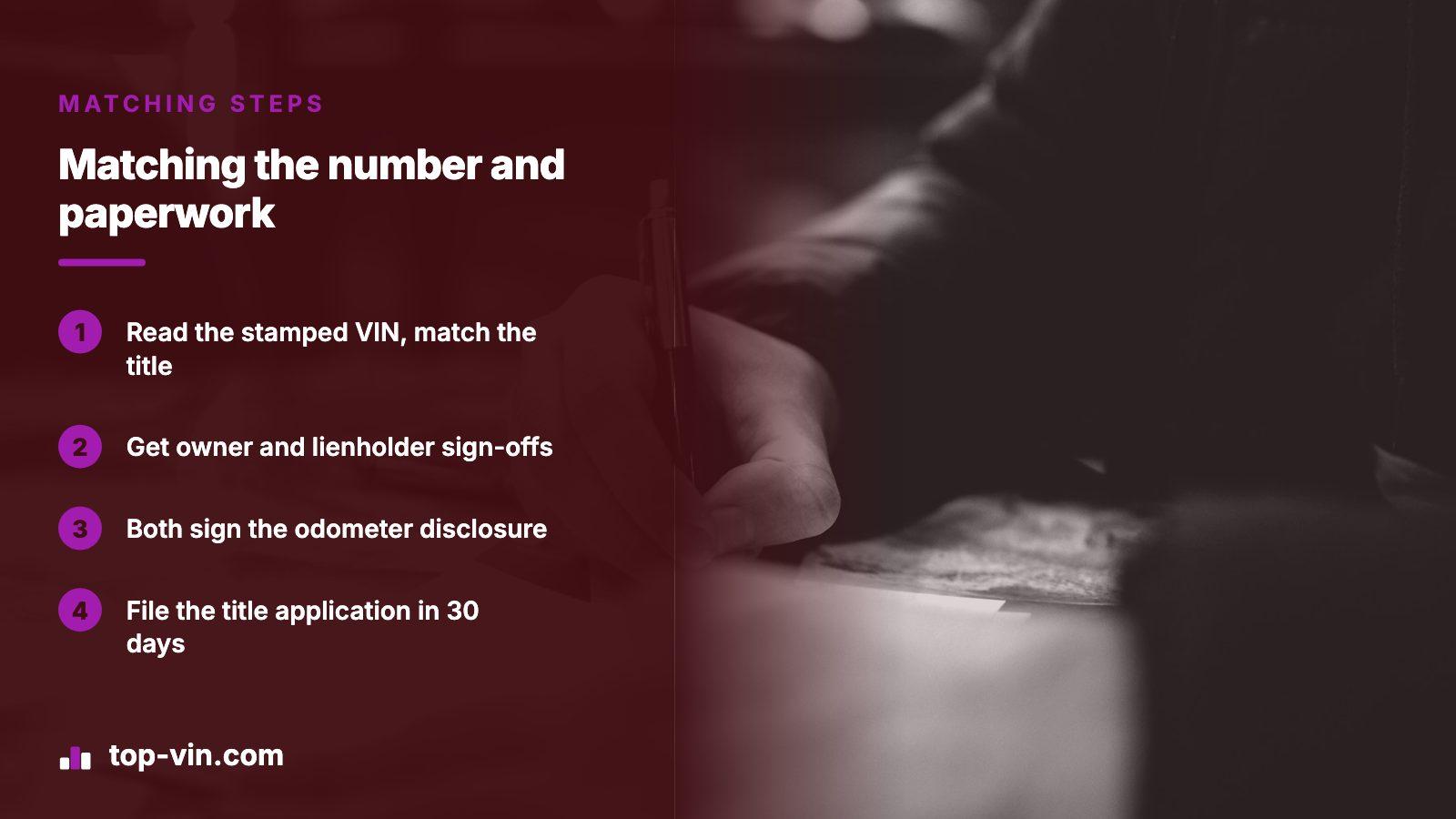
- Read the VIN stamped on the car, then hold it against the title and check each character.
- Make sure each owner listed, and any lienholder, has signed off. If the seller is not named on the title, get a bill of sale carrying the VIN, a release statement, a printed name, a signature and the sale date.
- For a model year 2011 or newer vehicle under 20 years old, make sure both of you sign the odometer disclosure.
- Look for brands on the title, such as totaled or flooded.
- File your title application inside 30 days of buying.
Miss the window and the state adds a fee: $25 for a transfer 31 to 60 days after the sale and $50 after 60 days.
Why the plate on a car proves little
DMV tells sellers they may take their plates off before a sale. A seller must also notify DMV through DMV2U within 10 days, giving the buyer's name and address, yet the state still lists the seller as the owner until the buyer completes the title transfer. Between the handshake and that transfer, the state's file can still point at the old owner.
So a plate bolted to a car you are viewing is a small clue, not a verdict. It does not confirm who owns the car, whether a loan exists or whether the title is clean. The VIN does all three jobs, which is the reason to chase it instead of the plate.
Running the VIN in TopVIN
Type the 17 characters into TopVIN and open the preview. Viewing it costs nothing, and it signals whether the vehicle has records worth reading in detail. Unlocking the whole report means a single purchase for that car, no subscription, and bundles of several reports are on the pricing page.
| Look for | Why it matters on an Oregon car |
|---|---|
| Title brands | A brand set in another state still follows a car into Oregon |
| Theft record | A stolen car can arrive with tidy-looking paperwork |
| Odometer readings | A drop or a long gap between entries needs an answer |
| Liens | Oregon bars a sale while a loan is unpaid |
| Open recalls | Repairs the maker may owe you |
DMV's tips also point to NMVTIS for title history, which has a fee, and to NICB for a free check of stolen reports.
Cars titled elsewhere, and VIN inspections
Oregon sits beside states with cars that move over the line often. DMV calls for a physical VIN inspection when a vehicle carries a title from another state or country, at a $9 fee. The inspector confirms the stamped number agrees with the ownership paper, and DMV, a licensed Oregon dealer selling you the car, or DEQ where emissions testing applies can do it.
That inspection compares a number to paper. It will not tell you about a salvage brand from two states away or an odometer that was rolled back before the car came west. A history record is how you learn that, so run the VIN before the money moves.
What to do next
Collect the VIN from the title and a second source, and make sure they agree. Open a TopVIN preview with that number, see what it flags, and weigh whether this car justifies the full report. If a record raises doubts, ask the seller about it in writing before you meet.
If your reason is a crash or a hit-and-run, hand the plate number to the police and let them make the request.
Where this information comes from
- Oregon DMV: Available DMV Records and Fees — Who may order, record types and the fee list.
- Oregon DMV: General Records and Privacy Information — What counts as personal information and the sanitized-record rule.
- Oregon DMV: How to Request a DMV Record — Which requesters qualify, the forms and the account fee.
- Oregon DMV: Buying or Selling a Vehicle — Title checks, odometer disclosure, plates and sale notice.
- Oregon DMV: VIN Inspections — Who inspects, the fee and which vehicles need one.
- 18 U.S.C. 2721 at Cornell LII — The federal limits and the permitted uses.
Sources and photos: Facts checked against the sources above in November 2026. Photos by Richard R, Owen Michael Grech and Iain on Unsplash; diagrams by TopVIN.
Keep reading
- License plate to VIN: the lawful ways to find a car's VIN from its plateThe national picture of plate searches and why they fall short.
- Where the VIN sits on a title, and what to do nextHow to read the number printed on a title.
- Is the VIN on the insurance card? What to check before you trust itUsing an insurance card to find the number.
- License plate lookup privacy laws: what you can and cannot get from a plateWhat privacy law lets a plate lookup return.
Frequently asked questions
Can I find a VIN from an Oregon license plate number?
No, not as a private buyer going through DMV. Oregon reserves personal data for requesters who qualify under state law, and a person weighing a purchase does not. Get the number from the seller, the title, the insurance paperwork or the car itself, and check that instead.
Does Oregon DMV give out a car owner's name from a plate?
Only to a requester who qualifies under ORS 802.175 to 802.191, such as an attorney, an insurer or a police agency. Everyone else receives a sanitized record, with personal details removed. A requester also signs a statement, and misuse can lead to criminal or civil action.
What if the seller keeps putting off sending the VIN?
Treat it as a warning. The VIN is printed on the title and the insurance card, and the seller can copy it from the car in seconds. Delay, odd excuses or a missing title are reasons to pause. DMV says the title VIN must match the vehicle.
What is the deadline to title a used car in Oregon?
You get 30 days from the sale. Past that, DMV charges a late fee of $25 for days 31 to 60 and $50 beyond 60 days. The seller is expected to report the sale on DMV2U within 10 days, yet DMV keeps showing the seller as owner until your transfer is processed.
Is the TopVIN report free?
Only the preview is free; it lets you see whether a VIN has records before you spend a cent. The report itself is bought once per vehicle, with no subscription, and multi-report packs are listed on the pricing page. TopVIN works from VINs and does not run plate searches.
Now check the car itself
The guide explains what to look for. The report shows what this VIN has on record.