THE SHORT ANSWER
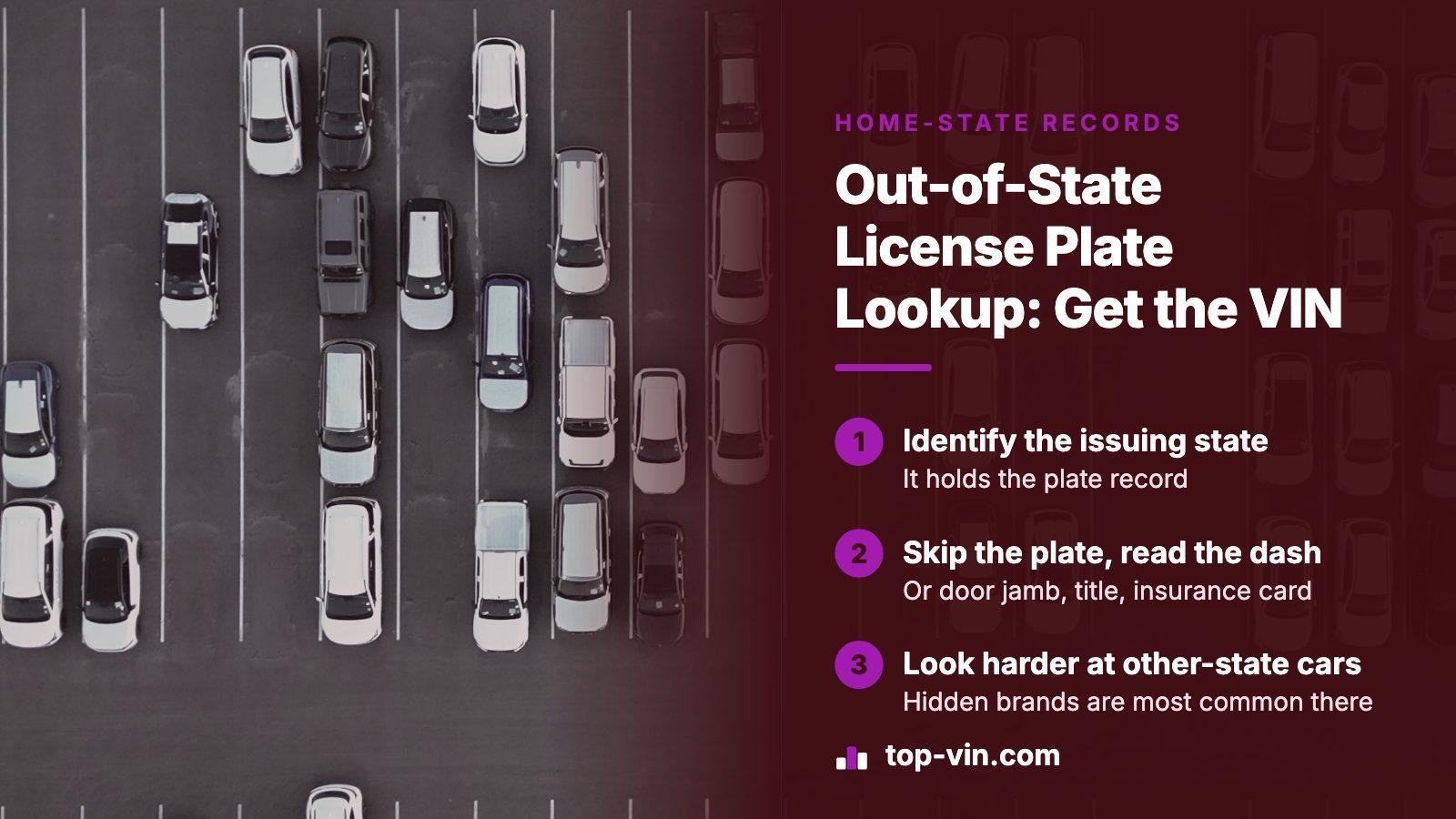
An out-of-state plate cannot be searched by the public. The issuing state keeps the record, and a federal privacy statute narrows what it may share. Buyers should skip the plate and read the VIN off the dash, door jamb, title or insurance card, then run a VIN check, because a car from another state is where a hidden brand is most likely to surface.
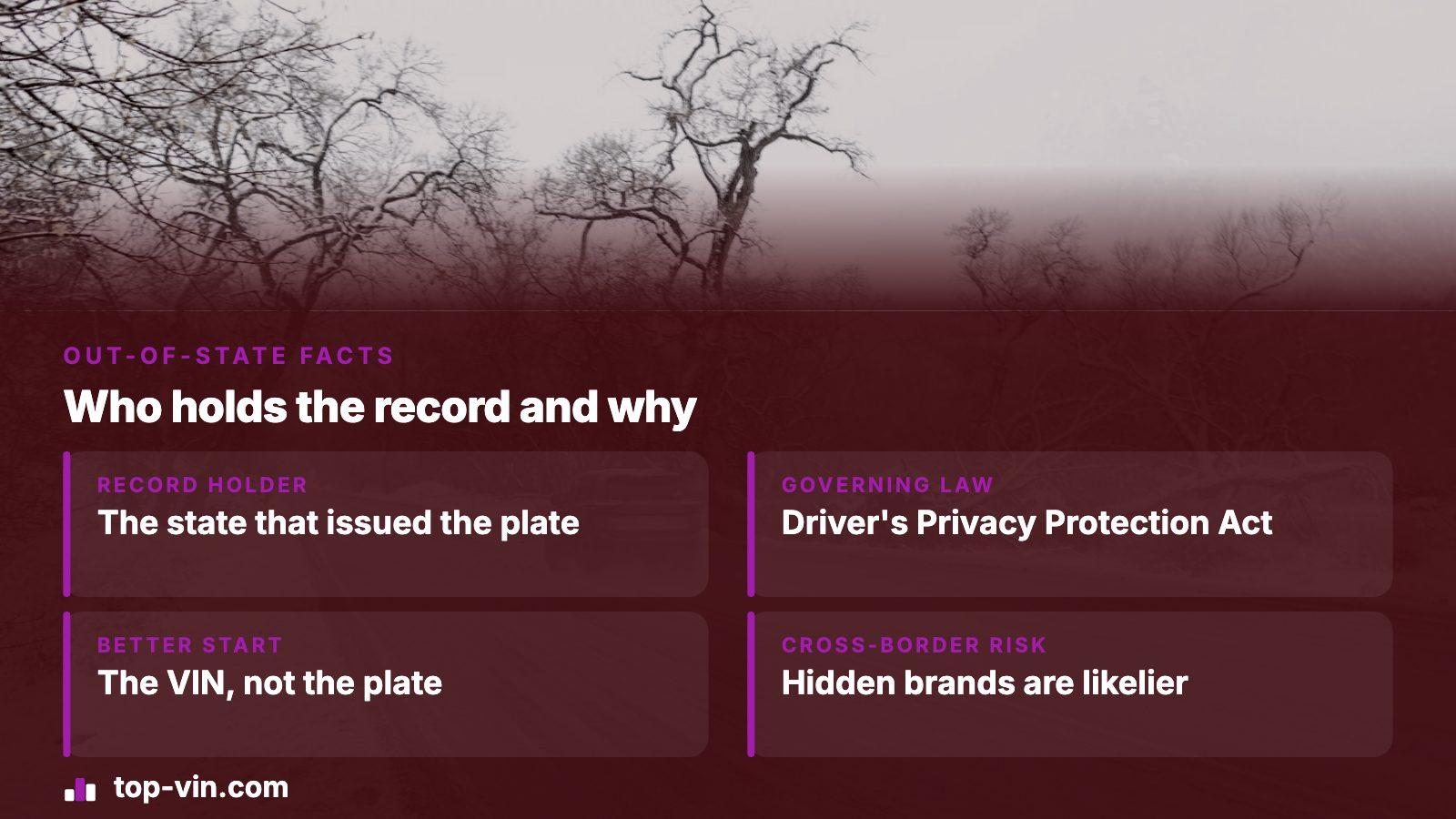
- Who holds the record
- The state that issued the plate
- Governing law
- Federal Driver's Privacy Protection Act
- Better starting point
- The VIN, not the plate
- TopVIN check
- Free preview, then one payment
Why the plate's home state matters
A plate is a registration tag, and the registration lives in the files of the state that handed it out. Your own DMV has nothing on a car it never titled. That is why a search for an out-of-state plate on your state's website goes nowhere, and why a request would have to be sent to a different agency in a different capital.
One federal law reaches every state. It forbids a motor vehicle department and its contractors from knowingly giving out personal data held in a vehicle record, unless the request matches a use the statute names. Idle curiosity about someone's car does not qualify. So the question is not which state is friendliest, but whether you have a legitimate reason and the standing to use it.
What a records request can legitimately cover
The federal list of permitted uses is short and specific. Several of the entries matter to ordinary people only in unusual situations, and none of them is simply wanting to know a car's history before buying it.
- Government bodies, courts and police on official duty.
- Vehicle safety, theft, recall and emissions work.
- Insurers investigating claims or fraud.
- Lawsuits and other proceedings, including delivering legal papers.
- A requester with signed approval from the person named in the file.
Some states publish a request form and ask you to declare which permitted use applies. California's form for record information, for example, takes either a California plate or a VIN, covers one vehicle per form, and warns that a false statement or a use outside the stated purpose is a misdemeanor. Treat that as the pattern: the state wants a reason on paper, and it takes the declaration seriously.
Getting the VIN without the state
A buyer almost never needs the records office. The number is printed on the car and in its paperwork, and an honest seller produces it within minutes. Texas names the usual spots: the dash corner on the driver's side by the windshield, a label on the driver's door or its frame, the insurance paperwork, and the title.
- Have the seller send a picture of the dash number and of the title, before you drive anywhere.
- At the car, compare the dash number with the door sticker and with the title.
- Check the insurance card, which usually prints the VIN for the covered vehicle.
- If the plate is on a car you have a lawful reason to identify, send the issuing state a request and name the permitted use truthfully.
Numbers that disagree between the dash and the title are a reason to stop, not to keep haggling.

Why a car from another state deserves a harder look
Title brands are assigned state by state, and states do not all label the same damage the same way. A car can carry a flood or salvage label in one place and arrive clean on paper in another. The federal NMVTIS site describes exactly this pattern: after Hurricane Katrina, authorities reported truckloads of flooded vehicles hauled out of Louisiana and trucked to other states, reaching the upper Midwest, where they were cleaned up and offered in states with no flood branding.
What salt water does
The federal page adds that a saltwater soaking makes wiring and the airbag sensors likelier to fail later. A thorough detailing does not undo that, which is why title history counts for more than a clean carpet.
NMVTIS was built to make that kind of laundering harder, by collecting brand data from state titling agencies, recyclers, salvage and junk yards and insurers in one national store. A plate from far away is not a warning sign on its own, but it is a reason to read the history instead of trusting the title in your hand.
Running the check once the VIN is in hand
Type the VIN into TopVIN and a preview appears without payment. It confirms the car and shows what the record holds, enough to judge whether the full report suits you. Buying is one payment, never a subscription, and the pricing page spells out the packs.
For a car that arrived from elsewhere, read the title section first. Look for brands, the state or states where the car was titled, and the odometer readings over time. A mileage figure that drops between states, or a title that moved quickly through several, is the pattern worth asking the seller about before any money changes hands.
Two free federal tools sit alongside any paid report: the NHTSA recall lookup by VIN and NMVTIS data. Neither replaces a full history, but both cost nothing to open.
Paperwork traps when the seller lives in another state
Check the title against the seller before anything else. Texas advises buyers to note the VIN and run the state's title check against the national database, get a mechanic's opinion before signing or putting down a deposit, and refuse to walk away from a private sale without the title, which the seller signs and marks with the mileage.
| Step | What to confirm |
|---|---|
| Title | Name matches the seller, VIN matches the car, signed on the back |
| Brand check | No salvage, flood or junk label in the national data |
| Odometer | Reading on the title agrees with the dash and the history |
| Plates | Plates often stay with the seller, so ask how you will drive it home |
| Insurance | Card lists the same VIN you read on the car |
After the purchase: titling the car at home
Once the car is yours, your own state takes over, and its clock starts quickly. Texas is one example: titling is due within 30 days of the sale, and registration within 30 days of the car arriving. The counter wants the prior state's original title or other proof of ownership, insurance proof and the state application form. Where no inspection applies, the owner certifies the VIN personally on that form.
Other states differ in the details, so read your own agency's page before you travel to collect the car. The fact that holds everywhere is that the VIN on the paperwork has to match the VIN on the vehicle, and a mismatch will stop the transaction at the counter. Better to find it in the seller's driveway than in a line at the tax office.
Where this information comes from
- 18 U.S. Code 2721: Driver's Privacy Protection Act — what a state department may release, and the permitted uses
- NMVTIS for consumers — the national title database, brands and the flood example
- California DMV: form INF 70 — an example of a state's records request form and its warnings
- Texas DMV: Title Check, look before you buy — state advice on titles, mechanics and plates in a private sale
- Texas DMV: out of state and imported vehicles — titling and registering a car bought in another state
Sources and photos: Facts checked against the sources above in November 2026. Photos by Iain, Michal Biernat and Zoshua Colah on Unsplash; diagrams by TopVIN.
Keep reading
- License plate to VIN: the lawful ways to find a car's VIN from its platethe general version of this question, for plates from any state
- Where the VIN sits on a title, and what to do nexthow to read and verify the number printed on a title
- License plate lookup privacy laws: what you can and cannot get from a platewhat the law protects and why plate searches are limited
- VIN verification: the four checks people mean and what each proveschecking that the car's number agrees with its papers
Frequently asked questions
Can I look up an out-of-state plate for free?
Not in any way that reveals a VIN or owner. States offer no public plate search, and federal privacy law limits what they hand out. Free tools exist for the VIN itself, such as the NHTSA recall lookup. If you have the VIN, TopVIN shows a free preview first, so you can weigh the full report afterward.
Which DMV do I contact for a plate from another state?
The agency in the state that issued the plate, because that is where the registration record sits. Look for its records request page and form. Expect to declare a use the federal law permits, and to be held to it.
Does an out-of-state plate mean the car has a bad history?
No. People move and buy across state lines every day. The plate alone says nothing about damage. What it does mean is that your local DMV has no record of the car, so a VIN-based history that pulls from national data is the sensible way to fill that gap.
What should I do if the seller withholds the VIN?
Treat it as a serious red flag. A seller who is willing to show the car in person can read the number off the dash and send a photo of the title. Refusing both, or giving numbers that do not agree, justifies leaving the deal.
Can I look up the owner behind an out-of-state plate?
Not as a member of the public. Owner details count as personal information under federal law, and a state may release them only for a use the statute names. A buyer who wants the car's history does not need the owner's name at all, only the VIN.
Now check the car itself
The guide explains what to look for. The report shows what this VIN has on record.