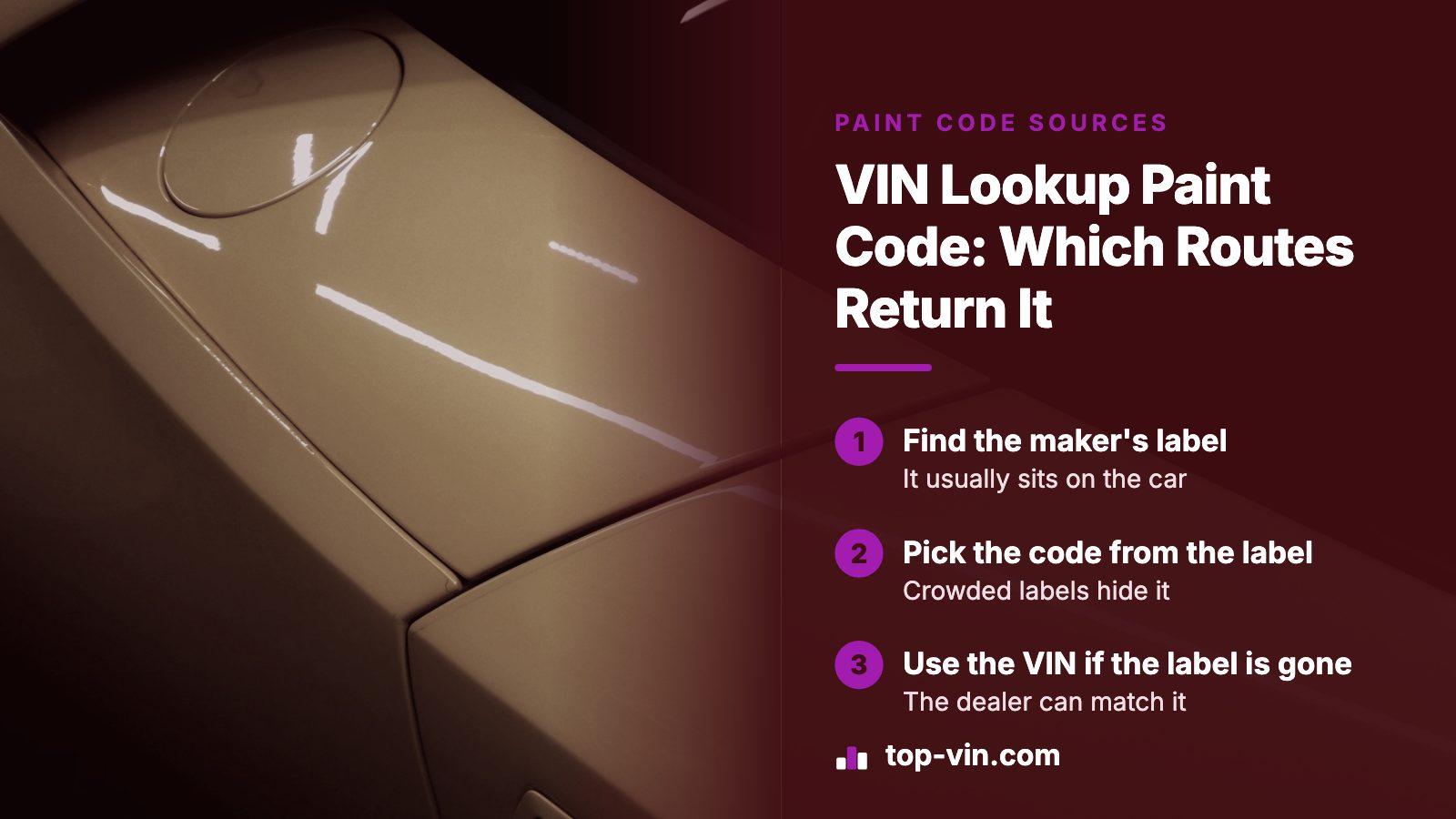
THE SHORT ANSWER
No VIN lookup pulls a paint code out of the VIN itself. The characters describe the make, line, series, body and engine, not the color. The code sits on the maker's label on the car, and a franchise dealer's parts desk can read it back from the build record when you give them the VIN. A TopVIN preview confirms which car you are dealing with, while the code itself still comes from the label or the dealer.
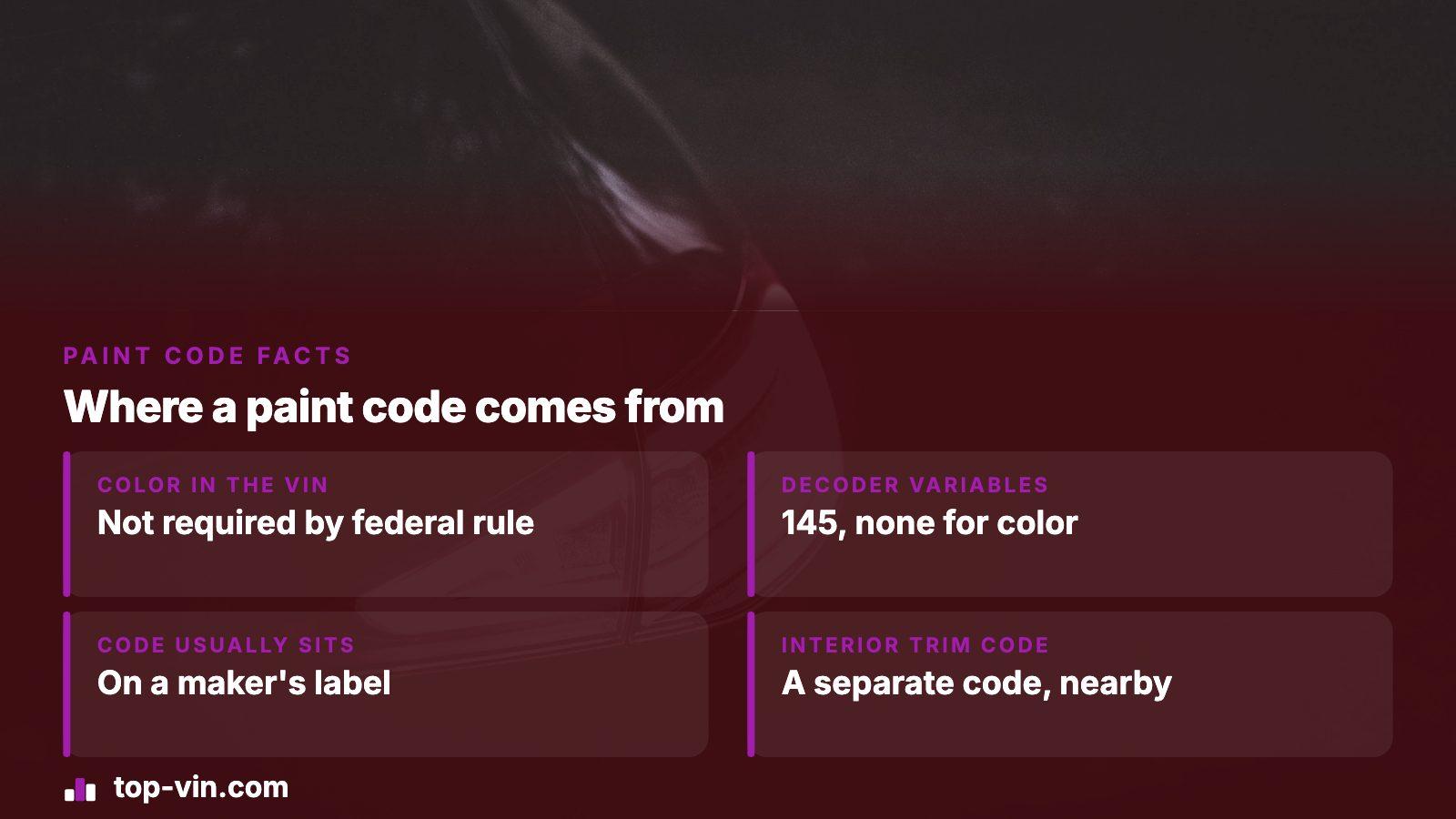
- Color in the VIN
- Not required by federal rule
- NHTSA decoder variables
- 145, none for color
- Where the code usually sits
- A maker's label on the car
- TopVIN check
- Free preview, then one payment
What a VIN lookup can return about color
Federal rule 49 CFR 565.15 gives positions four through eight of the VIN a narrow job. Those five characters must let a reader work out a short list of attributes, using information the maker files with NHTSA. For a car the list covers make, line, series, body, engine and restraints; for a truck it adds things like cab type, chassis and brakes. Color is not listed.
NHTSA's public decoder is built from those maker filings. Its variable list held 145 entries when checked in November 2026, and none was named color, paint or finish. Decoding the agency's own partial-VIN example, a 2011 BMW X3, returned trim, body class, drive type and plant city, but no color.
Five ways to get a paint code, compared
The tools behind a VIN lookup, a VIN check and a paint-code search answer different questions, and only the first two rows below return the code.
| Route | Returns the code? | Best use |
|---|---|---|
| Label on the car | Yes, as the maker printed it | First stop for anyone standing beside the vehicle |
| Dealer parts desk, given your VIN | Yes, from the maker's build record | A label that is missing, unreadable or painted over |
| NHTSA's public decoder | No, it has no color field | Confirming year, body, drive type and assembly plant |
| Paint supplier, given VIN and model year | Often, where they hold maker databases | Ordering touch-up or repair paint |
| TopVIN preview and report | Not what it is built for: it is a history check, not a build sheet | Damage, salvage and auction photos, title and odometer records before you buy |
Where the maker's label tends to sit
No federal rule fixes where a paint label goes. The certification label that carries the VIN and build month is regulated: 49 CFR 567.4 places it on the hinge pillar, the latch post or the door edge, around the opening on the driver's side. The maker's own paint label only tends to sit near it.
- Driver's door frame or edge: read every sticker around the certification label.
- Engine bay: a strut tower, the firewall or the radiator support.
- Glove box: on GM vehicles, a parts label lists option codes, paint among them.
- Trunk: under the floor mat, by the spare or on the lid, a habit of Volkswagen and Audi.
Finding the paint code on a busy label
A parts label packs trim, axle, plant and option codes into a single block, so the paint line is easy to misread. Shapes vary too. Owners who quote their codes in NHTSA complaints give a bare three-digit 040 for a Toyota in Super White and NH830M, digits wrapped in letters, for a Honda in Lunar Silver Metallic.
- Find the line headed paint, color or EXT PNT, and photograph the whole label.
- Keep prefix and suffix letters, since they belong to the code.
- Do not confuse it with the interior trim code beside it.
- Quote the code with the model year, because color names get recycled.
When the label is gone, the VIN does the work
A respray, rust or a replacement door can take the label away. The VIN then becomes a key, though only for someone who can open the maker's record.
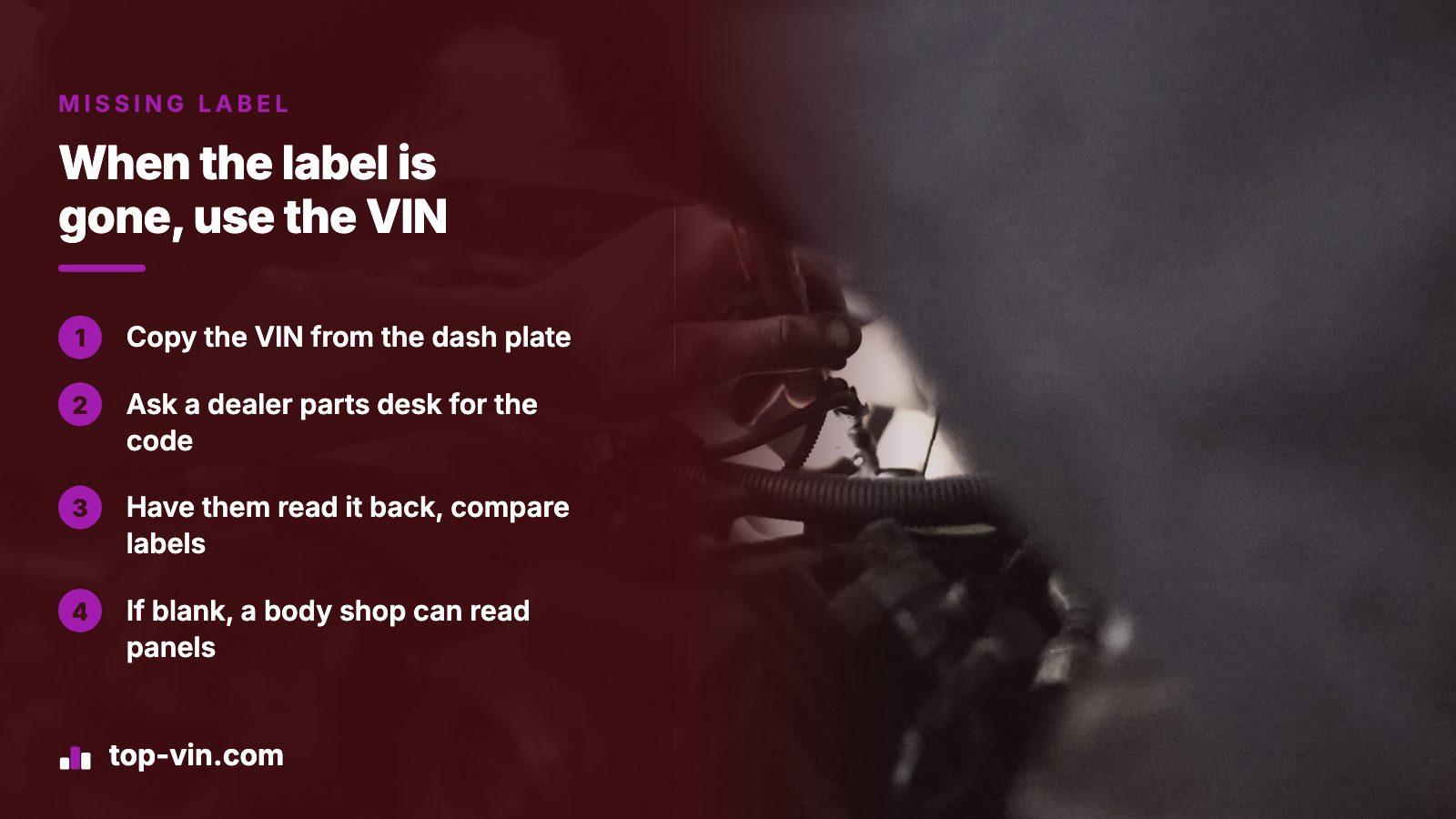
- Take the VIN from the windshield-corner plate and check that it matches the sticker near the door.
- Give a franchise dealer's parts desk the VIN and ask for the paint code and the color name.
- Have them read the code back, then compare it with any label you can still see.
- If the record gives nothing, a body shop can measure the panel's present color using a spectrophotometer.
From an NHTSA owner complaint
The owner of a 2019 Subaru Forester had a passenger-side mirror replaced at a dealership in May 2025. They were told the part would be matched to the car's VIN, which calls for dark metallic grey. The casing that went on was a "visibly lighter grey", and the owner says the dealership agreed the color was wrong but wanted full payment before swapping it.
The VIN gets a part ordered, but it never replaces a visual check. Ask the desk to read the code aloud before ordering, and hold the part against the car before anyone fits it.
Right code, panel still looks off
A formula reproduces the factory's color, but the car has aged in the sun since, so fresh paint can look cleaner than its neighbors. One code may also have several approved variants, so a careful supplier asks which you need and offers a spray-out card to hold against the car in daylight. Body shops hide the join by blending into adjacent panels, which is why a single door's quote can include others.
From an NHTSA owner complaint
A 2019 Hyundai Sonata owner with peeling white paint said the shops Hyundai pointed them to would not blend horizontal panels like the hood, roof and trunk lid, and offered tint instead. Hyundai's corporate office, the owner says, confirmed in writing that tint alone falls short of its repair standard. Independent shops quoted $3,064 to $10,378.92 to refinish to that standard.
Before approving paint work, ask whether the quote includes blending and what the job costs without it.
Paint as evidence on a used car
For a buyer the code is a test as well as an ordering detail: the car should wear the color on its label. Overspray across the door-area sticker, or a panel that shifts shade along the body line, points to a respray. It may be innocent, a parking-lot scrape or a failed clear coat, or the visible end of an accident repair nobody mentioned.
From an NHTSA owner complaint
A 2016 Toyota Corolla owner bought used in 2023 and later found the Super White paint, code 040, peeled to bare metal on several panels. The owner says Toyota had run a support program for that model, year and color, nobody mentioned it, and coverage had lapsed by the time they heard.
With failing paint on a used car, ask the maker's customer line to check the VIN for any open paint or service program. A history report adds damage and accident records, salvage and auction history, title brands and odometer readings, and an auction photo in a different color than the car you see gives you a pointed question for the seller.
Before you commit to the car
Enter the VIN on TopVIN for a free preview that checks year, make and model against the listing. The full report costs one fee and never renews; the pricing page shows the options. Neither is a build sheet, so do not count on either for the paint code, and pair the check with the label work above.
- Photograph the paint label and the certification label together.
- Compare the preview with the advertised car, then open the report if it still fits.
- Put any color mismatch or painted-over label to the seller in writing.
Where this information comes from
- NHTSA owner complaint 11664785 — owner experience, paraphrased
- NHTSA owner complaint 11703039 — owner experience, paraphrased
- NHTSA owner complaint 11746704 — owner experience, paraphrased; also the source of the 040 code example
- NHTSA owner complaint 11761228 — source of the NH830M code example, as the owner wrote it
- NHTSA vPIC: vehicle API — Explains that decoder data comes from maker filings, and its variable list has no color or paint field.
- 49 CFR 565.15: VIN content requirements — Lists what positions four through eight must make decipherable, with no color entry.
- 49 CFR 567.4: certification label — Sets where the certification label goes and what it must state, paint color not included.
Sources and photos: Facts checked against the sources above in November 2026. Photos by Franck V., Mustafa Sheikhmouss and Maurice Sahl on Unsplash; diagrams by TopVIN.
Keep reading
- How to read a VIN: a left-to-right walkthrough with a worked decodeWhat each position of the VIN fixes, and why none of them is color.
- GM VIN lookup: check a Chevrolet, GMC, Buick or CadillacThe make hub for Chevrolet, GMC, Buick and Cadillac lookups.
- VIN check with photos: what a report shows and what it can'tAuction and damage photos can show a car's earlier color and repair history.
- Specs by VIN compared: what each lookup returns and what it leaves blankWhat a decode returns about the build, which narrows a paint supplier's options.
Frequently asked questions
Can you find a paint code with a VIN lookup?
Not from the VIN characters, since color is not encoded in them. The VIN works as a key instead: a franchise dealer's parts desk can open the car's build record and read the paint code back. Ask for the color name too, and compare both with any label on the car.
Does the NHTSA VIN decoder show paint color?
No. Its variable list has no color, paint or finish entry, so a blank is not a gap in your result. It does return year, body class, drive type and assembly plant, which help a paint supplier choose between formulas once you hold the code.
What if the paint sticker is missing from my car?
Check every spot the maker uses, since some cars carry more than one label. If none survives, give the VIN to a dealer parts desk. A painted-over label can mean the panel was refinished, so match the paint you see today.
Will a TopVIN report show my paint code?
Do not count on it. The report is a history record plus factory specs, not a build sheet. The preview is free and confirms the car; the full report is one payment. Use it for damage, salvage, title and odometer records.
Will a VIN report show a repaint?
Sometimes, indirectly. A report can list damage records and show auction photos in the car's earlier color. Many repaints leave no record at all, so your own look along the panel gaps and under the door-area sticker still counts.
Now check the car itself
The guide explains what to look for. The report shows what this VIN has on record.