THE SHORT ANSWER
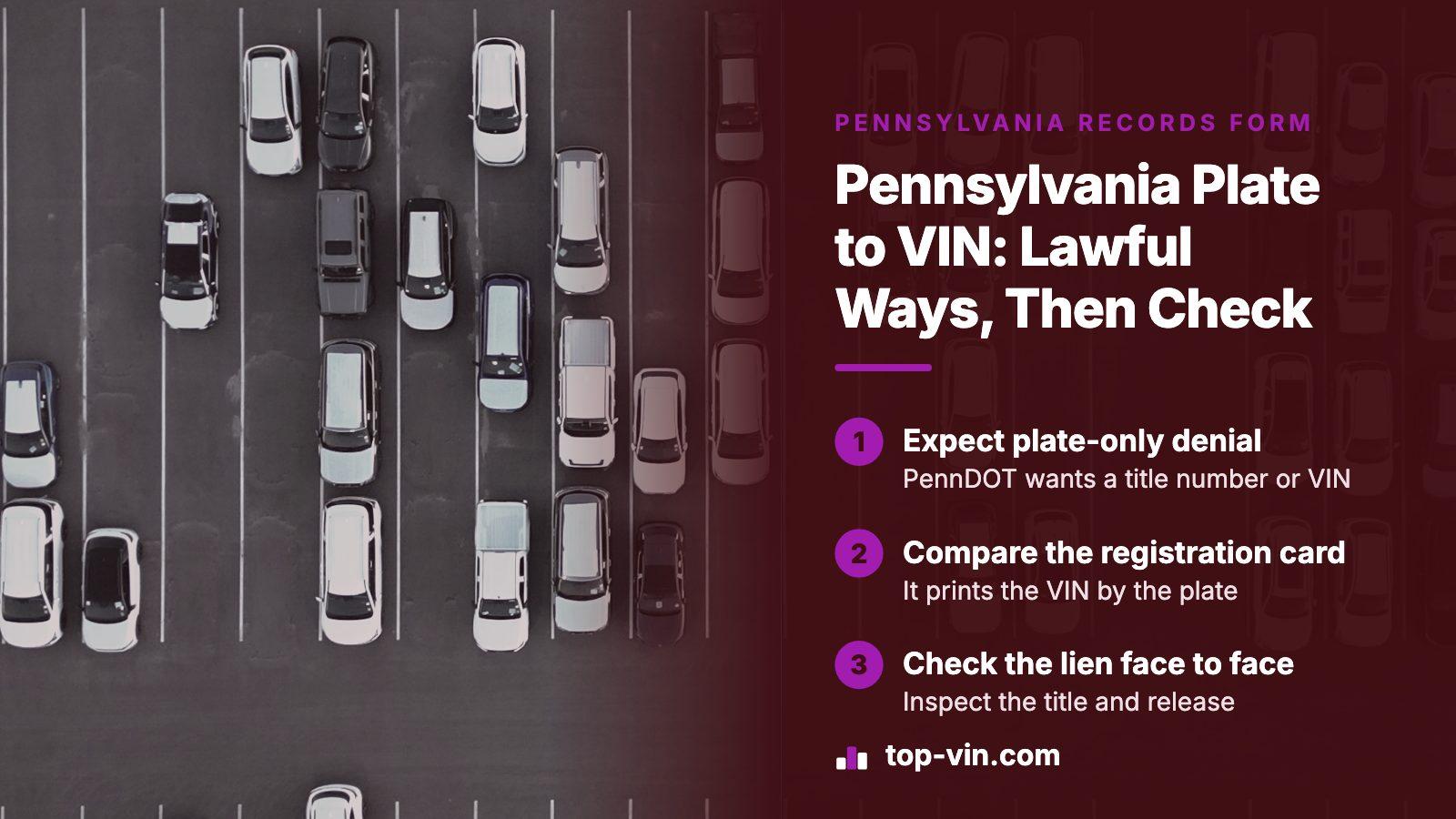
A Pennsylvania plate alone does not open a VIN. PennDOT says a records request needs the title number or VIN as well, and releases personal data only for permitted purposes. The seller, the title, the registration card and the insurance card all carry the number; compare any of them with the stamping on the car itself. After that, enter it for a free TopVIN preview.
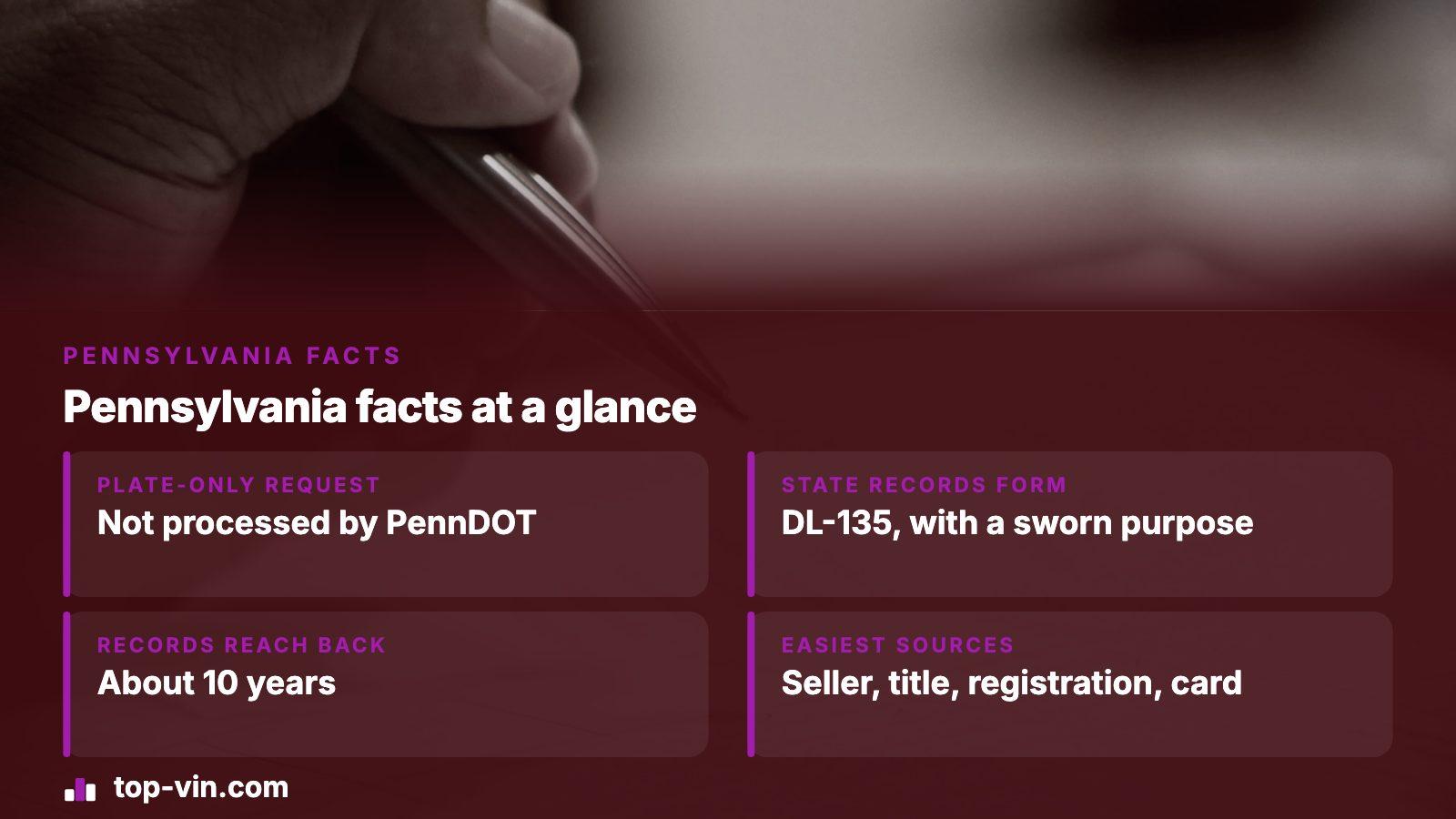
- Plate-only request to PennDOT
- Not processed
- State records form
- DL-135, with a sworn purpose
- Easiest VIN sources
- Seller, title, registration, insurance card
- TopVIN check
- Free preview, then one payment
Why the plate is the wrong end of the search
Most people who type a Pennsylvania plate into a search box want the same thing: proof that the car in the driveway is what the seller says it is. The trouble is that a plate belongs to a registration, while the damage files, title brands and mileage entries that matter are attached to the vehicle identification number. Every serious history database is keyed to the VIN.
That is also why TopVIN starts from the VIN and never asks for a plate. A VIN describes a car. A plate lookup, done carelessly, describes a person, and the law treats those very differently.
What PennDOT says about plate requests
The department answers this question directly on its public records page. Its answer is no: a request resting on the tag number alone is turned away, and a proper one has to include the title number or the VIN as well. In other words, the state expects you to arrive with the vehicle's number already in hand, which defeats the purpose for a stranger hoping to learn it.
The records that PennDOT does sell are a different matter. A returned vehicle record lists the current owner's name and address, the VIN, the title, the plate and the make, model and year. Because that file contains personal information, it sits behind a sworn statement of purpose rather than a simple web form.
Plate-only requests have one narrow door
PennDOT's form allows a plate to be the only vehicle detail in one situation: the requester must also supply an insurer's claim and policy numbers, or attach an accident report or parking ticket. That is a path for claims and tickets, not for car shopping.
Form DL-135 in plain terms
The state's request is Form DL-135, titled Request for Vehicle Information. Pricing on the current edition is $15.00 for each record, or $47.00 for a certified record, and the fee is non-refundable. Payment goes by check or money order, with the paper form mailed to vehicle record services at the Bureau of Driver Licensing in Harrisburg. Confirm the current edition and fees on PennDOT's site before sending anything.
- Requesting your own record needs no notary; requesting anyone else's needs a notarized signature.
- Section E is the owner's written release. Section F is a sworn affidavit naming your purpose.
- You tick one purpose: title, odometer, encumbrance, insurance or other.
- The form lists eight permitted uses, including insurance work, legal proceedings and notice to owners of towed vehicles.
- Records reach back about 10 years, and false statements carry penalties under state law.
The form also forbids passing the record on, mailing campaigns and posting it online without PennDOT's written permission. A private shopper sizing up a used car does not appear in those eight.
The federal law behind the paperwork
The affidavit references the Driver's Privacy Protection Act, codified at Title 18, Section 2721 of the U.S. Code. In short, a state's motor vehicle agency and its employees may not knowingly release personal details held in a vehicle record unless one of the statute's listed uses applies. Pennsylvania's list on Form DL-135 follows that framework.
Any website that promises an owner name behind a Pennsylvania plate for a small fee should be viewed with suspicion, and this page does not recommend one. Where we could not read a source, we say so rather than guess.
Four ways to get the VIN without the state
A Pennsylvania buyer rarely needs a records request at all. The number is printed on documents the seller already owns. PennDOT's own guide to finding your numbers shows that the registration card and the renewal invitation display the seven-character plate, the title number and the VIN side by side.
- Before driving out, get the seller to text or email the VIN, and keep that message.
- Request a photo of the Pennsylvania title and read the VIN line against the vehicle itself.
- Ask to see the registration card, which prints it beside the plate.
- Ask for the insurance card or a policy page, since the insured vehicle is identified there.
When two documents disagree on a single character, stop. It may be a typo. It may also be a cloned identity or a doctored title, and a short delay costs far less than discovering that after payment.

Why a Pennsylvania plate tells you so little by sight
Under Act 89 of 2013, drivers stopped needing a registration sticker on the plate after December 31, 2016. Registration itself is still compulsory, and the card has to be shown to an officer on request. Police verify status through electronic access to PennDOT's database, and many use plate readers.
For a buyer this removes a visual clue. A bare plate shows nothing about whether the registration is current, and nothing about whose car it was. Plates can also move: a Pennsylvania plate that goes to a new vehicle is a registration matter, and the VIN stamped on the car is the only identifier that stays with the metal.
Run the VIN, read the result
Enter the VIN and a free TopVIN preview appears first, so you can confirm the number decodes to the year, make and model in the listing. When it fits, the whole report is one purchase with nothing recurring; amounts are on the pricing page. Pennsylvania reports titling data to the federal NMVTIS database in real time and has since May 2010, so brands applied in other states travel with the VIN.
| Finding | Your move |
|---|---|
| Salvage, junk or flood brand | Request repair records. Value it as a branded car or pass. |
| Mileage lower than an earlier entry | Suspect a rollback and ask for service receipts. |
| Lien on record | Insist on the lender's written release first. |
| Theft record | Call police or the insurer before anything else. |
| Open recall | Schedule the maker's fix once you own it. |
Before money changes hands in Pennsylvania
Federal used-car guidance suggests hiring a mechanic to inspect the car and driving it on hills, on a highway and in slow traffic, alongside a history report. A clean federal title record is encouraging, but it is deliberately brief, limited to five items: where it is titled, brands, odometer, total loss and salvage history. It cannot stand in for a mechanic.
For the transfer itself, PennDOT lists the Pennsylvania certificate of title, a Pennsylvania driver's license or photo card, proof of insurance when a registration will be issued, and Form MV-4ST, which authorized agents hand out. Check the VIN on that title against the one you ran.
- Gather the VIN from two sources; they must agree.
- Run the preview and hold it against the advertisement.
- Buy the full report if the preview still fits the listing.
- Inspect the title and any lien release face to face.
- Schedule an independent inspection.
Where this information comes from
- PennDOT: Public Records FAQs — The department's stance on plate-only requests and the vehicle record request.
- PennDOT: Form DL-135, Request for Vehicle Information — Fees, sworn purposes, notarization rules and handling limits.
- PennDOT: Locate your title, VIN and plate information — Where the VIN appears on a registration card.
- PennDOT: Elimination of Registration Stickers FAQs — End of plate stickers and how police check registration.
- Driver's Privacy Protection Act, 18 U.S.C. 2721 — The federal limit on releasing personal data from motor vehicle records.
- NMVTIS: Understanding a vehicle history report — What the federal title record covers.
Sources and photos: Facts checked against the sources above in November 2026. Photos by Iain, Anastasiia Nelen and Masjid MABA on Unsplash; diagrams by TopVIN.
Keep reading
- License plate to VIN: the lawful ways to find a car's VIN from its plateThe national version of this question, beyond Pennsylvania.
- Where the VIN sits on a title, and what to do nextFind and read the VIN line on a title.
- Is the VIN on the insurance card? What to check before you trust itAnother document that names the number.
- Motor vehicle records: what a car buyer can see, and what stays closedHow state records differ from a history report.
Frequently asked questions
Can I find a VIN from a Pennsylvania license plate?
Not through a public search we could confirm. PennDOT turns away a plate-number-only request. A buyer gets the VIN from the seller, the title, the registration card, the insurance card or the car, then runs a history check on it.
How do I request a Pennsylvania vehicle record?
Use Form DL-135, Request for Vehicle Information, which asks for a stated purpose and, for someone else's record, a notarized signature. Fees are listed on the form, and PennDOT's own page is the place to confirm the current version.
Does TopVIN look up Pennsylvania plates?
No. TopVIN works from a VIN and returns no owner names or addresses. Type in the 17 characters and look over the free preview; the paid report is optional after that.
What if the seller refuses to give the VIN?
Read that as a warning sign. The number sits on the title and on the vehicle, so there is little honest reason to hide it. Offer to copy it at the car yourself, and leave if it does not match the paperwork.
Is the TopVIN report free?
No. The preview costs nothing, and that is all. After it comes one payment for the report, never a monthly plan; see the pricing page for options. Start with the preview so you know the VIN belongs to the right car.
Now check the car itself
The guide explains what to look for. The report shows what this VIN has on record.