THE SHORT ANSWER
There is no lawful public plate-to-VIN lookup for South Carolina buyers. Federal privacy law restricts what a state records office may release, and screening a used car is not one of the uses it names. Request the number from the seller, find it on the title, registration or insurance paperwork, and match it to the metal on the vehicle. After that, open a TopVIN preview.
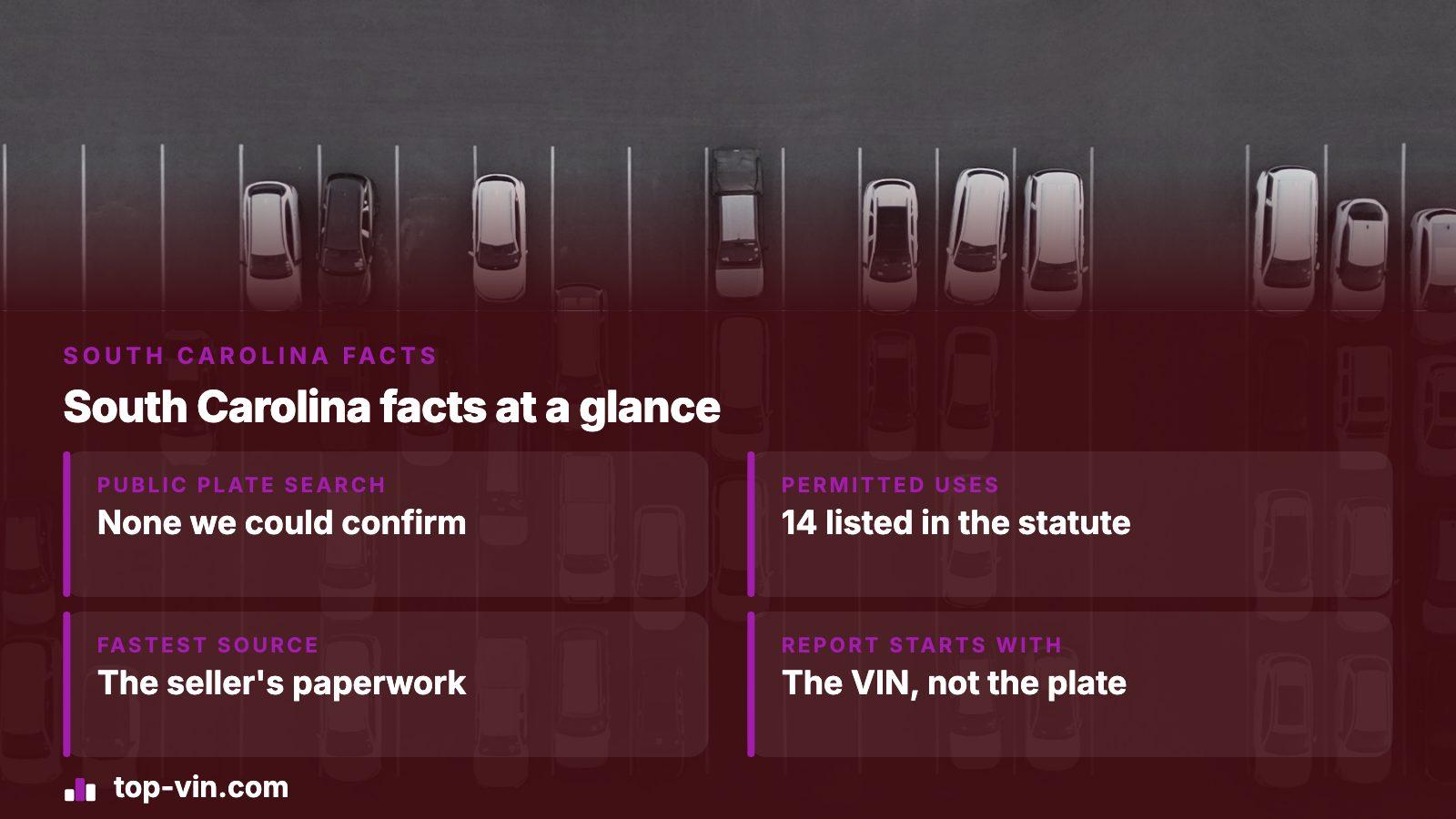
- Public plate search
- None we could confirm
- Federal permitted uses
- 14 listed in the statute
- Fastest source
- The seller's paperwork
- TopVIN
- Free preview, then one payment
Why TopVIN starts from the VIN and not the plate
Title offices, insurers and salvage buyers file what they know about a car under its VIN. A plate is attached to a registration instead, and registrations move around. The same piece of metal can end up on a different car, and the car can end up behind a different plate. Searching by plate therefore tells you about a paperwork event, not about the vehicle's life.
That is why TopVIN asks for the 17-character number. If you are standing in a driveway in Columbia, Greenville or Charleston with only a photo of a tag, the job is to obtain the stamped number in a way that is lawful and checkable. Everything below is about doing that, and about what to do when the number arrives.
What the federal privacy law does to plate requests
The Driver's Privacy Protection Act bars a state's motor vehicle department from knowingly releasing personal details in its files, apart from purposes spelled out in the statute itself. The listing has 14 entries. Most describe institutions: courts and agencies, insurers working a claim, investigators with a license, and parties to a legal proceeding.
- Insurers running claims, fraud or underwriting work.
- Courts, agencies and people serving papers or enforcing a judgment.
- Contacting the owner of a car that was towed or impounded.
- Investigators and security firms that hold a license.
- A requester who can show the written consent of the person in the record.
- A business confirming details a customer supplied, to stop fraud or collect a debt.
Checking out a car you might buy is not named in the text I read. A website promising an owner's identity from a plate for a few dollars is selling something the statute does not hand to ordinary shoppers. The statute also lets a state charge an administrative fee for a record, so a legitimate request is not necessarily free.
Asking the state itself
South Carolina's motor vehicle agency, SCDMV, is the body that holds registration records, and any request that turns a plate into vehicle details goes through it. SCDMV's website would not load for me during research, so this guide leaves out any form name, fee or turnaround time. A guess would only mislead you.
Before you spend time on a request, contact SCDMV and ask three things: which of the federal permitted uses it will accept, what the current fee is, and how long a response takes. If you cannot honestly claim one of the listed uses, expect to be turned down. Someone who signs a request claiming a use that does not fit takes on legal risk, and a used-car purchase is a poor reason to try.
Skip the shortcut
A lookup site that says it can reveal a South Carolina owner from a tag is not a substitute for the state's process. You cannot verify where its data came from or how old it is.
Four ways to get the number without a request
A genuine seller already holds the VIN. Request it by text before you drive over, which leaves a written record, then test it against a second document.
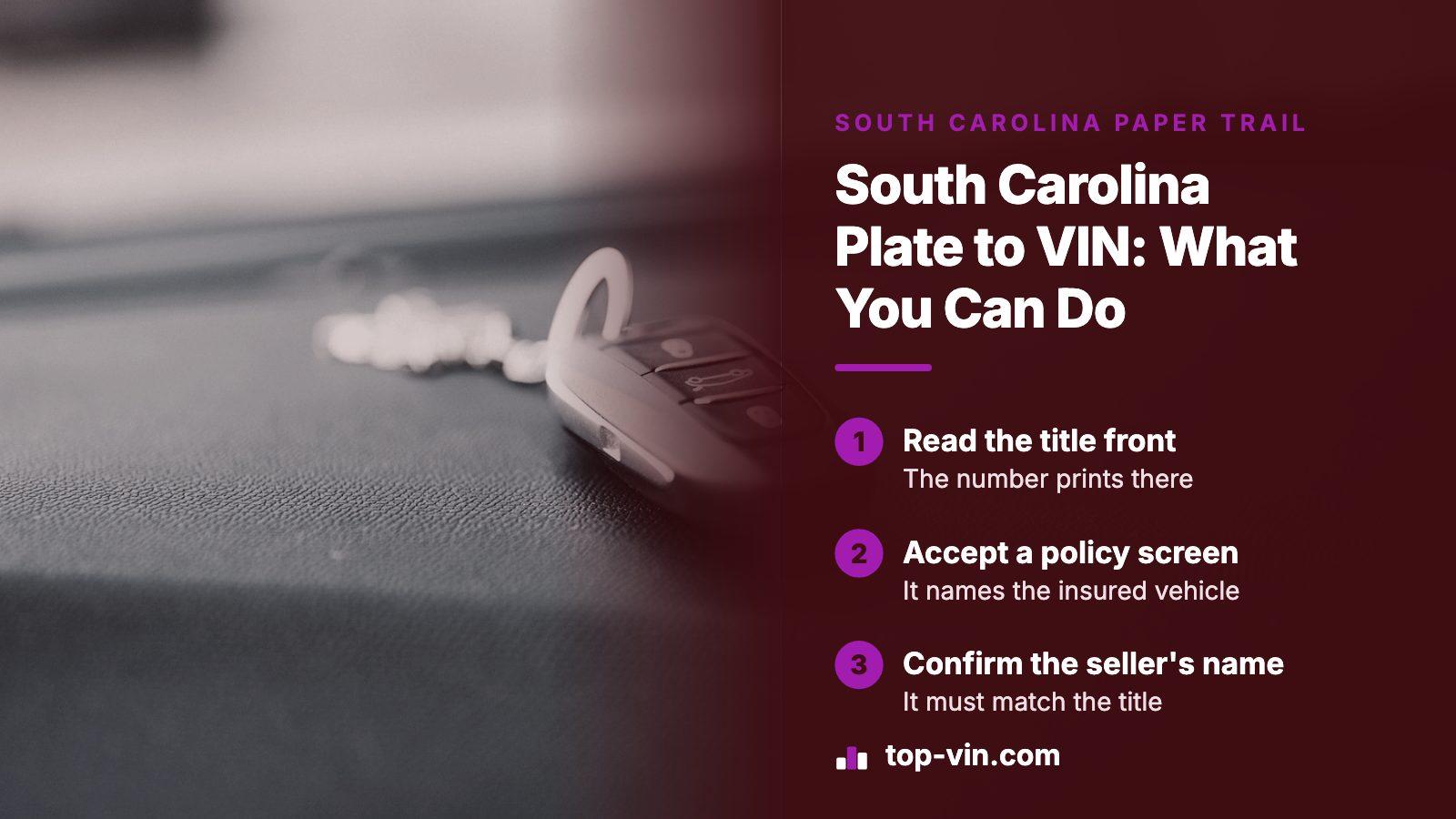
- The title certificate, which prints the number on its front.
- The registration card, whose number should agree with the title character by character.
- The insurance card, or the policy screen on the seller's phone, which names the insured vehicle.
- The car itself: photograph the number on the dashboard plate and the door-pillar sticker, then lay them next to the papers.
Matching three sources is the real test. A single transposed character might be a typing slip. It might also mean a title was altered or a part was swapped, and either one deserves an explanation in writing before you hand over money.

From a number in hand to a TopVIN preview
Type the VIN into the TopVIN box and the preview loads before you are asked to pay. Confirm that the make, model and model year line up with the listing. NHTSA's public decoder does the same job, turning the number into a year, make and model. When it leaves a field empty, that only means the agency holds nothing on the item.
If the preview matches, one payment buys a full report for a single car, and a multi-car pack suits anyone still comparing listings. Nothing auto-renews. Amounts appear on the pricing page, and no charge happens before it. TopVIN returns no owner names, addresses or personal details, and it does not search plates.
What to read first for a South Carolina car
Start with the title brand entries, then the damage and accident records, then odometer readings and any lien or theft entry. Insurer salvage and auction records with photos come next; they often explain a repair that the seller glosses over. Coastal counties see storms, so a flood or water-damage entry deserves a slow read.
| What turns up | What to do next |
|---|---|
| Salvage, junk or flood brand | Want repair paperwork, then discount the car as branded or pass. |
| Odometer lower than an earlier reading | Suspect a rollback and request maintenance receipts. |
| Open lien | Do not pay until the lender's release is in your hands. |
| Theft record | Stop and verify with police or the insurer. |
| No problems found | Encouraging, but still have a mechanic inspect it. |
Limits of a spotless report
The Justice Department's NMVTIS page says a clean title report is a good sign, yet it also warns about false negatives. It puts the share of the vehicle population in the system at 87 percent, notes that more than half of states report, and counts roughly twenty million salvage or total-loss entries. Gaps in reporting mean a missing brand is not proof that none exists.
States also set their own standards. A car can pick up a salvage brand in one state after damage that a neighboring state would not brand, and the page tells consumers to learn those differences before leaning on any report. For a South Carolina buyer, the practical answer is simple: use the report to decide whether to look closer, then pay a shop to look underneath.
A short checklist before money changes hands
- Collect the VIN in writing, then check it against title, registration and vehicle in turn.
- Run the TopVIN preview and see whether it agrees with the advertisement.
- If it does, buy the report and read brands, damage, odometer and liens first.
- Confirm the seller's name is the name printed on the title.
- Pay an outside mechanic to look the car over, particularly after any flag.
None of these steps needs the plate. If a seller refuses to share a VIN at all, that refusal is information about the deal, and it is reasonable to look at a different car.
Where this information comes from
- GovInfo: 18 U.S.C. 2721, Driver's Privacy Protection Act — the list of permitted uses, fees and limits on release of record data
- NMVTIS: Information for consumers — what the national title system covers and where it has gaps
- NHTSA vPIC: VIN decoder — how a VIN decodes to make, model and year
Sources and photos: Facts checked against the sources above in November 2026. Photos by Bence Balla-Schottner, Cole Keister and Iain on Unsplash; diagrams by TopVIN.
Keep reading
- Where the VIN sits on a title, and what to do nextWhere the number sits on a title and how to read it.
- Is the VIN on the insurance card? What to check before you trust itA second paper source when the seller is slow to reply.
- DMV VIN check compared: what the state shows and what to run beside itWhat a state agency check covers and what it leaves out.
- VIN lookup by owner name: what the law lets a buyer seeWhy a name is no better a starting point than a plate.
Frequently asked questions
Can I find a VIN from a South Carolina license plate for free?
Not through a public tool we could confirm. The free route for a buyer is the seller, the title, the registration or insurance card, or the number on the car. State record requests are meant for people with a permitted use, and fees may apply.
Is it legal to get a VIN from a plate through SCDMV?
It can be, if you truly fit one of the permitted uses in the federal statute and say so honestly. Wanting to vet a used car is not named there. Ask SCDMV directly what it accepts before you apply.
Will TopVIN tell me who owns a South Carolina plate?
No. TopVIN does not search plates and returns no owner names or addresses. It starts from the VIN and describes the vehicle: brands, damage, mileage, liens and similar records.
What if the seller refuses to share the VIN?
Treat that as a warning. Any real owner can read the number off the title or the dash in seconds. If photos of the title and the car are refused, move on to another vehicle.
Is the TopVIN report free?
The preview alone costs nothing. Past that point you pay once for a report or pack, and nothing rebills. Prices are listed on the pricing page before you pay.
Now check the car itself
The guide explains what to look for. The report shows what this VIN has on record.