THE SHORT ANSWER
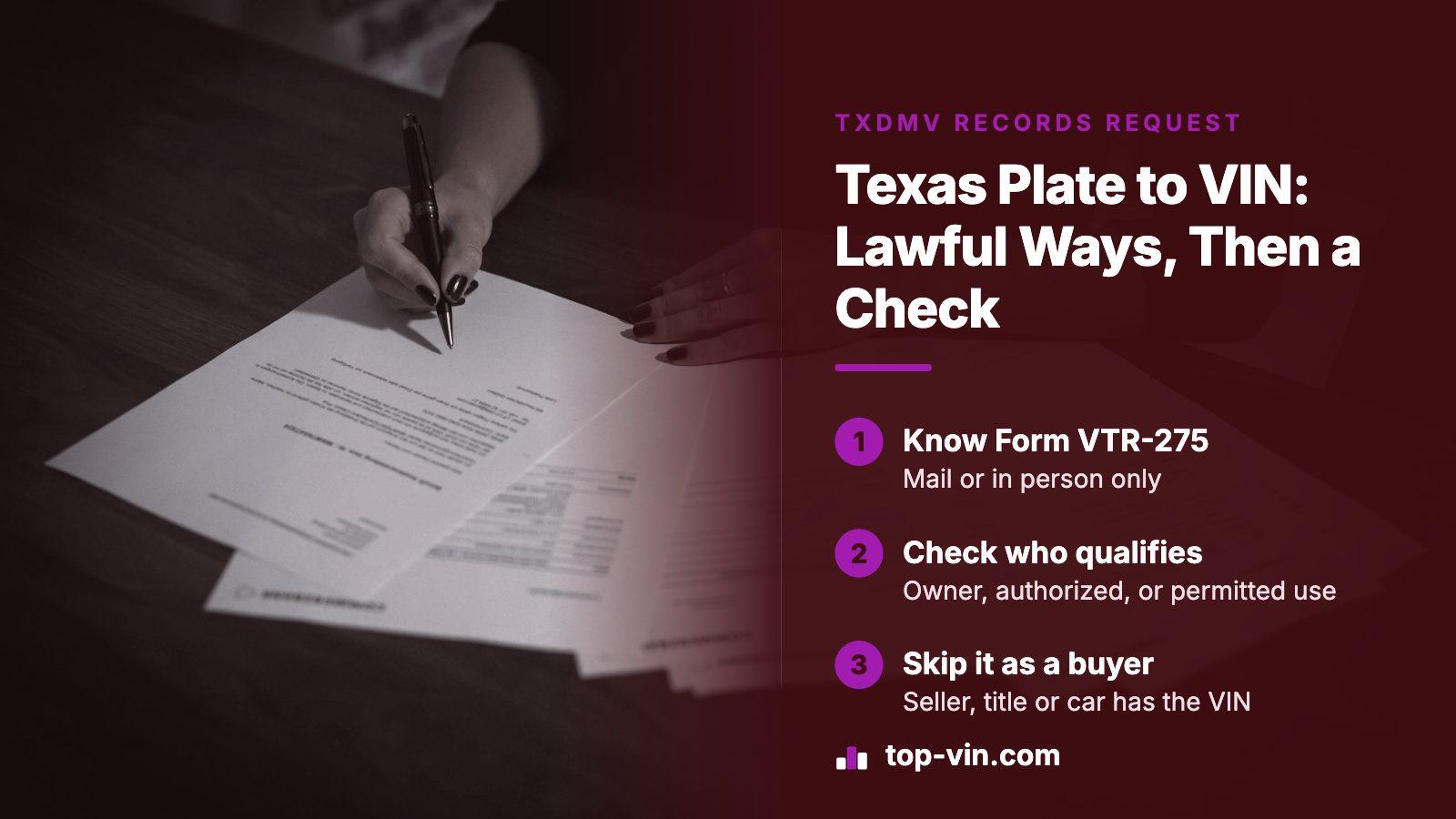
A Texas plate will not return a VIN from any lawful public search. TxDMV answers record requests on Form VTR-275, by mail or in person, and the requester must be the owner, hold written authorization or sign a permitted use under the federal Driver's Privacy Protection Act. Buyers skip all that: ask the seller, read the title or insurance card, or copy the number off the car, then run it for a free TopVIN preview.
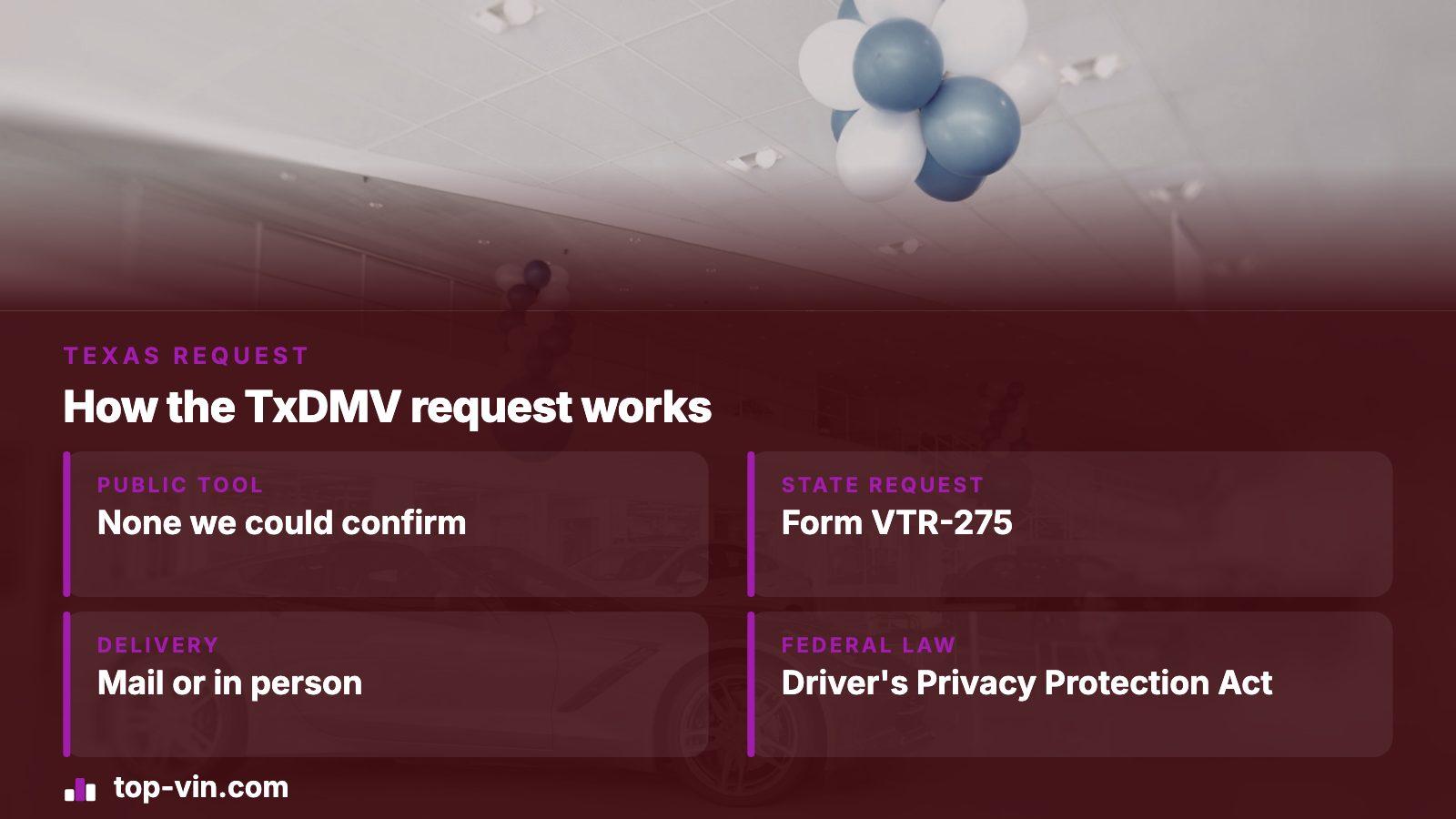
- Public plate-to-VIN tool
- None we could confirm
- State records request
- TxDMV Form VTR-275, mail or in person
- Governing federal law
- Driver's Privacy Protection Act
- TopVIN check
- Free preview, then one payment
Why a plate does not hand you a VIN
A Texas plate is a registration number. It points to a record at the state, and that record names a person. Everything a used-car buyer wants to learn, from title brands to odometer entries to theft flags, is filed against the vehicle identification number instead. So the search is popular for a good reason, and it also attracts sites that overpromise.
A site that offers an owner name or address from a plate is selling data the law restricts. TopVIN does not run plate searches and returns no personal details. It starts from the VIN, which describes the vehicle, and that is the number you need anyway before you can judge the car.
What we did and did not confirm
We read TxDMV's open records page, its buying guidance, its plate page and the request form. We found no public plate-to-VIN lookup on any of them, and we are not describing a tool we could not open.
How a TxDMV records request actually works
For anything beyond a counter transaction, TxDMV sends you to one document, Form VTR-275, titled Request for Texas Motor Vehicle Information. It covers title histories, registration details and a list of what is registered to you. Mail it, or hand it in at a regional service center. Email is not accepted.
The form has a search section with boxes for the plate, the year and make, the VIN and the title document number, so a plate can be the starting clue. You attach a copy of government photo ID and any supporting papers the form lists. Payment is a personal check, money order or cashier's check made out to TxDMV, never cash.
The fee list printed on the version of the form we opened is dated and may have changed, so we are not quoting amounts. Pull the current form from TxDMV before you send anything. The department also notes it may redact personal information from what it returns.
Who qualifies, and what you certify by signing
A requester who is not the recorded owner or lienholder has two ways in. One is written authorization from the recorded owner, lienholder or a previous owner. The other is initialing a permitted use on page two of the form. Signing certifies a lawful purpose, no marketing or solicitation use, and no earlier violation of the privacy laws. The form warns that falsifying it is a third degree felony.
- A court or police agency carrying out official duties.
- Work on vehicle safety, theft, emissions or recall campaigns.
- An insurer checking a claim, a fraud concern or a rate.
- A tow operator or lot sending notice to the owner.
- A lawsuit or administrative case, such as serving papers.
- A licensed investigator working inside one of those purposes.
Shopping for a used car is not on that list by itself. A buyer who wants a VIN to evaluate a purchase should use the routes in the next section, which need no request at all.
Four ways to get the VIN without a records request
Most buyers have the number within minutes. Try these in order:
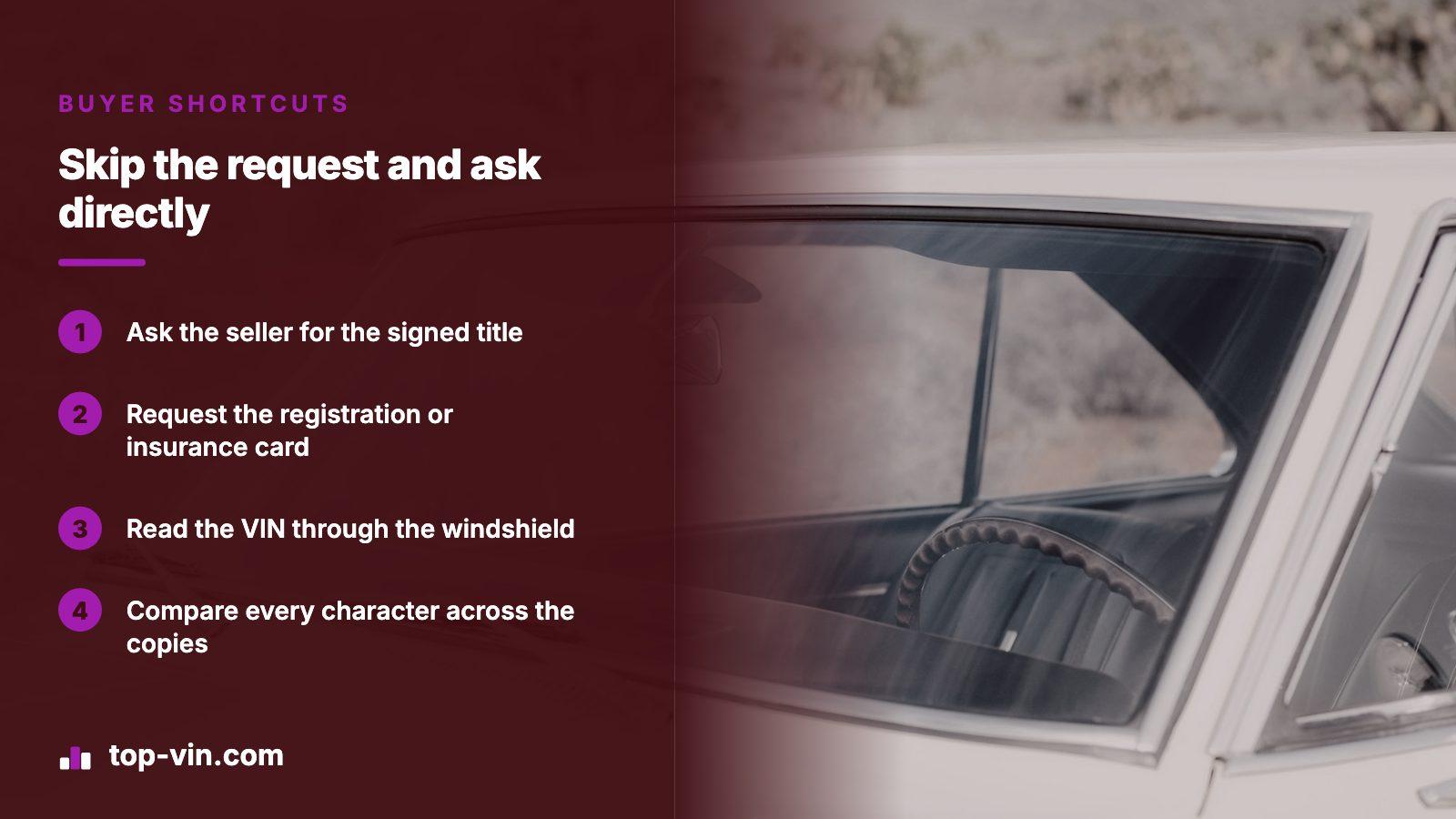
- Ask the seller for the title, which must be signed with the sale date and mileage at transfer and shows the VIN.
- Ask for the registration receipt or insurance card, since both list it.
- Look through the glass at the corner nearest the steering wheel, then compare what you see with the sticker inside the driver's door.
- Snap both spots and compare each character against the title before money moves.
If the seller is reluctant to share a number that is stamped on the car in plain view, treat that as information. A sale built around a plate and no VIN is a sale where nobody has compared the car to its paperwork.
Why the plate on the car tells you little in a private sale
TxDMV allows a seller to take the plates and the registration sticker when the car is sold. The plates can move to another vehicle in the same class, stay with the seller for later use, or be scrubbed unreadable on the front with a black marker or similar. In short, the plate you photographed on a listing may not be on the car at handover.
When a weekend sale leaves a car with no plates, the buyer prints a Vehicle Transit Permit, valid for five calendar days and issued once per vehicle sale. That permit exists so nobody has to borrow plates. A seller who offers their old plates for the drive home is proposing something the state's own process is designed to avoid, and plates that disagree with the registration record are a classic mark of a cloned or disguised car.
Run the VIN, then read what comes back
With the number in hand, enter it for the free TopVIN preview. It shows how much a full report holds. Going further means buying the report once, with no monthly billing, at the prices on the pricing page. Texas buyers get the most from these parts of it:
| Record | Why it matters on a Texas car |
|---|---|
| Title brands | Salvage, flood or rebuilt marks that should have been visible on the title you were shown. |
| Accident and damage records | Whether the repairs you can see cover everything that was reported. |
| Odometer readings | A mileage trail you can compare to the number on the dash. |
| Liens and theft | Whether a lender or an insurer still has a claim on the car. |
| Open recalls | Safety campaigns that were never completed. |
Both run from the VIN alone, so nothing needs signing.
Texas gives buyers two more places to look
TxDMV recommends its Title Check service to buyers who want to know whether the title of a car has issues that affect its value. It also tells private-sale buyers to bring the seller along to the county tax office, where a representative can say whether the signed title is correct and whether it shows salvage or legal problems before the application is filed.
On the national side, NMVTIS is the federal title database meant to shield shoppers from fraud and dangerous cars, and to keep stolen ones off the resale market. Reports from approved providers draw on it.
After the check: the Texas steps that follow
A clean result is not the end. The buyer must title the car within 30 days of the sale or risk delinquent transfer penalties. A private purchase triggers a 6.25 percent vehicle sales tax, figured on whichever is greater, the price paid or the standard presumptive value, and you must show proof of liability insurance at the counter.
- Get the signed title along with Form 130-U carrying the sales price.
- Keep the seller's contact details, the date and the VIN on paper.
- Ask the seller to file a Vehicle Transfer Notification, which limits their exposure to your tickets and tolls.
- Check whether your county needs an emissions test before registration. Seventeen counties still require one, though not a safety inspection for private cars.
- Plan on a wait of 20 business days or more for the title.
Where this information comes from
- TxDMV: Open Records — how motor vehicle records requests are submitted and what they require
- TxDMV: Request for Texas Motor Vehicle Information (VTR-275) — search fields, permitted-use list and certification wording
- TxDMV: Buying or selling a vehicle — title, plates, transit permit, tax and transfer notification
- TxDMV: License plates — general-issue plates and disposal of old plates
- govinfo: 18 U.S.C. 2721 — federal permitted uses for motor vehicle record data
- NMVTIS: VehicleHistory.gov — federal title information system for consumers
Sources and photos: Facts checked against the sources above in November 2026. Photos by Dimitri Karastelev, Wesley Tingey and Richard R on Unsplash; diagrams by TopVIN.
Keep reading
- License plate to VIN: the lawful ways to find a car's VIN from its plateThe national version of this question, state by state.
- License plate lookup privacy laws: what you can and cannot get from a plateWhat privacy law keeps out of plate searches and why.
- DMV VIN check compared: what the state shows and what to run beside itWhat a DMV can and cannot tell you about a VIN.
- VIN cloning: why a VIN check can pass a stolen car and what catches itHow mismatched plates and numbers expose a disguised car.
Frequently asked questions
Can I look up a VIN by license plate in Texas?
Not through a public search we could confirm. TxDMV releases that link on a written Form VTR-275 request, and the requester must be the owner, hold written authorization or sign a permitted use. For a purchase, the seller, title or insurance card is quicker.
Can TxDMV give me a VIN if I only know the plate?
The request form does include a field for the plate, but it also needs your ID and a qualifying reason, and it goes by mail or in person. Ordinary shopping does not appear on the permitted-use list, so most buyers need another route.
Is the VIN on the Texas title?
Yes. A transfer needs a signed title with the sale date and odometer reading, and the vehicle number is printed on it. Compare it with the car itself before paying, and walk away if the characters differ.
What if the seller already removed the plates?
That is normal. Texas lets sellers take their plates and sticker. Request the title plus a picture of the stamped number, then run the VIN. Never drive home on the seller's old plates.
Does the free TopVIN preview need a plate?
No. It runs from the VIN alone and asks nothing about the owner. If you want the whole report afterward, you pay once and nothing renews. See the pricing page.
Now check the car itself
The guide explains what to look for. The report shows what this VIN has on record.