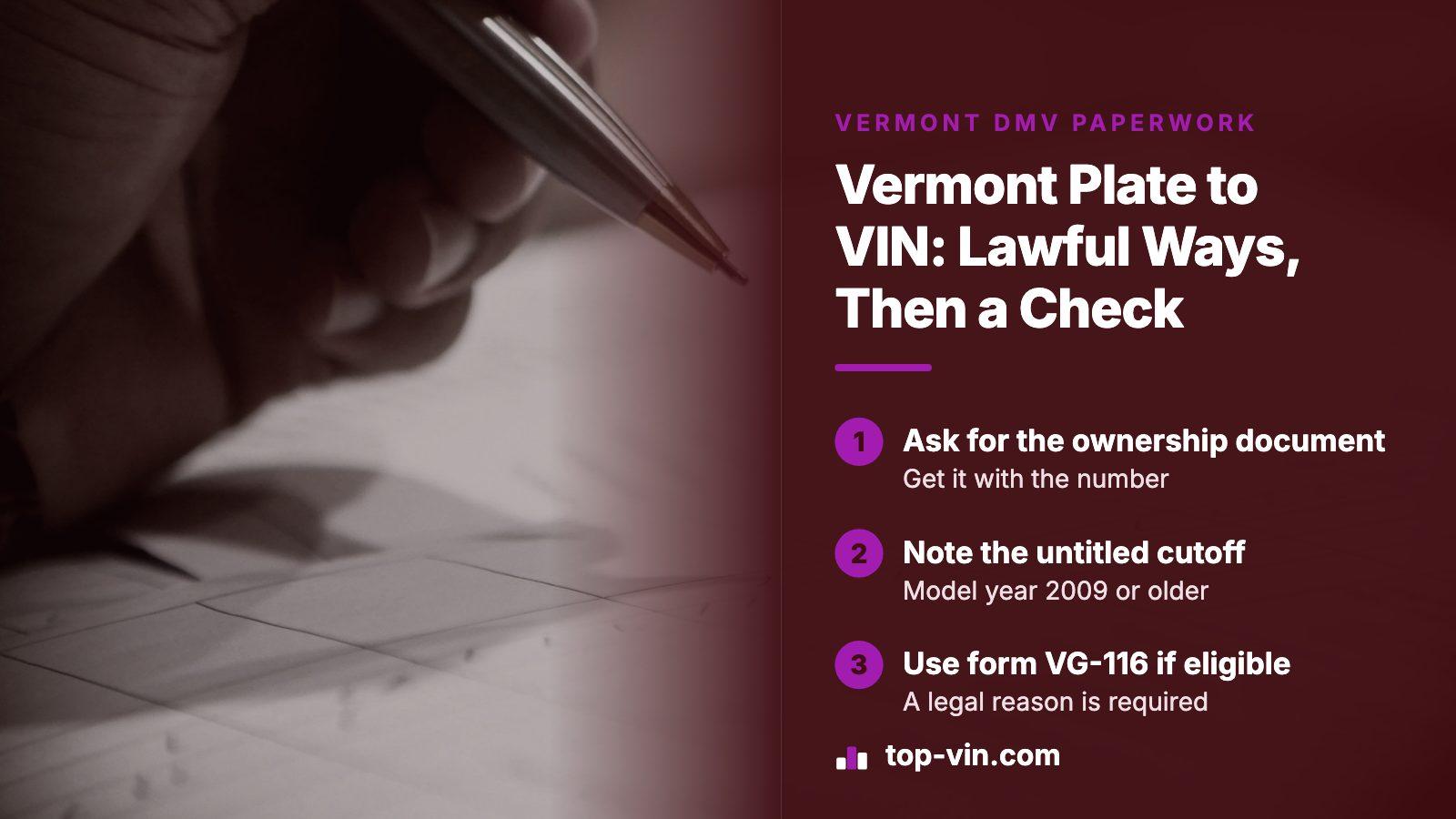
THE SHORT ANSWER
No public Vermont service converts a plate into a VIN or names the owner. Get the number from the seller along with a copy of the ownership document, copy it off the car, or find it on the registration or an insurance card. People with a legal reason can go through the DMV records process. Once you have the 17 characters, run the check; the preview costs nothing.
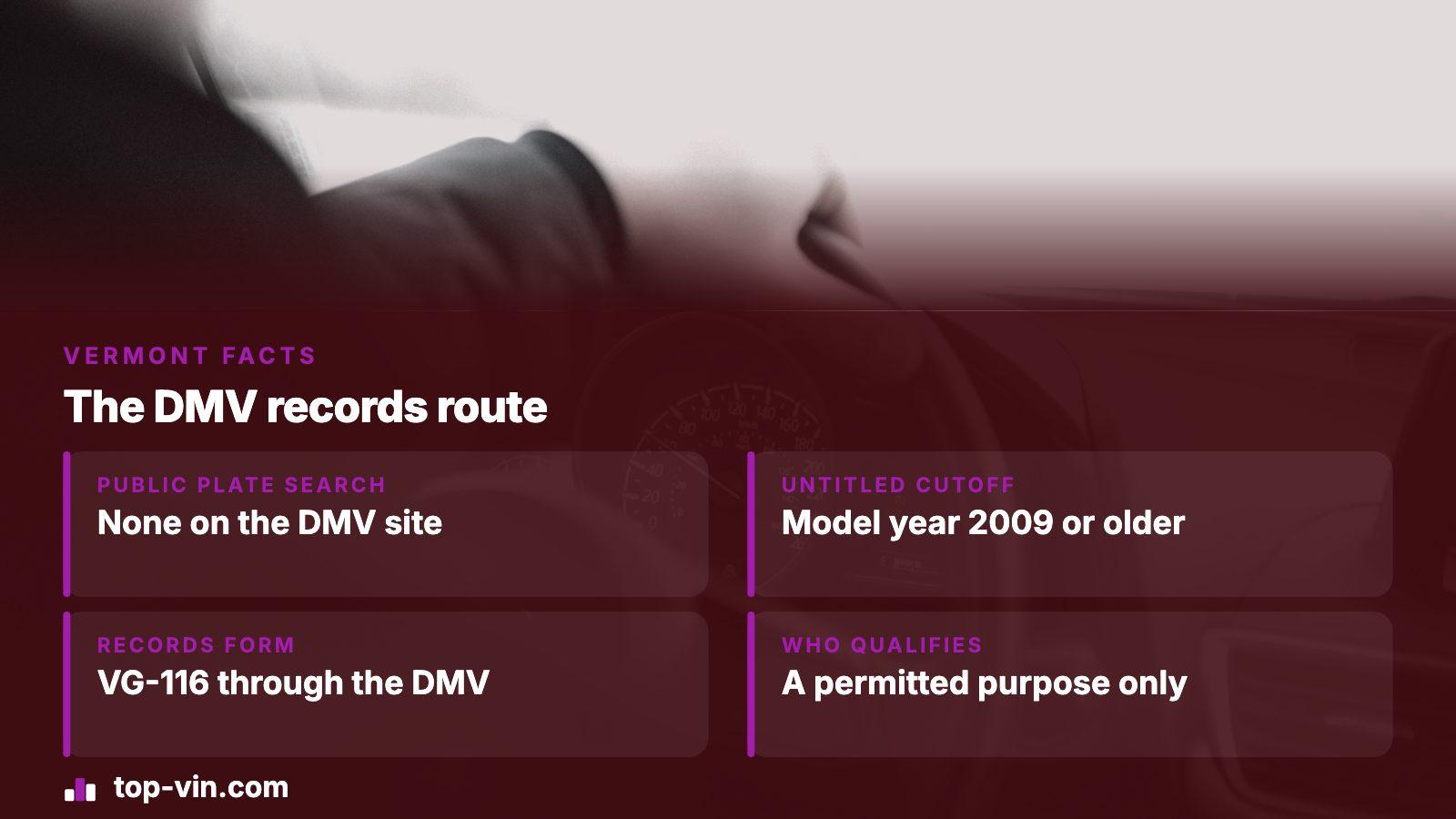
- Public plate-to-VIN search
- None on the Vermont DMV site
- Untitled cutoff
- Model year 2009 or older
- Records form
- VG-116 through the DMV
- TopVIN check
- Free preview, one payment after
What a Vermont plate search really delivers
Search results for a Vermont plate are crowded with pages promising a VIN, an owner and a history in seconds. None of that comes from a public state tool. The Vermont DMV publishes a policy on who may receive personal information from a motor vehicle record, and general curiosity does not qualify.
What a buyer needs is simpler than an owner profile. You need the exact 17-character number for the exact car in front of you, because every title brand, odometer entry, salvage sale and theft report is filed under it. The plate only tells you which registration was on the car on one particular day. So the sensible order is to get the number from a trustworthy source first, and let the check do the rest.
Five lawful ways to end up with the VIN
Each route below works without any plate database, and the first three cost nothing.
- Message the seller and ask for the number in writing, plus a photo of the ownership document, before you travel.
- Read it off the vehicle yourself and compare it to what the seller sent. A mismatch ends the conversation.
- Look at the Vermont registration certificate, which should carry the same number as the car.
- Check an insurance card or policy page, which usually lists each insured vehicle's number.
- If you hold a permitted purpose, file a records request with the DMV, covered in the section below.
A seller who dodges the first request is giving you information too. Honest sellers send the number in a minute.

Vermont paperwork has a quirk that affects what you are handed
Vermont changed its title rules on July 1, 2024, under Act 165, and the DMV's title guide spells out the result. For a 2009-or-older car already registered to its owner, the state does not demand a title. Proof of ownership is the registration certificate, which the seller gives you together with a signed sales receipt. Your own registration is what produces a title in your name.
That means a Vermont seller of an older car may legitimately have no title to show you, so the missing title alone is not a red flag. A receipt with no certificate behind it is another matter.
| What the seller hands you | How to read it |
|---|---|
| Vermont title | Normal for newer cars, or older ones sold since the rule change |
| Registration certificate plus signed bill of sale | Correct for a 2009-or-older Vermont car that never needed a title |
| Bill of sale only | A gap in the chain; ask where the certificate is |
| Out-of-state title with Vermont plates | Read which state issued the title and run the VIN |
The DMV records route, and who it is for
The DMV does take record requests. Its form VG-116 covers records and documents such as driving records, certified copies and crash reports, and individuals use it for their own driving record. Organizations that need personal information in volume, such as insurers, sign the DPPA user agreement, form VG-118, and a subscriber agreement.
Check the DMV's own page for the current fee and for what a given request can return, since the form is aimed at specific purposes rather than open-ended searching. Expect to state your reason. Expect a refusal if all you want is the name behind a car you noticed on the street.
The uses Vermont recognizes under federal privacy law
The federal Driver's Privacy Protection Act, 18 U.S.C. section 2721, limits what a state motor vehicle agency may hand out from its files to a defined set of purposes. Vermont's DMV restates those uses on its permissible-uses page. A few that matter to ordinary readers:
- Insurance companies working on claims, fraud screening or pricing.
- Litigation and arbitration, such as delivering court papers.
- Alerting an owner whose car was towed or impounded.
- Licensed investigators working inside one of those purposes.
- A requester carrying signed consent from the person in the record.
Vermont adds its own limits: its own law forbids giving out a Social Security number, and license photos need consent in most cases.
Match the number to the document before you check anything
Once a VIN is in hand, line up three copies: the one the seller texted, the one on the paperwork and the one on the car. For a Vermont sale, the DMV says a bill of sale for a car with no prior title must name the make, year, VIN, price, mileage, seller signature and sale date. Treat any bill of sale missing those details as incomplete.
Odometer paperwork matters too. Vermont requires an odometer disclosure on the bill of sale form, VT-005, for model year 2011 or newer. Compare the mileage written there against the odometer readings the check returns. A number that went down between entries deserves a hard question.
What the VIN check tells you that the plate cannot
A VIN check sits on records tied to the car itself. The national title system, NMVTIS, pools reports from several sources: state title offices, recyclers, scrapyards and insurers. A buyer can see who titled the car, its newest mileage figure, any brands and, now and then, a theft entry. Labels like junk, salvage or flood travel with the car across borders, so a car that spent time in another state cannot quietly shed it.
TopVIN's report goes further, with crash and damage entries, auction sales with pictures, lienholders and unresolved recalls, so you are reading the car's file rather than a snapshot of one registration.
Why this matters in Vermont
The DMV runs NMVTIS on every title and registration transaction. If your own registration later hits an active title elsewhere, you may have to track down the previous title or go through a title bond process. Checking before you pay is far cheaper.
Signs the deal should pause
- The seller will not share the VIN until you arrive with cash.
- The stamped number and the number on the paperwork disagree.
- An older car with no registration certificate, only a handwritten receipt.
- A brand in the history that the seller never mentioned.
- A lender listed on the record although the seller calls the car paid off.
- Mileage on the bill of sale lower than a prior reading.
One flag is a question to ask. Two or three together are a reason to walk. If the history shows no NMVTIS record at all, note that Vermont's DMV then asks for a notarized affidavit and a VIN verification form, so the car's paper trail needs extra work.
Running the check and what to do next
Type the VIN into TopVIN and read the free preview first. If the car still interests you, you can pay once for the full report, with nothing recurring. The /pricing page lists current options, so check it instead of trusting a figure repeated elsewhere.
- Get the VIN in writing and verify it against the car.
- Run the preview and read any brand, theft or lien flags.
- Buy the full report only for a car you are seriously considering.
- Compare mileage and ownership against the paperwork.
- Arrange an independent inspection before any money moves.
Then register in your own name using the DMV's registration and title application, form VD-119.
Where this information comes from
- Vermont DMV: title guide — Act 165 title rules, forms VD-119, VT-005, VT-025 and VT-010, and NMVTIS checks.
- Vermont DMV: permissible uses for personal information — The uses under which personal data may be released.
- Vermont DMV: driving records requests — Forms VG-116 and VG-118 and who files them.
- Vermont DMV: NMVTIS — What the national title system holds and what a brand is.
- 18 U.S.C. 2721 (Driver's Privacy Protection Act) — The federal limit on releasing motor vehicle record data.
Sources and photos: Facts checked against the sources above in November 2026. Photos by Masjid MABA, Justin Cron and Miles Loewen on Unsplash; diagrams by TopVIN.
Keep reading
- License plate to VIN: the lawful ways to find a car's VIN from its plateThe national picture of plate-to-VIN searches.
- Where the VIN sits on a title, and what to do nextReading the number on a title.
- Is the VIN on the insurance card? What to check before you trust itAnother place the number often appears.
- License plate lookup privacy laws: what you can and cannot get from a plateWhy plate searches return so little about people.
Frequently asked questions
Can I look up a VIN by license plate in Vermont?
Not through any public Vermont tool. The DMV releases personal information only for uses its policy lists. A buyer is better served by asking the seller for the VIN, copying it from the car, or finding it on the registration or insurance card, then running the check on that number.
Does a Vermont car need a title to be sold?
Not always. Under the DMV's guide, a 2009-or-older car registered to its owner can be sold on the strength of the registration certificate and a signed bill of sale. Whoever buys it gets a Vermont title as part of registering.
Which Vermont DMV form requests records?
Form VG-116 is the DMV record request, used for driving records, certified copies and crash reports. Organizations needing personal information in volume use the DPPA user agreement, form VG-118. Check the DMV page for the current fee and what each request can return.
Can a VIN check tell me who owns the car?
No. A VIN check reports on the vehicle: title brands, odometer entries, salvage and theft records, liens and recalls. It is not an owner lookup, and no lawful service returns a private person's name from a plate.
Is the TopVIN report free?
Only the preview costs nothing. After it, the report is paid once and does not renew; amounts sit on the pricing page. Look at what the preview flags before you decide.
Now check the car itself
The guide explains what to look for. The report shows what this VIN has on record.