THE SHORT ANSWER
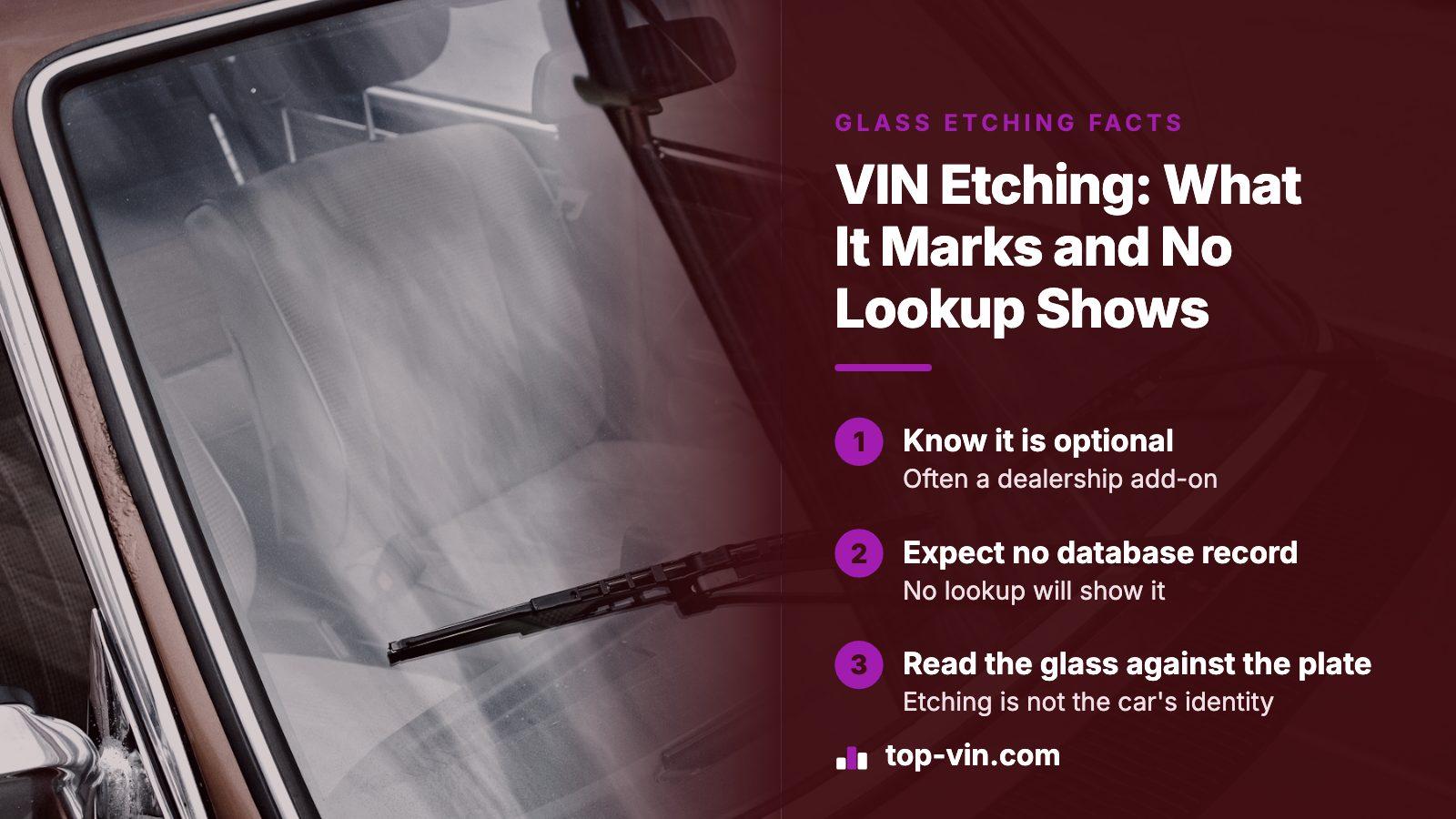
A stencil and etching compound leave the VIN frosted on the glass. The mark is optional, covers a part the federal parts-marking list skips, and is filed nowhere, so no VIN lookup can tell you a car has it. For a buyer the value lies in the number: read it, compare it with the dash plate and the title, and treat any mismatch as a question for the seller.
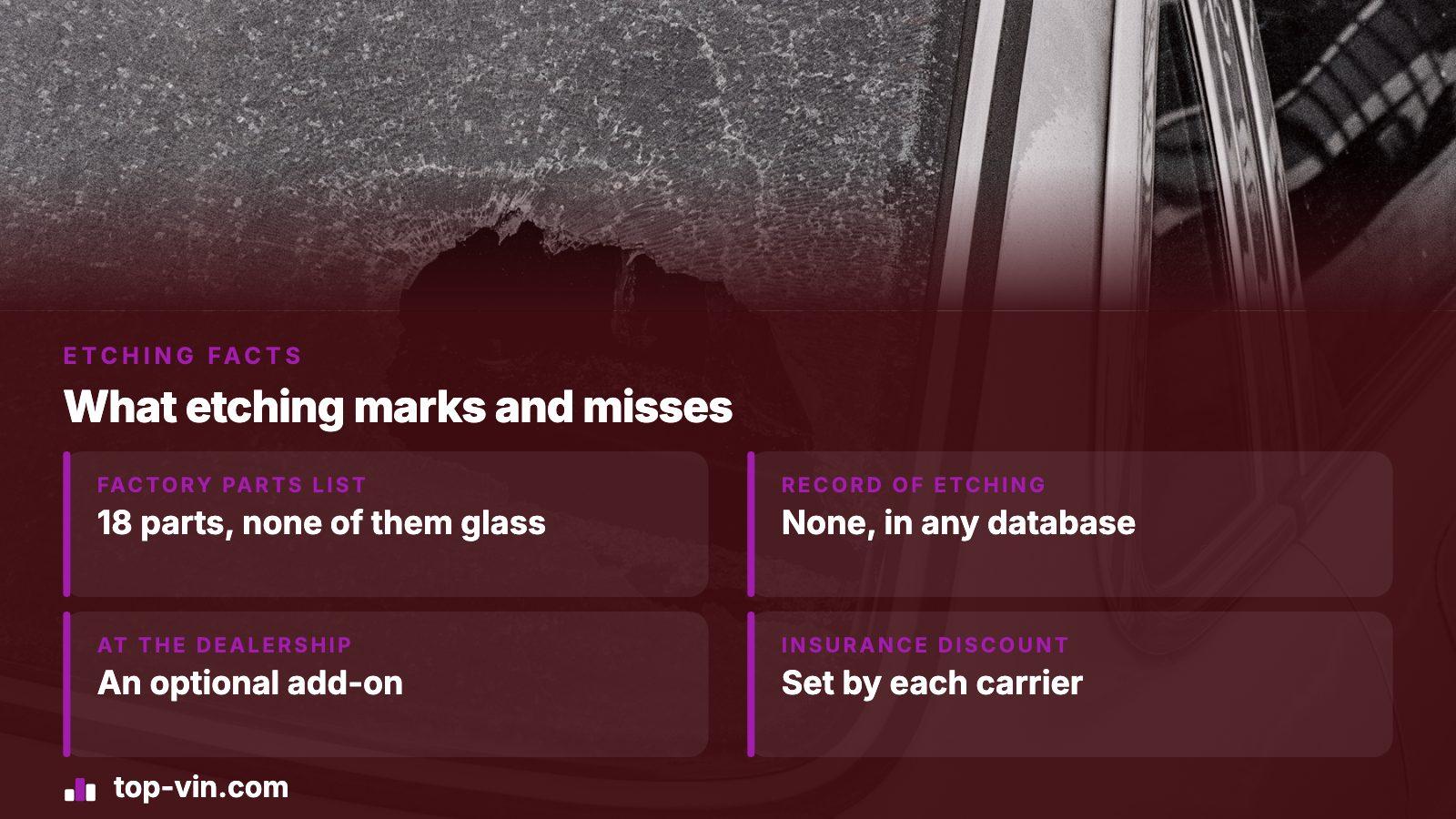
- Factory parts list
- 18 parts, and none of them is glass
- Record of the etching
- None, in any database
- At the dealership
- An optional add-on
- Insurance discount
- Set by each carrier
What gets frosted onto the glass
Someone presses a VIN stencil onto the pane and works etching compound through the cut-outs. Minutes later the stencil is peeled off, leaving the characters frosted into the glass. The windshield is the main target, and most jobs add the side and rear windows.
NHTSA files window etching under visible deterrents, alongside theft-deterrent decals, flashing lights and steering-wheel locks. Such a device works by being noticed before a thief commits to a car. It does not track the vehicle or sound an alarm.
Why no VIN lookup will ever show it
A lookup returns records that an institution filed under the 17 characters. Etching is not filed with anyone, so there is nothing for any provider to return.
| Record source | What it holds |
|---|---|
| NICB VINCheck | Stolen-and-unrecovered, salvage and flood entries from participating insurers |
| Federal title system (NMVTIS) | Where the car is titled and since when, any brands, the odometer, and total-loss and salvage entries |
| A paid history report | Title brands, theft and salvage entries, odometer readings and accident records from several sources |
No row has a field for window markings, so anyone claiming a report will confirm etching is guessing. The only test is to look at the bottom corners of the glass.
What the factory already stamps, and the gap on the glass
Part 541 of Title 49 aims to help police trace parts taken from stolen vehicles. It tells makers to mark 18 listed parts with an identifying number, normally the VIN: engine and transmission, fenders, hood, doors, bumpers, quarter panels or side assemblies, the cargo box and the rear closure. No windshield or window is on the list, and that gap is the honest case for etching.
Coverage is narrower than it sounds. Small makers and low-volume lines are left out, light trucks count only when NHTSA flags them, and a line with a qualifying antitheft device can be exempted. Appendix A-I names those lines, so look your model up before assuming its panels carry numbers.
Why the glass copy is not the car's identity
Under Part 565 the official VIN may not live on glazing. It sits on a non-glass part, or on a plate or label attached permanently to one, inside the cabin, legible through the glazing to someone outside the car at the driver's-side windshield pillar, in characters at least 4 mm tall. Etched glass is an extra copy added by someone other than the maker.
| Where you read a VIN | Put there by | What a match tells you |
|---|---|---|
| Plate on the dash | The maker, under Part 565 | The identity the car was built with |
| Stamped or labeled parts | The maker, on covered lines | Those parts belong to this car |
| Title and registration | The state | The identity the state has on file |
| Etched glass | A dealer, a shop or the owner | Only that the glass carries that number; a pane from another car carries that car's |
Reading etched glass on a used car
Etching on a used car doubles as a two-minute consistency check.
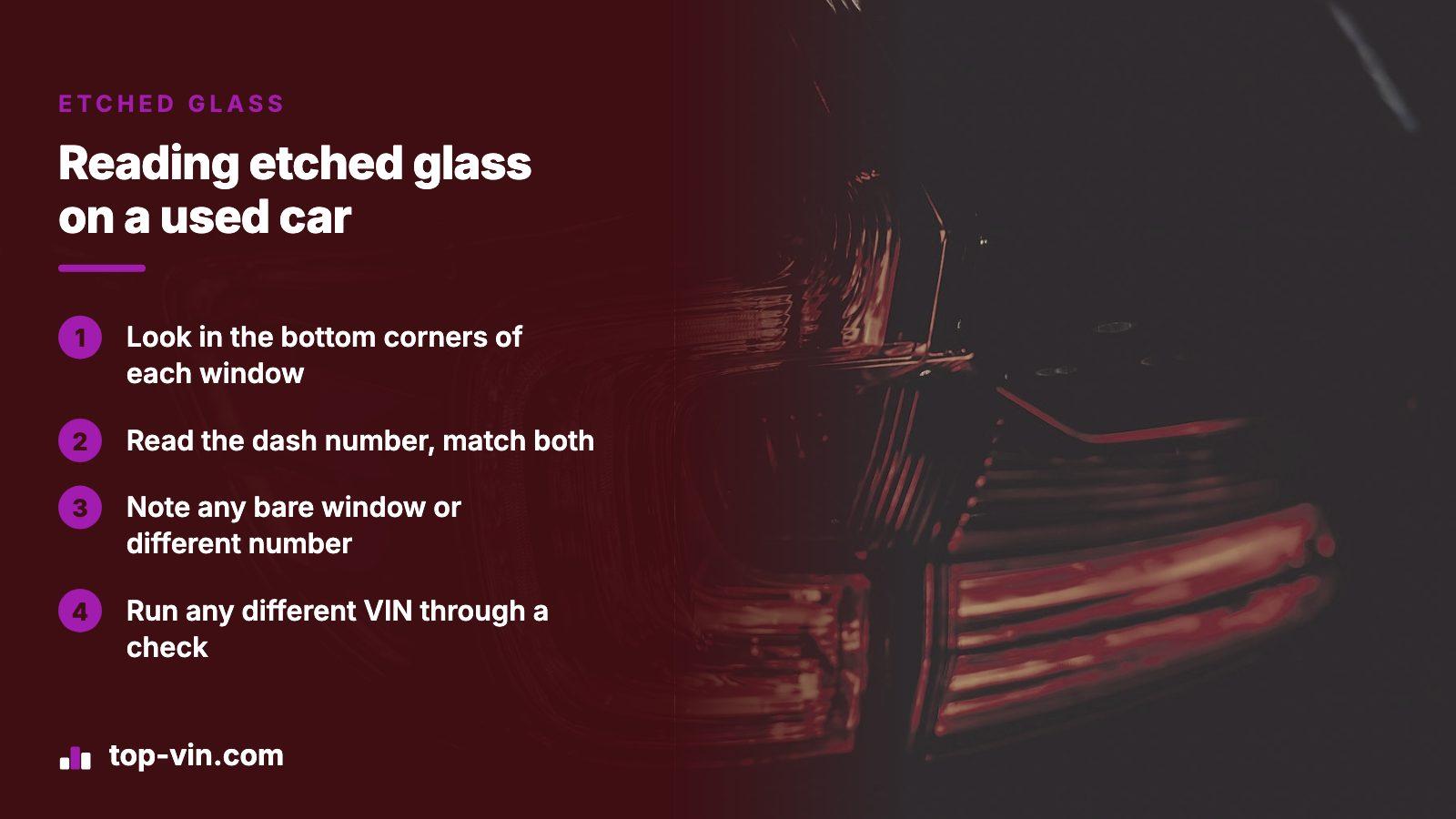
- Look in the bottom corners of the windshield and each side window for the frosted number.
- Read the dash number through the windshield, then match both to the title, character for character.
- Note any window that is bare or shows a different number. A bare pane in an etched set may be a replacement, so ask.
- If a window shows a different VIN, run that number through a check as well.
A matching set is a small point in the car's favor and says nothing about title, accidents or theft. A different number has two likely explanations: replacement glass from another vehicle, or an identity swap to rule out before paying. Checking the glass number shows which vehicle it belongs to, and the full report on the dash number shows whether that car's theft, title and salvage records are clean. The VIN cloning guide covers real mismatches.
At the finance desk: an optional line, not a requirement
The FTC lists VIN etching with gap insurance and rustproofing as typical dealer add-ons. Its used-car guidance warns that they tend to surface at the end of a long day, that some dealers fold them into the deal unannounced, and that the car can usually be bought without them. Most can also be bought from independent retailers.
- Ask for out-the-door prices in writing before you visit; the FTC says this helps spot late additions.
- Read the buyer's order for an etching line, and ask what it costs and what you get, in writing.
- Price a do-it-yourself kit beside the quote; it is usually the cheapest route to the same frosted glass.
If the glass is already marked, the dealer's cost is not your agreement to pay, so the price remains open.
The insurance discount in the pitch
Dealers often mention a lower premium. According to NICB, some insurers give a break for anti-theft equipment like alarms and trackers, and a few extend it to a VIN engraved in the windows. NICB also tells owners to ask their own carrier about its program, and no federal rule obliges an insurer to offer one.
So a call to your agent is the cheapest step in the decision. Before you sign, ask whether etched glass changes your premium in your state and what proof the insurer wants. If it does, set the saving against the dealer quote and then against a kit. If not, finding out cost a phone call.
What etching does not do once a car is gone
- It tracks nothing and alerts no one; NHTSA files recovery systems, which transmit a location to police, in a separate category.
- It does not stop hot-wiring, which is what immobilizers are for.
- It ignores what thieves go after: NHTSA lists air bags, GPS units, phones and laptops, while doors, engines and transmissions get stripped and sold.
- It creates no database entry, so police and insurers learn nothing until someone reads the glass.
If a theft does happen, the numbers that matter are on paper. NHTSA says to call police at once, ask for a report copy or case number, and notify your insurer within 24 hours. NICB adds that reporting immediately raises the chance of recovery in the first 24 hours by 34 percent.
Where a VIN check fits when theft is the worry
For a buyer, theft history lives in records, not in glass. NICB's VINCheck is a quick first screen: it costs nothing and matches the VIN against stolen, salvage and flood entries from participating insurers, with a daily search limit. NICB advises against relying on it alone.
TopVIN's preview is the free step in the same spirit: enter the VIN, see what the car is and decide whether the full report is worth it. The report is paid once, with no recurring plan, and adds title brands, theft and salvage entries, odometer readings and accident records. The pricing page lists current amounts.
Neither replaces a hands-on look: the FTC notes that history reports usually list accidents and flood damage but not mechanical problems, so pay for an independent inspection too.
Where this information comes from
- FTC: Buying a Used Car From a Dealer — Names VIN etching as an optional add-on, with the questions to ask and the limits of a history report.
- NHTSA: Vehicle Theft Prevention — Places window etching among visible deterrents and describes what thieves take and what to do after a theft.
- NICB: Prevent Vehicle Theft — The insurer-discount statement for anti-theft devices and the recovery figure for fast reporting.
- NICB: VINCheck — What the no-charge theft and salvage screen searches, its daily limit and its stated gaps.
- 49 CFR Part 541: Federal Motor Vehicle Theft Prevention Standard — The list of marked parts, the vehicles it covers and the exempted lines in Appendix A-I.
- 49 CFR Part 565: VIN requirements — Where the official number must sit, including the exclusion of glazing and the readability rule.
- NMVTIS: Understanding an NMVTIS Vehicle History Report — The five indicators a federal title report carries and who must report to it.
Sources and photos: Facts checked against the sources above in November 2026. Photos by Max Tokarev, A n v e s h and Kenan Reed on Unsplash; diagrams by TopVIN.
Keep reading
- VIN cloning: why a VIN check can pass a stolen car and what catches itWhat a mismatch between the glass, the dash and the title can mean.
- VIN verification: the four checks people mean and what each provesCompare the car's plates with the number you ran.
- How to read a VIN: a left-to-right walkthrough with a worked decodeWhat the 17 characters mean and where to read them.
- VIN inspection: what the inspector checks and what a VIN check addsThe in-person look that history records cannot replace.
Frequently asked questions
Is VIN etching worth it?
A small deterrent is worth a small price. Etching marks glass, which the factory list skips, but it tracks and locks nothing. Judge the quote against a kit and against any discount your insurer confirms, and decline it if the numbers do not work.
Will a VIN report show that a car is etched?
No. Etching leaves no record, so neither a preview nor a full report nor a federal title search has a field for it. Look at the bottom corners of the glass and compare the number you find with the dash plate and the title.
Does VIN etching affect a car's title or history record?
No. Brands, salvage entries and odometer readings come from state titling agencies, insurers and salvage yards, and none of them records window markings. A clean or branded history looks the same before and after etching.
Can I refuse VIN etching at a dealership?
Yes. The FTC treats it as an optional add-on. Ask what the line costs and what it includes, get the answer in writing, and ask for it to come off the sheet. If the glass is already marked, the price is still open to discussion.
Is etched glass on a used car a good sign or a warning?
Usually a small good sign, because someone spent money on security. If the number matches the dash plate and the title, nothing is wrong. If one window differs, ask where the glass came from and run the second number through a check.
Now check the car itself
The guide explains what to look for. The report shows what this VIN has on record.