
THE SHORT ANSWER
A VIN is reported as not found when the decoder cannot match it to a maker's filing, or when a history database holds no record for it. Typing errors cause most cases: a wrong character, a letter where a digit belongs, or a string shorter than 17. The rest are makers missing from the federal list, very new or unusual vehicles, and numbers that do not match the car being sold.
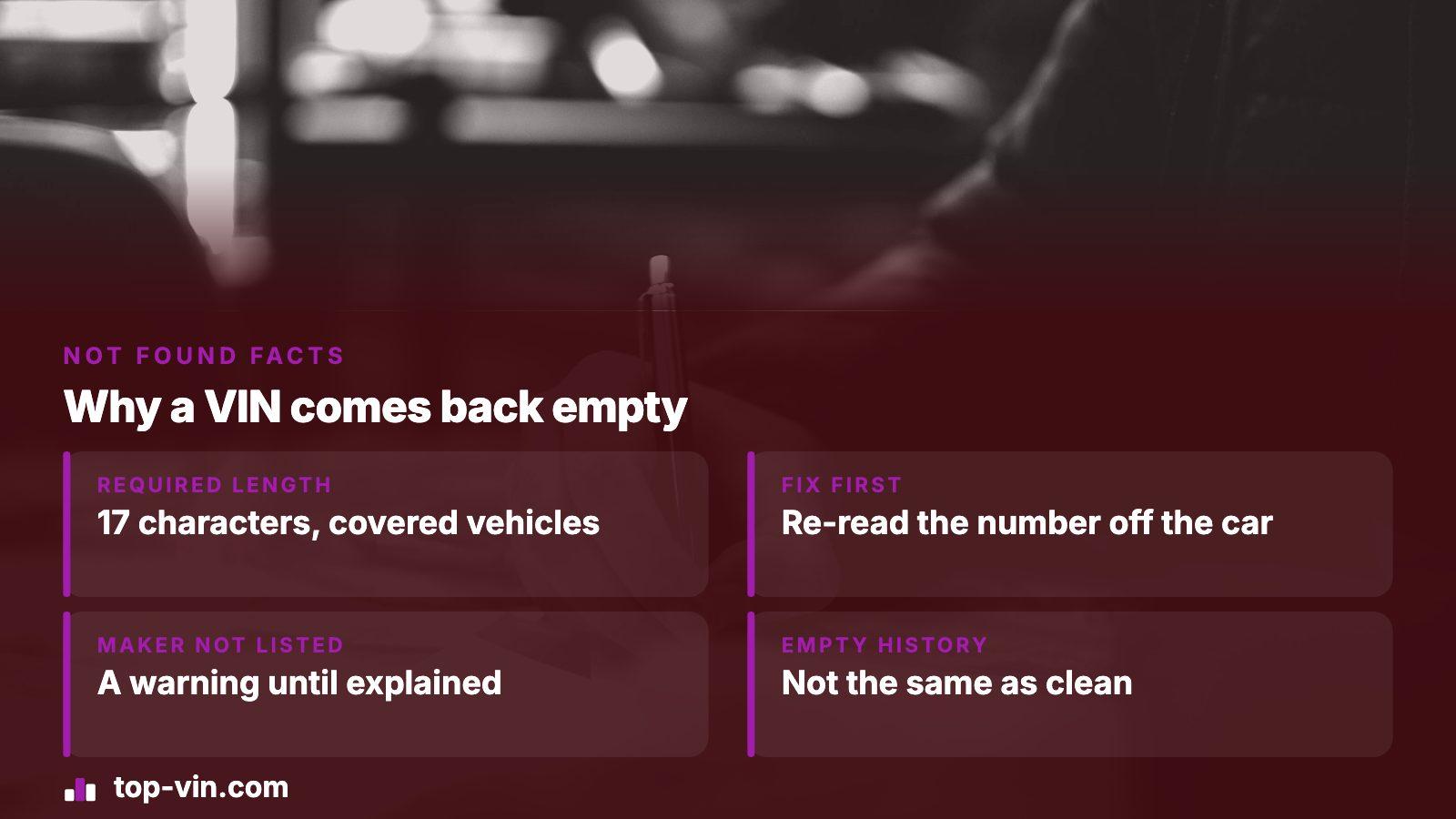
- Required length
- 17 characters for covered vehicles
- Fix first
- Re-read the number off the car itself
- Maker not listed
- Treat as a warning until explained
- Empty history
- Not the same as a clean history
Two different failures hide behind the same message
Lookup tools use "not found" for two separate events. In the first, the decoder cannot make sense of the string, so it never gets as far as naming a make or a model year. In the second, the string decodes cleanly into a real vehicle, but the title and damage databases have nothing filed against it.
The first is almost always a problem on your side of the screen. The second is a question about the car, and it deserves more care than the first. Reading the exact wording of the error tells you which one you are in.
| What you see | Likely cause | First step |
|---|---|---|
| Incomplete or too short | A character was dropped | Count the characters, then re-read the car |
| Check digit does not calculate | A character was misread | Compare against the plate on the dash and the paperwork |
| Invalid character | A letter typed in place of a numeral | Look at every letter that resembles a digit |
| Maker not registered | Unlisted or non-U.S. build | Ask the seller where the car was first sold |
| Decodes, but no records | New, unreported or unusual car | Find out why before trusting the blank |
Typing slips, and the letters that cause them
Run the decoder on a number where the letter O has replaced a zero and it does not shrug; it lists the exact position it objects to. Our test on a sample VIN put an O in the tenth place and got three messages at once: a failed check digit, a model-year complaint and an invalid-character flag naming the culprit. It even proposed a corrected string with an exclamation mark at the bad spot.
That behavior is useful. If your lookup tool does not show the position, assume the same kinds of slips and go through the string one character at a time, starting with anything that looks like another character: the numeral one and a capital I, a zero and an O, a five and an S, an eight and a B.
- Copy the number from a photo of the dash plate rather than retyping it by eye.
- Do not accept a VIN read aloud over the phone without having it spelled back.
- Paste, do not type, whenever the seller sends it in a message.
- Remove spaces and dashes the seller added for readability.
Too short, or not meant to be 17
Federal rules make a VIN 17 characters long for the vehicles they cover. A string with 16 comes back as an incomplete VIN, which is how one lost character looks to the decoder: it still guesses at a make and a year, but it will not call the decode clean.
Partial decoding is a deliberate feature, though. NHTSA's decoder accepts a short VIN with an asterisk standing in for every unknown character, and the ninth character can be left out of that kind of request. Use it when a badly worn plate leaves you with only part of the number. It will describe the build, and it will not tell you the car's past.
Older vehicles
A shorter number on an older car is not by itself a red flag, since the 17-character standard governs what makers file today. Treat a vintage car's VIN as a separate problem and read the title together with the stamped number before drawing conclusions.
When only the ninth character is wrong
The federal rule describes the check digit as a number or the letter X that confirms the VIN was copied accurately. When it fails but the make and model still decode, a different character elsewhere in the string was probably misread, and the ninth character simply exposed it.
We changed the final character of a valid Honda sample from 2 to 3. The decoder still named the car as a 2003 Accord, and added a single note: the ninth position did not calculate properly. A decoder can be right about the car and wrong about your number at the same moment.
One more outcome is worth knowing. On a Corvette string with a bad ninth character, the decoder said it had corrected an error in a single position and found several possible matches. Several matches means the typo is real but its location is ambiguous, so go back to the vehicle.
A maker the federal list does not recognize
This is the one worth stopping on. The decoder draws on filings that manufacturers make with NHTSA. A string whose first characters match no filed maker returned a message saying the manufacturer is not registered for sale or importation for use on U.S. roads, with no make or year at all.
There are harmless explanations: a low-volume builder, a kit or custom car, an import that arrived by a different route. Small makers, defined as builders under 1,000 units of a type annually, use a longer identifier that splits across the number, and a nine in the third position signals it. None of that is a reason to pay.
- Ask who built the car and in which state or country it was first titled.
- Request the title and any import paperwork, not just the registration.
- Get the decoder's message in writing before you argue with the seller.
The VIN decodes, but the history is empty
Now the VIN is fine and the databases are quiet. Quiet can be good news on a car that has simply had no incidents. It can also mean the records never reached the system, a new vehicle has not generated any yet, or the number belongs to a different car than the one on the lot.
The government's NMVTIS site exists to keep title fraud and stolen vehicles from being resold, and it lets you confirm the last date a reporting entity sent in data. That second tool matters here: a blank result means more when you know the source was reporting recently.
Read the blank carefully
No records is a statement about the database, not the vehicle. Two cars can return the same empty result for opposite reasons, one spotless and one never reported.
What to do when the number still fails
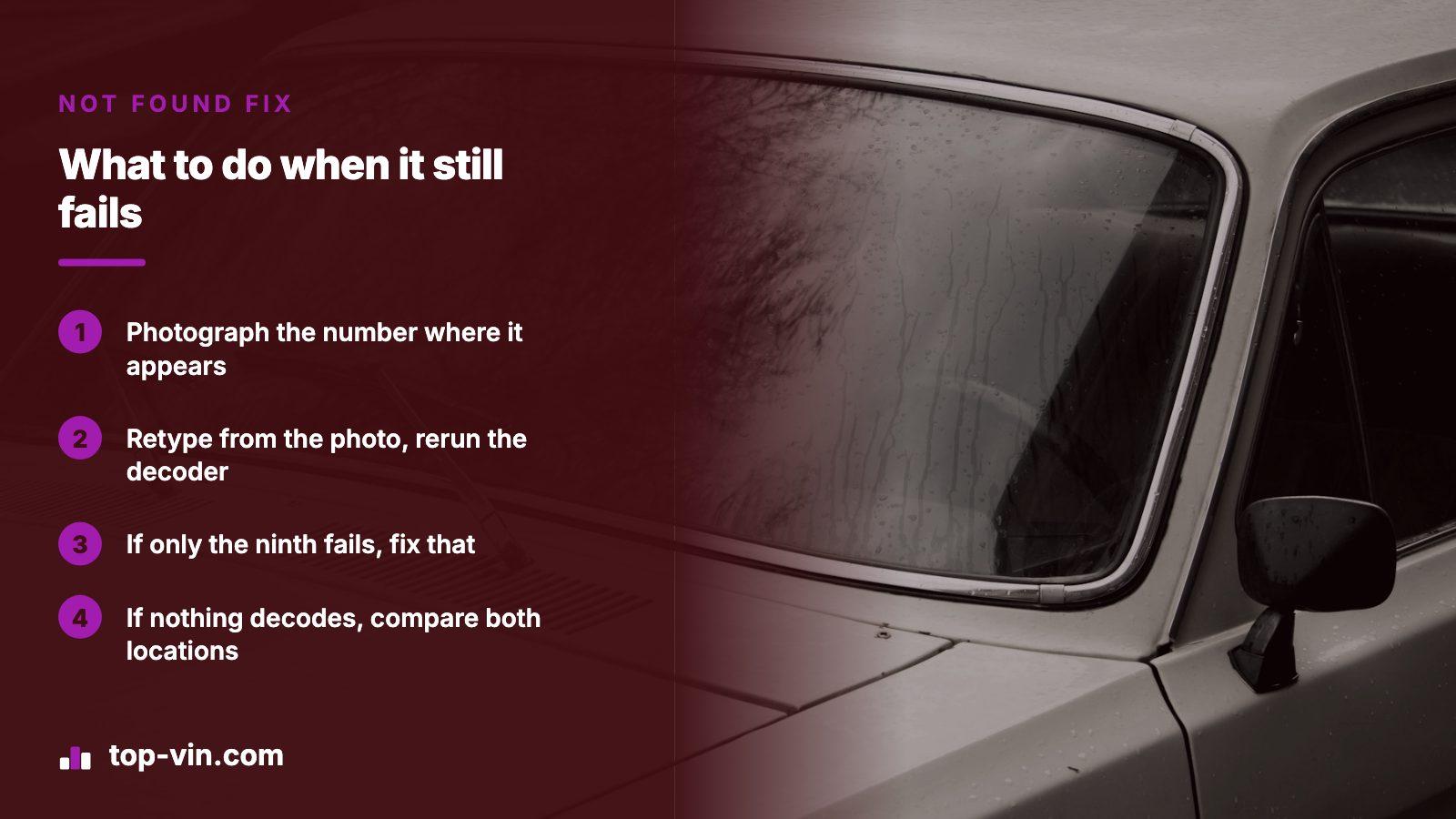
- Photograph the number where it appears on the dashboard and on the driver's door label, then hold both pictures against the title.
- Retype from the photo, and run it through the NHTSA decoder to see the exact message.
- If the make decodes and only the ninth character fails, fix the misread and repeat.
- If nothing decodes, or two locations show different numbers, stop and get the seller's explanation in writing.
- Run the number through the vehicle history preview on this site, which is free; the full report is a single payment, with the details on the pricing page.
A lookup that keeps failing on a car you intend to buy is information. A seller with a clean story will not mind an inspection that confirms the number, and a seller who resists one has told you what you needed to know.
Where this information comes from
- NHTSA: vPIC API documentation — How the decoder uses maker filings and accepts partial VINs with asterisks; our test runs used its API.
- eCFR: 49 CFR Part 565, VIN requirements — The 17-character rule, the check digit definition and the low-volume maker identifier.
- eCFR: 49 CFR 565.15, content requirements — The six-character maker identifier and the nine in the third position.
- NMVTIS: vehiclehistory.gov — The system's purpose and the tool for confirming when an entity last reported.
Sources and photos: Facts checked against the sources above in November 2026. Photos by Jakub Żerdzicki, Tigran Shishmanyan and Owen Michael Grech on Unsplash; diagrams by TopVIN.
Keep reading
- VIN check digit: how the ninth character is worked out and what it provesHow the ninth character is worked out, and which typos it catches.
- VIN lookup by last 6 digits: what six characters can and cannot findWhat you can learn when only part of the number is legible.
- VIN verification: the four checks people mean and what each provesHow to confirm that the car and its paperwork carry one number.
- How to read a VIN: a left-to-right walkthrough with a worked decodeWhat the sections of a VIN stand for, character by character.
Frequently asked questions
Why does my VIN say not found when I typed it correctly?
Check the exact message first. A clean decode with no history means the databases hold no record, which can mean a new or unreported car. A message about the maker means the first characters match no filed manufacturer. Either way, read the number off the vehicle again, since a swapped letter and numeral can look right on screen.
Does a VIN not found mean the car is stolen?
No. Most failures are typing errors, and an unlisted maker can be a small builder or an import. Still, a number that fails everywhere or differs between the dash and the paperwork is grounds to pause the purchase until the seller accounts for it.
Can a VIN with the wrong ninth character still be real?
Yes. We altered the last character of a sample number and the decoder still named the car, noting only that the check digit failed. That usually means another character was misread, so compare the number to the vehicle itself.
What if my VIN has fewer than 17 characters?
Recount first, because a dropped character is the usual cause. If the plate is damaged, the NHTSA decoder accepts partial numbers with asterisks for the missing characters. That describes the build only; a history search needs the full number.
Is an empty vehicle history a good sign?
Not by itself. It may mean nothing has happened, or that nothing was reported, or that the vehicle is very new. Confirm that sources reported recently, inspect the car, and check that the number matches the title before reading a blank as clean.
Now check the car itself
The guide explains what to look for. The report shows what this VIN has on record.