THE SHORT ANSWER
A West Virginia plate number alone will not give a private buyer a VIN. The DMV's records page releases information about other people only with written consent or a documented legitimate reason, and the federal Driver's Privacy Protection Act lists the permitted uses. Get the VIN from the seller's title, the registration, an insurance card or the car, then enter it at TopVIN for a free preview.
- Public plate-to-VIN tool
- None we could confirm
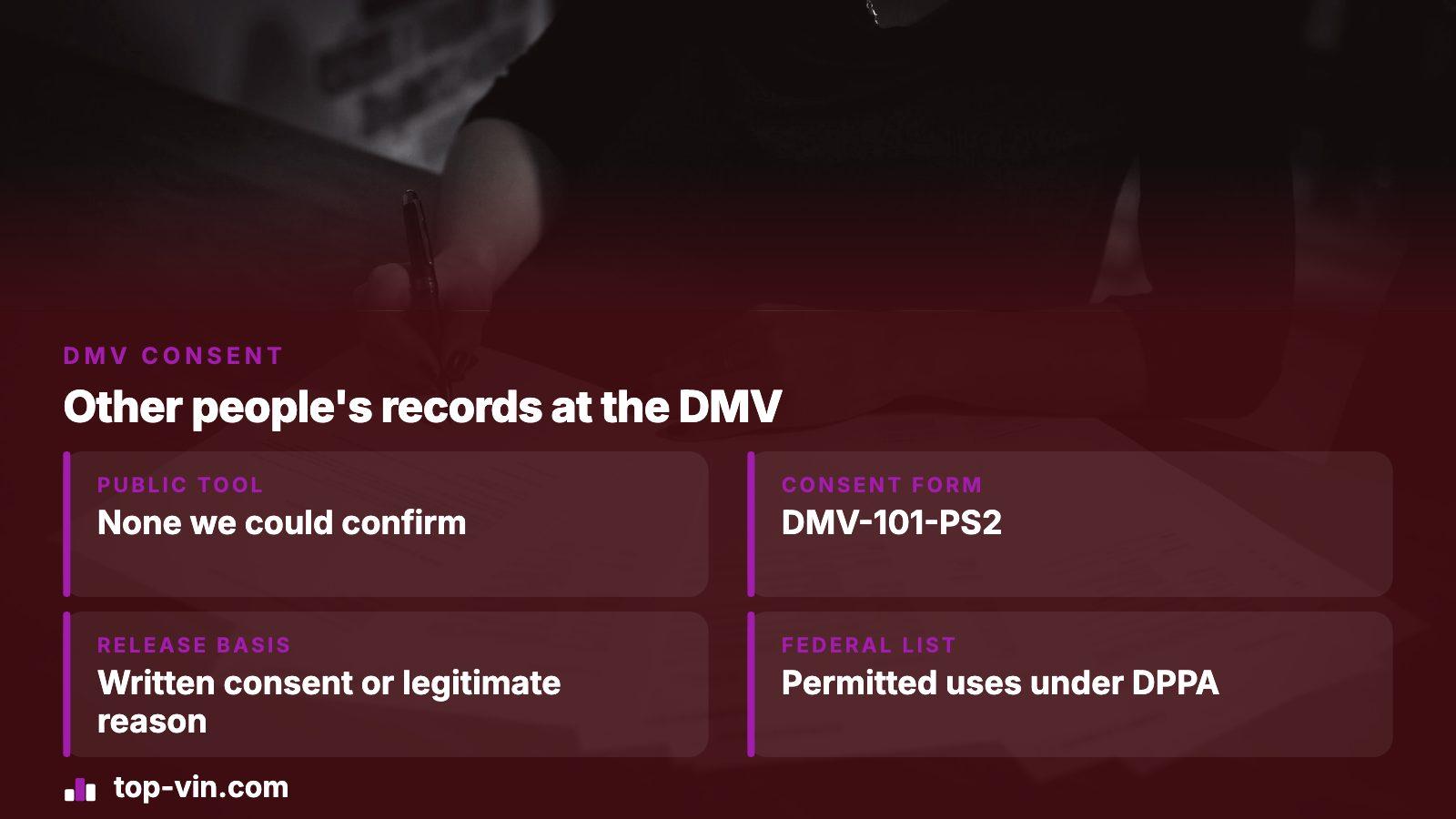
- Consent form for other people's records
- DMV-101-PS2
- Ordinary routes
- Title, registration, insurance card, the car, the seller
- TopVIN
- Free preview, then one payment
What a West Virginia plate can and cannot tell you
A plate is the one identifier you can read from the sidewalk, which is why shoppers start there. It is also the weakest handle on a used car. Plates move between vehicles, expire, and get swapped at sale, while the 17-character VIN stays with the vehicle for life. Every record a careful buyer wants hangs on the VIN.
Sites that promise an instant VIN and owner name from a West Virginia plate are offering something the DMV itself does not publish. TopVIN does not run plate searches and never shows an owner's name or address. It starts where the useful data starts, with the VIN.
What the West Virginia DMV says about other people's records
The records page we found on the DMV's site covers driving records. Its rule for anyone else's file: a signed Release Authorization, DMV-101-PS2, has to accompany the request. The only other path is a letterhead request that spells out a legitimate reason under the state's Uniform Motor Vehicles Records Disclosure Act. We did not find a separate vehicle-owner request form or fee on the pages we could open, and the state code site refused automated access, so check the DMV before relying on any process.
| Request | What the DMV page lists |
|---|---|
| Your own driving record | Form DMV-101-PS1, photo ID, $7.50 with license number or $8.50 without |
| Someone else's record | PS1 plus signed release PS2, ID, same fee scale |
| Request without consent | Business letterhead and a detailed legitimate reason |
| Message to a licensee | Form DMV-102-DL, $7.50, delivery not guaranteed |
Notice what is missing from that list: a way for a stranger to type in a plate and receive a VIN. The DMV's fallback for anyone refused is message forwarding, where the agency passes your note along instead.
The federal rule sitting above the state's
Congress wrote the Driver's Privacy Protection Act so that a DMV cannot hand out personal details from a vehicle record outside a closed list of purposes. The list covers safety and theft matters, recalls, legal proceedings, insurer claims and underwriting, towed-vehicle notices, licensed investigators with a permitted purpose, and cases where the person gave express consent.
Nosiness is not a purpose
Wondering who owns the blue pickup down the street, or whether a seller is honest about the car, is not a permitted use by itself. A buyer's real need, the vehicle's history, is met by the VIN and does not require anyone's personal data.
Resellers face a further duty: any onward sharing must serve a permitted purpose, with a log of recipients and reasons kept for 5 years.
Five ordinary ways to get the VIN
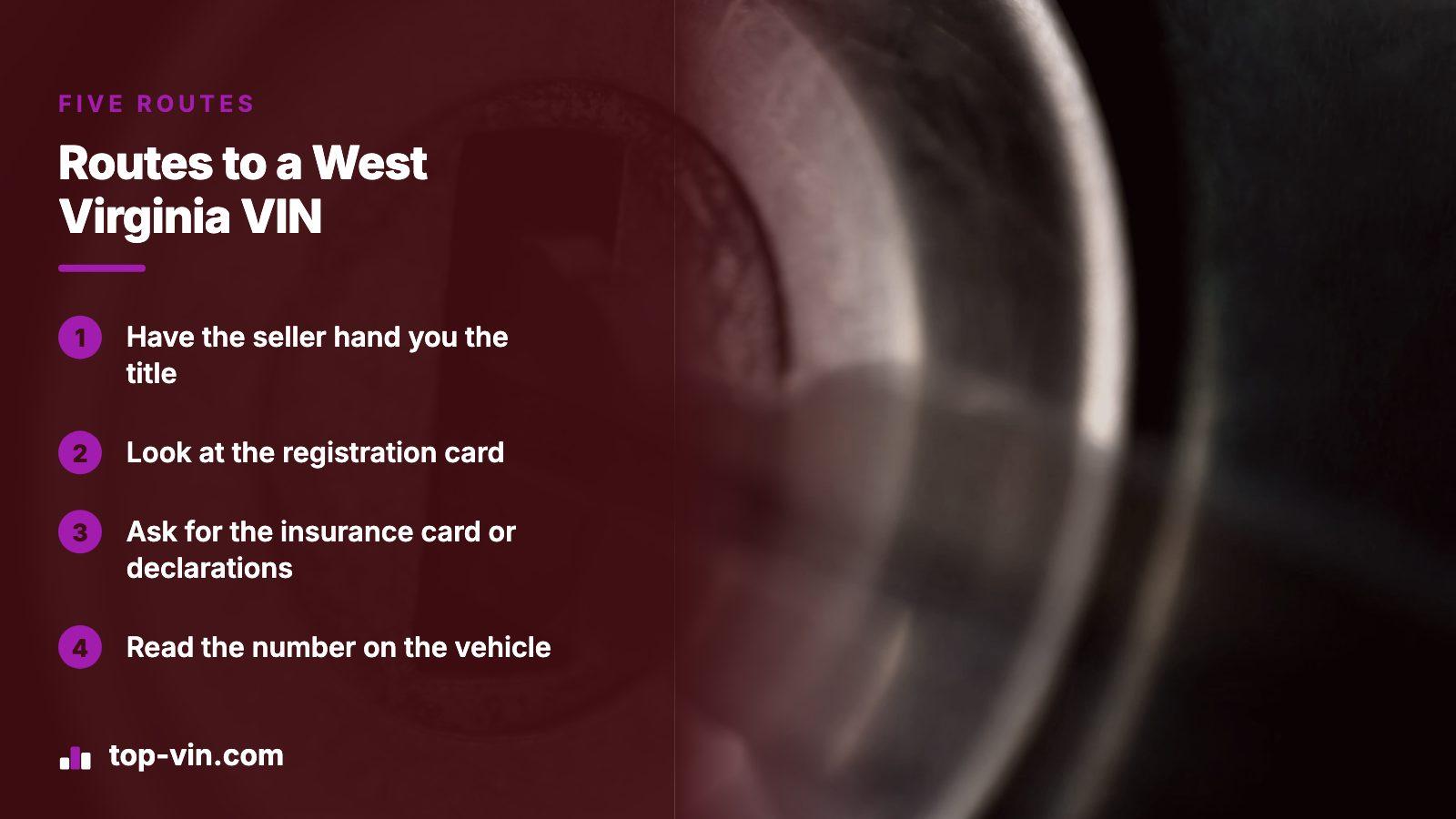
- Have the seller put the title in your hands and copy the VIN off it. The DMV treats the title as the legal proof of ownership.
- Look at the registration card. West Virginia registrants get a card with the plate, and it is meant to ride in the car beside the current insurance certificate.
- Ask for the insurance card or declarations page, which usually lists the vehicle by VIN. Insurers also send VIN lists to the DMV for its random coverage checks.
- Read the number on the vehicle itself and photograph it, so you can compare it with the paperwork.
- If you are the owner of a car and lost the paperwork, request a duplicate through the DMV rather than guessing.
A seller who will not show you any of these before you hand over money has told you something useful already.
The match test the DMV itself recommends
The DMV's title page carries buyer warnings worth repeating. Buy from an individual only if the title is printed in that person's own name and is handed to you at the sale. Look at the VIN on the car itself and hold it up against the title, digit by digit. Make sure the odometer on the dashboard is not lower than the reading recorded on the title.
Names matter too. A title with owners joined by AND needs both signatures to transfer, while OR or AND/OR lets either owner sign alone. Run the VIN check before the signing, because a brand found afterward is a problem you already own.
Running the VIN through TopVIN
Enter the VIN on the TopVIN home page. You get a free preview first, so you can confirm the make, model and year match the listing before paying anything. If they do not, you have caught a mismatch for free.
Nothing recurs after you pay for the report. For this kind of lookup, the sections that count are the title brands, damage entries, mileage history, lien records and any unrepaired recall. The pricing page lists amounts, including bundles for several cars.
Reading what comes back
- Brand labels like salvage, junk or flood, which a state attaches to flag what the car is or once was.
- Odometer readings that go backward between records.
- Theft entries, where a source has reported one.
- Liens, which affect whether the seller can legally transfer the car.
- Open recalls, which the maker fixes at no charge under the recall remedy.
A blank history is weaker evidence than it looks. The federal title system relies on whatever states, salvage yards and insurers send in, so a car can look spotless when a record never arrived. Pair the report with a mechanic's inspection.
Buying across the state line
Many West Virginia shoppers cross into Ohio, Virginia, Pennsylvania, Maryland or Kentucky for inventory. The plate on those cars was issued by another state, with its own rules, so the West Virginia DMV pages above do not apply to them. The VIN check does not change: the number works the same wherever the car was titled.
If the car was titled elsewhere and you will register it here, the DMV's title page says an out-of-state dealer purchase needs a complete dealer invoice with the final price, alongside the title application, form DMV-1-TR.
Cost and next step
No charge applies to the preview, and the report is bought once per vehicle or in a pack. Copy the VIN from the title or registration, check it against the car, run the preview, and decide about the full report after that.
Pair it with the free tools: NHTSA's recall lookup by VIN and your own look at the paperwork. If the seller resists showing the VIN, treat that as the answer.
Where this information comes from
- West Virginia DMV: how to obtain your driving record — Forms, fees and the consent rule for other people's records.
- West Virginia DMV: titles — Buyer warnings on matching the VIN and the odometer.
- West Virginia DMV: registrations — Registration card and insurance certificate kept in the vehicle.
- Federal DPPA, 18 U.S.C. 2721 — Permitted uses and the five-year resale record.
- NMVTIS for consumers — What the federal title system holds and where its data comes from.
Sources and photos: Facts checked against the sources above in November 2026. Photos by A n v e s h, Derek Nelson and Dimitri Karastelev on Unsplash; diagrams by TopVIN.
Keep reading
- License plate to VIN: the lawful ways to find a car's VIN from its plateThe national picture for plate-based searches.
- Where the VIN sits on a title, and what to do nextWhere to read the number on a title.
- Is the VIN on the insurance card? What to check before you trust itAnother paper source for the VIN.
- License plate lookup privacy laws: what you can and cannot get from a plateWhy plate data is protected.
Frequently asked questions
Can I find a VIN from a West Virginia license plate number?
Not through any public search we could confirm. The DMV hands over data on other people only with written consent or a documented, legitimate reason, and federal law narrows releases further. Buyers normally get the VIN from the seller's title, the registration, an insurance card or the vehicle.
Is there a West Virginia DMV form to request a vehicle's VIN by plate?
None turned up on the DMV pages that opened for us. The forms we did find cover driving records: DMV-101-PS1, and DMV-101-PS2 for a signed release. Ask the DMV directly before paying anyone who claims to file a plate request for you.
What can I legally do with the information the DMV releases?
Only what the federal act allows. Anyone who forwards DMV data needs a permitted purpose and must log the recipient and the reason for 5 years. Idle interest in an owner does not qualify.
How do I confirm a used car's VIN matches its paperwork?
Read the number on the vehicle, then check it against the title, one digit after another. The DMV tells buyers to confirm they match exactly and that the seller's name is printed on the title. Photograph both before you agree to buy.
Does TopVIN look up plates or owners?
No. TopVIN works from the VIN and never shows an owner's name or address. Previewing costs nothing. The full report is paid for once, and nothing renews. See the pricing page for options.
Now check the car itself
The guide explains what to look for. The report shows what this VIN has on record.